
In the age of rapid digital transformation, AI has seeped into almost every industry, revolutionizing how we conduct business, design products, and even create content. The ClusterMagic service is a great example, which seamlessly integrates AI for content generation in a hybrid model, providing significant benefits in the SEO results of brands seeking a massive increase in organic traffic. But while AI holds immense promise, it has its limitations. Let's explore the pros and cons of using AI for content creation and understand why a hybrid approach might be the way forward.
Major publishers in sensitive niches like CNET.com, Bankrate.com, and Creditcard.com have already integrated AI-generated content. Other large companies, such as CNN and Forbes, might also be doing so. Countless smaller companies and publishers are utilizing AI, not only on their websites but also on social media, in email marketing, and virtually everywhere else.
Google's stance on AI-generated content is neutral, emphasizing that content should primarily be user-centric. In fact, Google's September 2023 Helpful Content Update removed the mention of "written by people" from their helpful content system guidelines.
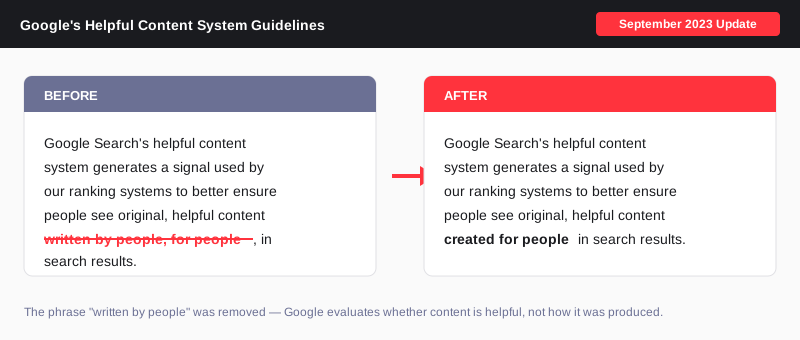
The message is clear: for content to rank well, it must be informative, answer users' queries satisfactorily, and showcase genuine expertise - regardless of how it's created.
AI Content Detectors like GPTZero, ZeroGPT, and many others are not reliable. Even OpenAI has said as much. They consistently produce false positives about human-written content. Conversely, they can be easily fooled with creative prompting or a bit of human editing.
An interesting note from OpenAI: "we found that it labeled human-written text like Shakespeare and the Declaration of Independence as AI-generated."
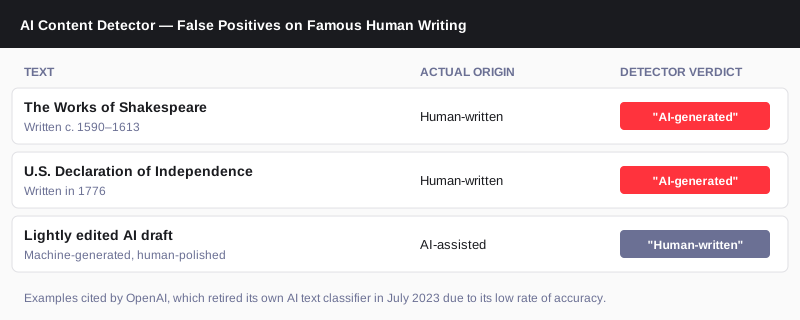
Anecdotal evidence and real-life ranking data suggest that while AI-generated content isn't penalized by search engines, it might only achieve high rankings if it meets the above criteria. The role of AI in content creation is still a developing narrative, and its significance is indispensable for maintaining a competitive edge in the future.
At EmberTribe, the understanding is clear - AI serves as a foundation, not the final product. With ClusterMagic, while AI aids in the initial draft based on expert-driven keyword research, human experts step in for the crucial phases of editing, fact-checking, and final review. This hybrid approach ensures the content is accurate and helpful, has the potential to rank, and truly represents their business.

If you run a small business and you're trying to grow without pouring money into paid ads, small business SEO services are one of the highest-leverage investments available to you. Done right, organic search builds a compounding traffic channel that keeps delivering leads without a cost-per-click attached to every visit.
The problem is that the SEO industry is full of vague promises, opaque deliverables, and agencies that look the same on the surface. Choosing wrong doesn't just waste budget — it can set your site back by months. This guide breaks down exactly what small businesses need from SEO, what it costs in 2026, and how to evaluate providers before you sign anything.
Most SEO frameworks are built for enterprises with dedicated content teams, six-figure link-building budgets, and technical developers on standby. Small businesses are operating with a fraction of those resources, which means the strategy has to be sharper and the priorities more ruthless.
What actually matters for a small business:
Small businesses do not need to compete across hundreds of keywords or dominate national search volume. The goal is to win the specific searches your actual customers are running — and convert them when they land.
Before evaluating any provider, you need to know what a solid baseline looks like. These are the services that consistently move the needle for small businesses:
Technical SEO audit and cleanup. This covers site speed, mobile optimization, crawl errors, broken links, and indexation issues. If Google can't efficiently crawl your site, nothing else matters. For most small business sites, a one-time audit with scheduled monitoring is sufficient.
On-page optimization. Every page on your site — especially the high-priority service or product pages — should have properly structured title tags, meta descriptions, header hierarchies, and content that addresses real search intent. This is foundational and often overlooked.
Content strategy and production. A steady cadence of useful, well-researched content signals topical authority to search engines over time. For small businesses, this doesn't mean publishing daily — two to four quality posts per month, each built around a real keyword opportunity, is often more valuable than ten thin posts.
Link building. Backlinks remain one of Google's strongest ranking signals. Small businesses benefit most from targeted link acquisition — local directory citations, industry-relevant publications, and press mentions — rather than mass outreach that generates low-authority links.
Monthly reporting. Any legitimate SEO service should provide transparent reporting on keyword rankings, organic traffic, and ideally lead or revenue attribution. If a provider only shows you impressions and "activity," that's a sign they're not measuring what matters.
For a deeper look at how SEO fits into a broader search strategy, the ecommerce SEO guide covers technical and content fundamentals that apply across business types — not just online stores.
If your business serves customers in a specific city, region, or set of locations, local SEO is where you should concentrate your resources. The competition at the local level is almost always lower than at the national level, and the searchers are closer to a purchase decision.
The core components of local SEO for small businesses:
Google Business Profile optimization. This is the single most impactful thing a local business can do. Your GBP listing appears in the local pack (the map results at the top of the search page) for relevant searches. An optimized, actively maintained profile — with regular posts, updated photos, accurate hours, and responses to reviews — substantially outperforms a profile that was set up once and forgotten.
Citation building and cleanup. Citations are mentions of your business name, address, and phone number across directories like Yelp, Apple Maps, and industry-specific platforms. Consistency across these listings builds trust with Google and improves local rankings. Outdated or inconsistent citations can suppress your visibility.
Local keyword targeting. Pages on your site should be optimized for terms like "plumber in [city]" or "[service] near [neighborhood]" — not just generic category keywords. This includes dedicated location pages if you serve multiple areas.
Review generation. Reviews on Google and other platforms influence both local rankings and conversion rates. A proactive system for requesting reviews from satisfied customers is often more impactful than any technical optimization.
Local SEO services typically cost $500–$2,000 per month depending on the number of locations, the competitiveness of your market, and the scope of services included.
Pricing for SEO services varies widely, but here are realistic benchmarks for 2026:
One-time SEO audits typically range from $500 to $2,500 depending on the size and complexity of your site. Some agencies offer project-based work for specific deliverables — a site audit, a set of optimized pages, or a content strategy — which can be a more accessible entry point for businesses with tight budgets.
Be cautious of services priced significantly below these ranges. SEO that costs $200/month almost certainly involves automated reporting with minimal real work, templated strategies, or outsourced execution that bypasses quality controls. You often get exactly what you pay for.
The agencies that generate real results invest time in understanding your business, your customers, and your competitive landscape — that work doesn't scale to $150/month retainers. If you're evaluating what the best SEO services look like at different price points, this breakdown of what actually works in 2026 is worth reading before you commit to a budget.
With dozens of agencies competing for small business budgets, these are the differentiators that actually matter:
Specificity in their proposals. A quality SEO provider will ask detailed questions about your business before making any recommendations. If they send you a generic proposal without understanding your market, your competition, or your current search performance, they're working from a playbook that wasn't built for you.
Transparency about methods. You should be able to ask exactly what they'll do each month and get a direct answer. What pages will they optimize? Where will they pursue backlinks? How will they track progress? Any provider who gets vague about their process has something to hide.
Realistic timelines. SEO is not a fast channel. Meaningful results typically take three to six months to materialize, with more substantial outcomes at the 12-month mark. An agency that promises page-one rankings within 30 days is either misleading you or planning to take shortcuts that will hurt your site.
Reporting on business outcomes. The best providers track rankings and traffic, but they also try to connect those metrics to leads, calls, or revenue. An agency that only reports on impressions and "keyword visibility" without any link to business outcomes is optimizing for their own retention, not your results.
Relevant experience. An agency that has worked with businesses in your category or market understands the competitive dynamics, the seasonal patterns, and the content types that actually convert. Ask for examples — not just case studies, but actual businesses they've worked with that you can verify.
For a useful framework on how to assess agency quality regardless of the service, the SaaS SEO agency guide covers evaluation criteria and proposal red flags that apply broadly across SEO engagements.
These signals consistently predict a bad experience:
Guaranteed rankings. No legitimate SEO provider can guarantee a specific ranking position. Google's algorithm is constantly evolving and no agency controls it. Guarantees are a sales tactic, not a service promise.
Black-hat tactics. Link farms, keyword stuffing, spammy directory submissions, and AI-generated content spun at scale are tactics that worked in 2010. In 2026, they trigger penalties that can take months to recover from. If a provider's pricing seems impossibly low, ask specifically how they build links and produce content.
Lock-in contracts without deliverables. A 12-month contract with vague language about "ongoing optimization" is a warning sign. Good agencies are confident enough in their results to define what they'll deliver and let the outcomes speak.
Vanity metrics as the primary KPI. If an agency leads every conversation with impressions, "keyword counts," or domain authority growth without tying those to organic traffic or business outcomes, they're measuring what's easy to show — not what matters.
No case studies or references. An agency that can't show you businesses they've helped — with specifics — hasn't done the work yet. Don't be the test case.
One-size-fits-all proposals. Your business is not identical to the last business they signed. If the proposal doesn't reflect your specific competitive situation, your target geography, or your actual content gaps, it wasn't written for you.
EmberTribe works with growth-stage businesses to build organic search engines that compound over time. We start with a thorough audit of your current search presence, identify the highest-leverage opportunities, and execute a strategy built around your specific market — not a generic template.
If you're evaluating SEO services and want a direct conversation about what's actually achievable for your business, get in touch with our team. We'll tell you what we think, not just what you want to hear.

If you're shopping for SEO help, you already know the market is flooded with options. Every agency and freelancer claims to offer the best SEO services. But the gap between SEO that builds compounding organic revenue and SEO that burns your budget producing nothing measurable is enormous. This guide is about the services themselves — what the right ones look like, what results to expect, and what to skip entirely.
SEO services are professional activities designed to improve a website's visibility in organic search results. They span technical website health, on-page content optimization, off-page authority building, and ongoing measurement. Done well, SEO services work together as a system — technical foundations enable content to rank, content earns links, links strengthen authority, and analytics inform what to do next.
For growth-stage DTC brands and ecommerce companies, SEO is one of the few channels where the work compounds over time. Paid ads stop the moment you stop spending. A well-executed SEO program keeps generating traffic and revenue years after the initial investment.
A technical SEO audit evaluates everything search engines need to crawl and index your site correctly. This includes crawlability, Core Web Vitals, site architecture, URL structure, canonical tags, structured data, JavaScript rendering, mobile responsiveness, and internal linking.
The audit itself is only half the value. The other half is remediation — actually fixing the issues uncovered, prioritized by impact. Agencies that deliver a 60-page report and walk away are selling you a document, not a service. Top-tier technical SEO services include a prioritized remediation roadmap and ongoing monitoring.
For ecommerce sites specifically, technical SEO often surfaces duplicate content from faceted navigation, pagination problems, and orphaned product pages — issues that silently suppress rankings across your entire catalog.
Effective SEO services don't just find keywords — they build topical authority. That means mapping keywords to buying intent, identifying content gaps versus competitors, and sequencing production so that pillar pages and supporting content reinforce each other.
Generic agencies produce surface-level blog posts without a coherent strategy behind them. What separates professional SEO services is a framework that ties every piece of content to a specific keyword cluster, a funnel stage, and a measurable traffic goal.
For DTC brands, this also means aligning keyword strategy with customer acquisition economics — targeting searches that attract buyers, not just browsers.
On-page optimization covers title tags, meta descriptions, header hierarchy, image alt text, internal linking, schema markup, and content structure. For most sites, a thorough on-page audit of existing pages produces faster wins than publishing new content, because you're improving pages that already have some authority.
This service extends to content quality improvements: updating outdated information, improving topical depth, and restructuring pages that have high impressions but low click-through rates. Search engine positioning depends heavily on whether your pages fully satisfy the intent behind the query, not just whether they contain the target keyword.
Backlinks remain one of the strongest ranking signals in 2026. Link building services acquire editorial links from relevant, authoritative domains — through content partnerships, digital PR campaigns, resource page outreach, and broken link building.
What distinguishes quality link building from low-grade services is link relevance and editorial context. A single contextual link from a respected industry publication outperforms dozens of directory listings or low-authority guest posts.
For growth-stage brands, link building should be tied to competitive gap analysis: which domains link to your top competitors but not to you, and what content would earn those links.
For brands with physical locations or local service areas, local SEO is its own discipline. This includes Google Business Profile optimization, local citation building, review management, and geo-targeted content.
Local SEO delivers measurable results quickly — Google Business Profile improvements can lift local pack visibility within weeks. For multi-location brands, this service scales into a systematic process for each location.
Measurement is not an afterthought — it is a core SEO service. Professional SEO services include tracking rank positions, organic traffic by landing page, click-through rates from Google Search Console, conversion data tied to organic sessions, and share-of-voice versus competitors.
The best reporting connects SEO activity directly to business outcomes: revenue influenced by organic, leads generated, and pipeline contribution. If your reporting only shows keyword positions and monthly traffic, you are missing the data needed to make good decisions.
Realistic timelines matter. Here is what to expect:
Technical SEO improvements — site speed gains, crawl error fixes, canonical corrections — show results in weeks. Google reindexes frequently, and structural improvements are often reflected in Search Console data within a few weeks of deployment.
Content strategy and on-page optimization take longer: typically 3 to 6 months before new or improved pages rank competitively. Search engines need time to crawl, index, and evaluate content against competing pages.
Link building is the longest-cycle service. Building a meaningful backlink profile takes consistent effort over 6 to 12 months. Agencies promising first-page rankings from link building within 30 days are either targeting low-competition terms or using tactics that create long-term risk.
Local SEO sits between these timelines. Google Business Profile optimizations can produce visible local pack improvements within 4 to 8 weeks.
Not everything sold as an SEO service moves the needle.
Guaranteed rankings are a red flag, not a selling point. No one can guarantee rankings on competitive terms. Agencies making this promise are either targeting negligible keywords or using black-hat tactics that work briefly and then trigger penalties.
Bulk directory submissions were relevant in 2012. Today they contribute minimal authority and can create citation inconsistency problems that hurt local SEO.
Thin content packages — producing 10 or 20 blog posts per month with no strategic framework — produce traffic noise rather than qualified organic sessions. Volume without strategy is one of the most common ways companies waste SEO budgets.
PBN link building (private blog networks) is a high-risk tactic that violates Google's guidelines. The short-term gains are real; so are the manual penalties that erase them.
Results from professional SEO services should be visible in several places simultaneously. Organic traffic growth in Google Analytics is the most obvious signal, but it is not the only one.
Watch Google Search Console for improvements in total impressions, average position for target queries, and click-through rates. A well-optimized page should improve in all three metrics over 3 to 6 months.
Monitor your rankings for primary keywords monthly, but resist over-indexing on daily ranking fluctuations. Positions vary by data center, user location, and personalization signals. Trends over 30 to 60 days are more meaningful than daily snapshots.
The clearest signal that SEO services are working is organic-attributed revenue. If you have conversion tracking configured properly, you should see organic sessions converting at rates comparable to other high-intent channels. Our post on building brand trust with SEO covers how organic visibility compounds into brand authority over time.
If organic traffic is climbing but revenue is flat, the issue is usually misaligned keyword targeting — traffic from informational queries that do not convert rather than commercial-intent searches that do.
For a deeper look at how ecommerce sites should structure their SEO programs, see our complete ecommerce SEO guide, which covers site architecture, product page optimization, and category page strategy in detail.
EmberTribe works with DTC brands and growth-stage companies that are serious about building organic revenue as a durable growth channel. Our SEO services are built around the same framework described in this guide: technical foundation, content strategy tied to buying intent, on-page optimization for existing pages, link building through legitimate outreach, and reporting that connects organic traffic to actual revenue.
We do not offer volume-based content packages or generic link outreach. Every engagement starts with a technical audit and a content strategy built around your competitive landscape and customer acquisition goals.
If you are evaluating what professional SEO services should look like for a brand at your stage, our SEO agency guide walks through how to assess any provider against the criteria that actually predict performance.
Ready to see what a real SEO program looks like for your brand? Talk to EmberTribe.

Finding the best SEO company is harder than it should be. The market is crowded with agencies making similar promises, and the gap between a firm that builds lasting organic growth and one that burns your budget on vanity metrics is enormous. For DTC brands and growth-stage companies, choosing the wrong SEO partner costs more than just money — it costs time and competitive ground you may not recover.
This guide cuts through the noise. We'll walk through exactly what separates a top SEO company from a mediocre one in 2026, what warning signs to look for, what real SEO costs look like, and the questions that reveal whether an agency actually knows what they're doing.
The best SEO companies share a set of characteristics that distinguish them from agencies that chase shortcuts or sell the same templated approach to every client.
At the core, elite agencies focus on outcomes tied to your business — not just rankings. A position-1 keyword that drives zero conversions is not a win. A firm worth hiring understands your funnel, your customers' search intent, and how organic traffic needs to connect to revenue.
They also operate with full transparency. That means clear reporting on what's being done, why, and what's moving. If an agency can't explain its strategy in plain language, that's a signal.
Finally, the best agencies invest in the full SEO stack: technical health, content authority, and link equity. A firm that excels at content but ignores Core Web Vitals is leaving rankings on the table. One that focuses only on link building without a content strategy is building on sand.
Use these six lenses when assessing any agency — including the ones your peers recommend.
1. White-hat methodology
Ask directly: how do they build links? How do they handle content at scale? The right answer involves editorial outreach, digital PR, genuine content partnerships, and original research — not link farms, private blog networks, or AI content dumped without human review. Agencies that rely on black-hat tactics can produce fast early results that collapse (or worse, trigger a Google penalty) within months.
2. Technical SEO depth
Any competent SEO company should be running regular technical audits: crawlability, indexation issues, page speed, Core Web Vitals, structured data, and internal linking architecture. In 2026, technical capability also extends to AI readability — ensuring your content is structured in ways that generative search tools can parse and cite. Ask for a sample audit or a technical walkthrough of a past client's site.
3. Content quality and E-E-A-T
Google's E-E-A-T framework — Experience, Expertise, Authoritativeness, Trustworthiness — continues to define how content ranks. The best agencies build content with genuine subject matter input, not just keyword optimization. Ask to see examples of content they've produced and assess whether it actually serves the reader or simply hits a word count.
4. Link building approach
Not all backlinks are equal. A link from a high-traffic, editorially relevant publication carries significantly more weight than a link from a directory or paid placement that any site can buy. Ask about their link acquisition methodology: Are outreach emails personalized? Are placements contextual? Do they vet the sites they target? Volume means nothing if the links lack authority.
5. Reporting and attribution
Good SEO reporting ties organic traffic to business outcomes. Look for agencies that track keyword movement, traffic by intent, and conversion contribution — not just rank position. Access to your own data (Google Search Console, Analytics) should always be yours to keep, regardless of the agency relationship.
6. Track record and references
Case studies and testimonials are a starting point, but references you can actually call are more valuable. Ask for clients in a similar industry or company stage. Ask specifically about results at 6 months and 12 months — not just what the agency claims in a slide deck.
For a deeper look at how these criteria apply specifically to SaaS businesses, see our guide to choosing a SaaS SEO agency.
The warning signs below appear consistently in agencies that underdeliver. Treat any one of them as a reason to ask harder questions. Multiple flags together should end the conversation.
Guaranteed rankings. No legitimate SEO professional guarantees a #1 ranking — and Google itself has said this explicitly. Any agency promising specific positions within a defined timeframe is either misleading you or planning to use manipulative tactics that put your domain at risk. Algorithmic and manual penalties from Google can take 6 to 24 months to recover from, and sometimes can't be fully undone.
Vague strategy. If an agency can't describe what they'll actually do in the first 90 days — in specific terms — that's a problem. Phrases like "improve your online presence" or "boost your rankings" without substance signal that they don't have a real plan.
AI content at scale, without editorial oversight. Churning out 100 AI-generated blog posts a month with no human editing or subject matter input is a formula for content that neither Google nor your readers will trust. Ask about their editorial process.
No access to your own data. Agencies that keep you walled off from your Analytics and Search Console accounts are hiding something. You should always have direct access to your own platforms.
Lock-in contracts with no performance milestones. Long contracts without built-in check-ins or performance expectations protect the agency, not you. A confident firm will structure accountability into the engagement.
Suspiciously low pricing. SEO that costs $200 a month is not a bargain — it's a signal that what's being delivered either isn't real or relies on tactics that will backfire.
Pricing varies by scope, market competitiveness, and agency tier. Here's what the 2026 market actually looks like:
Monthly retainers for professional SEO typically run $1,500 to $5,000 for mid-market businesses and $7,500 to $20,000+ for competitive industries or enterprise-scale sites. The average monthly engagement across agencies is approximately $3,200.
Hourly consulting rates fall in the $100 to $300 range, with senior strategists at specialist agencies typically at the higher end.
Project-based work — a technical audit, a content strategy engagement, or a site migration — generally runs $5,000 to $30,000 depending on scope.
What should concern you isn't spending $4,000 a month; it's spending $4,000 a month without clarity on where it goes. One industry study found that only 25% of the average US SEO retainer goes toward core SEO work. Ask for a breakdown of how your budget is allocated — and hold the agency to it.
These questions surface the information that agency presentations tend to obscure.
An agency that hesitates on these questions or deflects with generalities is telling you something important.
If you're scaling an ecommerce business, the considerations are similar but the technical complexity increases. Our ecommerce SEO guide covers the full framework in detail.
EmberTribe works with DTC brands and growth-stage companies that need SEO to function as a real revenue channel — not a line item that produces quarterly reports and little else.
Our approach starts with strategy: understanding your commercial keywords, your competitors' gaps, and where organic search can drive qualified traffic that converts. From there, we build on three pillars: technical foundations that search engines can crawl and AI tools can parse, content built around E-E-A-T principles with genuine editorial oversight, and link acquisition through actual editorial placements — not bought links or link farms.
Every engagement includes transparent reporting tied to business outcomes, full client access to all data, and a team that can explain every decision in plain language.
The best SEO company for your business is one that behaves like a growth partner. If you're evaluating agencies and want to understand what a results-oriented SEO engagement actually looks like, let's talk.
SEO done right compounds over time. The firms worth hiring know this — and they'll prove it with transparency, methodology, and a track record that holds up under scrutiny. The ones to avoid will promise rankings and deliver excuses. The criteria above give you the framework to tell the difference before you sign.

If you typed "SEO optimization near me" into Google, you already know what you want: someone who can actually move your organic rankings, revenue, and qualified traffic. The harder question is whether "near me" is the right filter to start with, or whether you're optimizing for the wrong variable before you've even taken the first call.
Here's the honest version most agencies won't tell you. For a lot of businesses, the best SEO partner is not the one geographically closest. For some, local really does matter. The difference comes down to what kind of SEO you actually need, and the answer is not obvious from the search phrase you used.
This guide walks through how to decide between local and remote SEO help, what modern SEO services actually include, realistic 2026 pricing, red flags that should end the call, and the questions that separate a credible operator from someone riding a trend.
Not everyone who searches "SEO optimization near me" needs the same thing, and the phrase hides a meaningful split in intent.
One group is a local service business. Think plumbers, HVAC contractors, dentists, medical practices, and single-location retailers. They need to show up in map packs, manage their Google Business Profile, and earn reviews in the cities they serve. For this group, local SEO is not a preference, it is the entire point of the work.
The other group is a growing brand or SaaS company. They might be DTC ecommerce, a B2B software company, a regional service firm with national ambitions, or a marketplace. They need technical cleanup, content that ranks for commercial intent, and link building tied to real revenue. For this group, "near me" is mostly a reflex, because the actual work lives inside tools and cloud dashboards and the agency can be anywhere.
Before you shortlist a single vendor, decide which group you're in. A local SEO specialist will struggle with enterprise site architecture, and a national agency will usually be weaker on citation cleanup and review workflows. Choosing the wrong category is the most common mistake buyers make in this search.
Local SEO has a legitimate home, and it is bigger than most buyers think. If your revenue depends on customers within a 25-mile radius, if foot traffic or service-area booking is your primary conversion event, and if your competitors are showing up in Google's map pack while you're not, you need someone whose daily work is Google Business Profile optimization, local citations, and review generation.
For that kind of business, proximity still has some value. A local firm may understand your regional competitor set, know which directories matter in your metro, and speak the same language as your customer base. They may also be cheaper for the work, because local SEO pricing genuinely runs lower than national campaigns. Ahrefs' SEO pricing survey found that local SEO averages around $1,557 per month, roughly half what worldwide-serving SEOs charge.
For almost everyone else, geography is a distraction. Technical SEO, content production, link outreach, and analytics all happen in cloud tools that work the same from any zip code. If you're running a growth-stage brand that needs sophisticated search strategy, the best SEO partner is the one whose process, track record, and specialization fit your business. Not the one that happens to be in your area code.
There's a middle scenario worth naming. Some businesses need both local and national SEO at once, for example, a multi-location retailer with an ecommerce arm. In that case, the right answer is usually one strong operator who understands both, not two separate vendors trying to coordinate.
"SEO" is an umbrella term, and buyers who don't know what sits underneath the word get sold packages that look expensive but move nothing. A credible SEO engagement in 2026 covers four pillars, and you should expect your partner to be explicit about which ones they're handling.
This is the plumbing. Site speed, crawlability, indexing, structured data, canonical tags, internal linking architecture, Core Web Vitals, and anything else that determines whether search engines can efficiently understand your site. Without this foundation, the rest of the work is pouring water into a leaky bucket.
Keyword research that maps to real buyer intent, page-level optimization, content creation aligned to commercial search queries, and information architecture that helps Google connect topics together. Content is where most traffic is won or lost, and the best SEO teams treat it as strategy, not an afterthought.
Link authority still matters. The right kind of links, from relevant, credible sources, earned through outreach or real editorial placements. Be skeptical of anyone selling bulk link packages at cheap per-link prices. That's the fastest way to a Google penalty.
Rankings, traffic, assisted conversions, and pipeline impact, tied back to real business outcomes. A good partner reports on metrics that connect to revenue, not vanity numbers like "impressions up 40 percent" with no context. If you want to see Google's own guidance on what matters structurally, their Search Essentials documentation is the canonical reference.
If a prospective agency can't clearly articulate what they do inside each of these four buckets, that's a signal. Either they specialize in one area (which is fine, if you know you only need that), or their service offering is vague enough to mean whatever they need it to mean in any given sales call.
Pricing varies more than most buyers realize. Some of the most expensive agencies deliver mediocre work, and some mid-market retainers buy senior expertise. The honest ranges look roughly like this. Engagement TypeTypical RetainerWhat It BuysLocal SEO$1,000 to $2,500/moMap pack, citations, reviews, single-location focusSmall business$1,500 to $3,000/moOn-page, basic technical, some contentGrowth-stage$3,000 to $7,500/moTechnical, content, link building, strategic oversightMid-market$7,500 to $15,000/moFull-stack SEO with senior team and dedicated resourcesEnterprise$15,000 to $50,000+/moMulti-site, multi-region, custom analytics, executive access
The Ahrefs survey of 439 SEO providers pegged the all-in average at roughly $2,917 per month, with U.S. and Canada-based operators pulling higher. Experience matters, too. Providers with more than five years in business charge meaningfully more, and the data suggests that premium is generally earned.
Be skeptical at the extremes. A $300 per month "SEO package" is usually a content farm, an offshore link dump, or both. At the top end, a $20,000 retainer is only worth it if the team attached to it has the senior experience to justify it. Ask who specifically will work on your account, what their track record looks like, and how many other clients they handle at once.
Bad SEO experiences share a consistent pattern. If any of the following show up in a sales conversation, treat it as a reason to walk away.
WebFX's breakdown of bad SEO agency warning signs covers several of these in more depth and is worth skimming before your first evaluation call. Our own take on 3 reasons to hire an SEO audit agency goes into what a credible operator should actually deliver when they inspect a site.
After hundreds of discovery calls, the questions that separate serious SEO operators from smooth talkers are usually the simple ones. Bring these to every evaluation.
Serious operators answer these crisply. People who dodge are telling you something important about how the next twelve months will go.
There are also non-geographic filters worth applying. Specialization beats breadth. An agency that serves mostly DTC ecommerce will outperform a generalist for a Shopify brand, and an agency built for B2B SaaS will outperform a generalist for a technical software company. If you're weighing broader questions about agency versus in-house versus freelance, our breakdown of agencies, freelancers, and in-house marketers goes deeper on the tradeoffs.
The search "SEO optimization near me" is a reasonable starting point, but geography should be a tiebreaker, not a filter. Figure out whether you actually need local SEO, and if you do, prioritize specialists with real map pack experience. If you don't, ignore zip codes and evaluate partners on specialization, process, transparency, and the quality of the work you can see.
The best SEO engagements start with honest conversations about your site's current state, your realistic growth targets, and the tradeoffs between different investment levels. They don't start with pricing or promises. And they almost never start with "where are you located?"
At EmberTribe, we work with growth-stage DTC brands and B2B SaaS companies as a remote-first SEO and search strategy partner, and we often tell prospects that the right fit for their business might be somebody else. That's the kind of conversation worth having before you sign anything. The best SEO partner for your next phase is usually one or two phone calls away, wherever they happen to sit.

Most SaaS founders assume SaaS SEO works the same way it does for any other business: pick keywords, publish blog posts, wait for traffic, watch signups climb. That mental model is the reason so many SaaS SEO programs underperform for 12 months and then get quietly defunded.
The buyer journey is longer, the intent signals are weirder, and the pages that actually generate pipeline rarely live on the blog. If your program is optimized around sessions, you are almost certainly measuring the wrong thing. This guide walks through how SaaS SEO is structurally different, what a full-funnel content strategy looks like, where technical foundations trip teams up, and how to measure the work so it survives the next budget cycle.
General SEO is about matching a query to a page. SaaS SEO is about matching a query to a buying committee that may take six to eighteen months to decide. Everything downstream, from keyword selection to content architecture to reporting, changes because of that.
B2B buyers are methodical by design. Gartner's research on the B2B buying journey describes a non-linear path where groups of stakeholders move in and out of jobs like problem identification, solution exploration, and supplier selection. Buyers spend only about 17% of their total purchase time meeting with vendors, which means the rest is spent reading, comparing, and filtering solutions on their own. Your organic content is the substitute for a sales rep during most of that window.
That single fact reshapes SaaS SEO strategy in four concrete ways:
If you remember one thing from this guide, it is this: SaaS SEO is a pipeline strategy disguised as a content strategy. Teams that treat it otherwise end up trapped in traffic charts that never translate to revenue.
Top-of-funnel content is where most programs start, and for good reason. Educational posts build topical authority and capture buyers before they know what category of product they need. The mistake is stopping there. A mature SaaS SEO program covers three clearly different jobs, and each job needs a different content type.
These searches use pain language, not product language. Think "how to forecast hiring budget" rather than "workforce planning software." The goal of top-funnel content is not to sell the product on the page. It is to show up in the reader's first three searches and establish your brand as a voice they trust when they move into the consideration phase. Top-funnel pieces work best when they solve the problem completely, even if the solution does not require your product.
By the time a buyer searches "project management software for remote teams" or "best customer onboarding tools," they have named the problem and are scoping the solution space. Middle-funnel content needs to shape the shortlist. Common formats include category roundups, feature comparisons, and use-case pages for specific job titles or team types. These pages are where a lot of SaaS SEO programs get their first meaningful MQLs, and they are the pages most often neglected in favor of blog volume.
Bottom-funnel SaaS SEO is where revenue lives, and it looks almost nothing like traditional content marketing. Effective bottom-funnel pages include "[your product] vs [competitor]," "[competitor] alternatives," integration pages, pricing explainers, and security or compliance documentation. These are the queries where buyers are already in the shortlist phase and need a final reason to move.
Reviews on sites like G2 also play an outsized role here. Branded comparison pages and alternative roundups on review platforms rank for many of the same queries your bottom-funnel pages target, which makes category presence on third-party review sites part of a serious SaaS SEO strategy, not an afterthought.
For a deeper framework on how content types map to the full buyer journey, our SaaS content marketing strategy guide covers the editorial planning side of this.
Most SaaS platforms run on JavaScript-heavy stacks. That is not a problem in itself, but it introduces failure modes a generalist SEO agency will miss entirely. Server-side rendering, pre-rendering, or hybrid approaches are usually necessary for pages that matter for rankings. Google's JavaScript SEO basics documentation is the canonical reference, and it is worth reading even if your engineering team swears React Helmet has the meta tags covered. Rendering bugs are the single most common technical issue we see in SaaS SEO audits.
A few other patterns cause recurring pain:
docs.yourdomain.comon a separate subdomain splits authority. Google treats subdomains as separate sites, so link equity does not flow between marketing and documentation. Subfolders almost always win.
These issues are fixable, but only if someone is actually looking. Monthly rank reports will not surface a rendering bug that is suppressing half your product pages from the index.
Link building for SaaS has changed substantially in the last two years, and the tactics that worked in 2020 are mostly dead. Guest posting on low-quality blogs and paid directory listings are now a net liability. What still works is earning links through assets worth linking to.
Three approaches consistently drive high-quality backlinks for growth-stage SaaS:
Original research and data reports. Surveys of your user base, aggregated benchmarks, and industry studies get cited by journalists because they fill a gap in the reporting ecosystem. A single well-executed industry report can generate more authoritative backlinks than six months of outreach.
Free tools and calculators. A product-led free tool that solves a specific problem (an ROI calculator, a compliance checker, a budget template) earns links because it provides utility. Tools also double as top-of-funnel acquisition assets. Competitive research platforms like Ahrefs are useful for finding which of your competitors' pages are earning links, and why.
Digital PR and thought leadership. Pitching founder expertise to journalists, landing quotes in trade publications, and contributing to industry conversations builds domain authority while shaping how your category perceives you. Slower than content outreach, but the compounding effect is higher.
Notice what is missing: link farms, PBNs, comment spam, and mass guest posting. Those tactics never built durable growth, and post-2024 Google updates have made them harmful. Agency selection matters here, which is why our SaaS SEO agency guide goes deep on separating specialists from generalists.
Ranking reports are a useful diagnostic tool and a terrible scorecard. A SaaS SEO program that cannot tie organic traffic to pipeline will be defunded the first time the CFO asks hard questions. The metrics that actually matter for SaaS SEO in 2026 look like this: MetricWhy it mattersOrganic-sourced pipelineDollar value of opportunities attributed to organic searchSQLs from organicSales-qualified leads, filtered for real buying intentOrganic-influenced ARRRevenue from deals where organic was a touchpointPipeline velocityHow long organic leads take to close vs other sourcesCAC payback from organicMonths until organic-acquired customers pay back their cost
These metrics require marketing, sales, and RevOps to agree on attribution, which is hard political work but the only way to make SEO accountable to revenue. Rankings, sessions, and impressions are fine as leading indicators. They should never be the headline numbers on a board deck.
A practical starting point: build a dashboard that shows organic traffic broken out by funnel stage, paired with MQL and SQL volume each stage produces. That view exposes most of the honest problems in a SaaS SEO program, including that most blog content drives sessions but not pipeline, and that a handful of bottom-funnel pages usually drive the majority of revenue impact. Our B2B SaaS lead generation playbook covers the measurement side of this in more depth.
Failure patterns across SaaS SEO programs are surprisingly consistent. If you are building or auditing a program, these are the traps worth guarding against.
If you are starting from scratch, the highest-leverage first move is to audit your product's bottom-funnel search landscape. Look at what buyers search in shortlist mode: alternatives, comparisons, integrations, and category roundups. Most SaaS companies find the pages with the highest potential revenue impact do not yet exist, and building them is a faster path to organic pipeline than any amount of blog content.
If you already have a program generating traffic but not pipeline, the diagnostic work is different. Audit which pages are producing MQLs, which are producing vanity sessions, and where the technical architecture is suppressing rankings on pages that matter. SaaS SEO rewards programs willing to look at their own reporting honestly, even when the honest answer is that half the blog archive is not pulling its weight.
Either way, the shift separating SaaS SEO programs that scale from those that stall is the same: stop treating organic search as a traffic channel and start treating it as a pipeline channel. That shift changes what you build, how you measure it, and ultimately whether it earns a seat at the budget table for the next five years.

Most brands still treat keyword research like a volume report. They export a list from a tool, sort by search volume, pick the biggest numbers they think they can win, and hand the list off. Then they wonder why ranking pages do not convert and why the articles they published never built real authority.
That workflow was already breaking in 2022. In 2026, with AI Overviews appearing on a large share of informational queries and search engines reading entities instead of strings, it does not work at all. Modern keyword research is less about finding big numbers and more about mapping what people actually want, which pages should earn the clicks, and how each keyword fits into a cluster your brand can legitimately own.
This guide covers how we approach keyword research at EmberTribe for DTC brands and growth-stage SaaS companies, and the mistakes we see burning budget on content and paid search.
The short version: keyword research is the process of discovering the queries your potential customers type, ask, or prompt, then understanding the intent behind each one well enough to decide what type of asset should answer it.
The old definition stopped at "find search terms with good volume and low difficulty." The new definition has to account for four shifts:
Keyword research that ignores any of these produces the same thing it always did: a spreadsheet with big numbers and no plan.
The biggest upgrade you can make to your keyword research process is to lead with intent and treat volume as a tiebreaker, not a filter.
Every query sits in one of four traditional intent buckets: informational, navigational, commercial investigation, or transactional. In 2026, that classification is not granular enough. The pages that win now match narrower sub-intents, things like comparative, instructional, reassurance, and problem-solving intent, each of which calls for a different content format.
A keyword like "best running shoes for flat feet" looks transactional on the surface. Look at the SERP and you see listicles, shoe brand category pages, and a People Also Ask block full of medical questions. The real intent is comparative and reassurance-driven, so a product page will not win that query. A comparison guide built around pain points will.
The practical workflow we use:
This is slower than sorting a CSV. It stops you from chasing terms you cannot rank for, and it tells you exactly what kind of page to build.
General SEO advice falls apart fast when applied to an ecommerce catalog. Ecommerce brands do not need one keyword per post. They need an architecture that maps collections, products, and content to different layers of demand.
As an ecommerce SEO consultant, the first thing we do with a new DTC client is separate their keyword universe into three jobs:
Collection page queries. These are your category-level commercial terms, things like "merino wool base layers" or "leather crossbody bags." They have the broadest commercial intent and drive the most organic revenue per page. Each collection page should own one primary keyword and three to five secondary terms, with supporting content cleaned up so the collection is the clear canonical answer.
Product page queries. These are the narrower, often long-tail terms that signal a shopper near the bottom of the funnel. "Smartwool 250 base layer men's medium" converts at rates a generic category page cannot touch. Most brands underinvest here because the volume looks small, even though revenue per click is the highest in the catalog.
Informational queries. These are the upper-funnel questions, buying guides, and problem-led searches that feed category pages with topical authority. They rarely convert directly. They exist to help collections rank and to earn citations in AI answer engines. This is where most brands working with ecommerce seo companies fall short: they either skip informational content entirely, or publish it in isolation with no link path to the commercial pages.
The mistake we see most often is treating every keyword as equally valid for any page type. If product pages target the same terms as collection pages, you are competing with yourself. If blog content is not explicitly feeding topical authority into your collections, it is a cost center pretending to be ecommerce content marketing.
Clustering is where intent work turns into a content plan. A good cluster is a small set of related keywords that share a primary intent and can be answered by one page well enough to compete. A bad cluster is a dumping ground for anything that shares a noun.
Our rule of thumb: if you can write one honest answer that satisfies every keyword in the group without contradicting itself, it is a cluster. If you cannot, split it.
Inside a cluster, one keyword is the anchor. That is the term that drives the URL, the H1, and the canonical intent of the page. The rest are secondary terms you weave into H2s, FAQs, and body copy. This matches how search engines actually read pages in 2026, where entity relationships and semantic context matter more than exact-match keyword density.
Across a site, clusters roll up into pillars. A pillar is a broad topic your brand wants to be known for, supported by five to twenty interlinked cluster pages. That is how topical authority gets built, and why one-off posts rarely move rankings anymore.
For a SaaS company, a pillar might be "product-led growth" with clusters for activation metrics, freemium models, onboarding flows, and expansion revenue. We walk through how this shows up in practice inside our complete guide to SaaS SEO, and it is one of the specific things to ask about when you are vetting a SaaS SEO agency.
One quiet upgrade modern keyword research makes possible is using the same work to brief both SEO and paid search teams. They are usually treated as separate workstreams with separate keyword lists. That is wasted effort, and it creates inconsistent messaging across the funnel.
The paid team cares about commercial intent, cost per click, and conversion rate. The SEO team cares about volume, difficulty, and topical fit. Intent-tagged, clustered keyword research gives both teams what they need from one source of truth.
A few patterns we use consistently:
One well-built keyword map can inform ad group structure, negative keyword lists, ad copy angles, and a content calendar at the same time.
There is no shortage of keyword research tools. The honest answer is that most of the best data comes from combining two or three, not from buying the most expensive all-in-one platform.
The tool matters less than the workflow. A disciplined researcher with Search Console and the actual SERPs will beat a sloppy operator with a five-figure SaaS stack.
The mistakes we see most often when we audit a brand's keyword strategy:
If your current keyword research is a spreadsheet sorted by volume, start over. Pull your list, open the SERPs, tag intent, and regroup everything into clusters mapped to the page type that should own each group. That single exercise is usually worth more than a new tool subscription.
From there, decide which two or three clusters your brand can legitimately own in the next two quarters, map them to specific collection pages, product pages, or content hubs, and use the same research to sharpen your paid search targeting. The payoff is a keyword strategy that pulls its weight in both channels instead of living in isolation on a strategist's laptop.
EmberTribe runs keyword research as part of every integrated paid media and SEO engagement for DTC and SaaS clients, which means the work never sits on a shelf. If your keyword strategy feels more like a list than a plan, we can help you rebuild it around intent and clusters that hold up in AI search.

Most SaaS content programs produce blog posts. Few produce pipeline. The gap between the two is almost always the same: a SaaS content marketing strategy that optimizes for publishing volume instead of buyer progression.
Content-led growth is real - Ahrefs, HubSpot, and Intercom all built dominant market positions on content before their competitors figured out paid was getting expensive. The data backs it up: First Page Sage puts average B2B SaaS SEO ROI at 702% over three years with a 7-month break-even, and organic search drives 44.6% of all B2B revenue - more than any other channel. But those outcomes came from systems, not just blog posts. This is the framework.
The instinct when building a SaaS content strategy is to start with a keyword list. That comes later. Start with the question: Who are we writing for, and what do they already believe?
In B2B SaaS, your audience typically includes three distinct profiles with different needs:
The Economic Buyer (VP, Director, C-suite): Cares about ROI, competitive risk, and strategic fit. Reads case studies, benchmark reports, and "how to evaluate" guides. Doesn't want to read tutorials.
The Technical Evaluator (engineer, IT, RevOps): Cares about security, integrations, implementation complexity, and edge cases. Reads documentation, technical comparisons, API guides.
The End User (the person using the product daily): Cares about workflow efficiency and solving the immediate problem. Reads how-tos, feature guides, use case walkthroughs.
Most SaaS content programs write only for the end user. The content gets traffic, but it fails to influence the people with budget authority or technical veto power. Map your content plan explicitly to each buyer profile before you write a single post.
Topic clusters are a useful SEO architecture, but they don't tell you what to prioritize. A "content hub" about project management can be almost entirely top-of-funnel and generate almost no pipeline - despite ranking well and driving traffic.
The more useful framework maps content by funnel stage: StageBuyer QuestionContent TypeAwareness"What is this problem called?"Explainers, trend posts, educational guidesConsideration"What are my options?"Comparisons, vendor roundups, evaluation checklistsDecision"Is this the right choice for us?"Case studies, ROI calculators, security docs, integrationsExpansion"How do we get more value?"Use case guides, feature deep-dives, customer stories
Most SaaS content plans are overweight at awareness and nearly empty at consideration and decision. That's exactly backwards from a pipeline standpoint. Consideration and decision content drives the highest-intent organic traffic - the searchers who already have the problem and are actively evaluating solutions.
A mature SaaS content marketing strategy targets all four stages, but deliberately overweights consideration and decision content because that's where conversion rates are highest and competition is often thinnest.
"[Your product] vs. [Competitor]" and "Best [Competitor] alternatives" pages consistently rank well and convert at high rates because the searcher is already in evaluation mode. Research from GenesysGrowth shows comparison pages convert at 3.2x the rate of standard feature pages. These pages require honesty - a one-sided comparison that pretends competitors have no strengths reads as a sales pitch and damages trust. Acknowledge tradeoffs, focus on fit, and let the positioning speak for itself.
"How [ICP job title] uses [your product] to [achieve outcome]" is the most neglected content type in SaaS. It's specific enough to attract qualified traffic, it maps directly to ICP conversations in sales, and it builds credibility that broad topic guides can't. If you serve five distinct use cases, each one deserves its own dedicated content.
"[Your product] + [popular tool in your ICP's stack]" content targets buyers who are already using connected tools. These are warm buyers: they have the budget, the workflow context, and often the exact problem your integration solves. This content also earns backlinks from partner pages.
Long-form, comprehensive guides on core topics in your space - the "complete guide to X" format - anchor your topic cluster strategy and generate consistent organic traffic over time. These aren't the fastest path to pipeline, but they're the compound interest of content: slow to build, durable once established.
Here's a number worth sitting with: most SaaS companies earn 60–70% of their revenue from existing customers through renewals, upsells, and expansion. Yet most SaaS content programs invest almost exclusively in acquisition.
Retention content isn't the same as a help center. It's proactive content that teaches customers to get more value from the product, surfaces use cases they haven't tried, and reinforces that the tool is evolving. Done well, it reduces churn, increases NPS, and generates the kind of organic word-of-mouth that no acquisition campaign can replicate.
Practical formats for retention content:
If your content plan has no entries for the expansion stage, you're optimizing the acquisition funnel while leaving the retention engine unmanned.
Content without distribution is just publishing. The post goes live, gets indexed, maybe earns some organic traffic over 6 months - but nothing happens in week one.
A working distribution stack for B2B SaaS content typically includes:
The internal linking piece is particularly easy to underinvest in. A new post that earns no links from existing content starts with zero internal authority. A deliberate backward linking pass - updating 3–5 relevant existing posts to reference the new one - meaningfully accelerates indexing and rankings.
Vanity metrics tell you whether publishing is happening. Revenue metrics tell you whether content is working. MetricWhat It MeasuresOrganic sessions by stageWhether traffic distribution is balanced or overweight at awarenessMQLs from organicWhether content is generating leads, not just readersContent-assisted pipelineRevenue where a content touchpoint appeared in the customer journeyTrial signups from blogWhether content is driving product engagementExpansion revenue influencedWhether retention content is contributing to upsell and renewalTime-on-page and scroll depthWhether content is being read or just visited
The single most useful reporting change most SaaS content teams can make: add UTM tracking to every internal CTA in blog posts and route those conversions into a dedicated attribution report. Most teams can't answer "how much pipeline came from content" - because they never built the tracking to know.
A SaaS content marketing strategy isn't a content calendar. It's a system: audience segmentation feeds topic selection, funnel mapping sets prioritization, content types match buyer intent, distribution multiplies reach, and metrics close the feedback loop.
The companies that invest early in this system - rather than publishing whatever seems interesting - build an organic pipeline machine that compounds year over year. SaaS-focused content SEO is the engine underneath; strategy is what decides what to put in it.
If you're building a B2B pipeline alongside this content foundation, the B2B SaaS lead generation playbook covers the channel and conversion layer that turns content readers into qualified leads.

Organic search drives 44.6% of all B2B SaaS revenue - more than paid, email, and social combined. Yet most SaaS companies either skip SEO entirely or hire a generic agency that treats their product like an e-commerce store. Both are expensive mistakes.
If you're evaluating a saas seo agency, the difference between a generalist and a specialist isn't subtle. It shows up in your pipeline within 12 months - or doesn't.
Here's what separates agencies that drive measurable growth from those that generate traffic that never converts.
General SEO optimizes for traffic. SaaS SEO optimizes for trials, demos, and MRR. That distinction changes everything downstream - keyword strategy, content architecture, success metrics, and what a good agency proposal looks like.
The buyer journey is non-linear and long. B2B software buyers run an average of 12 searches before making a purchase decision. They move through awareness (pain and problem content), consideration (comparison pages, "[category] software" roundups, G2 listings), and decision (competitor alternatives, integration pages, case studies). A proper SaaS SEO strategy has to serve all three stages with purpose-built content - not just a blog and a homepage.
Keyword strategy is product-specific. SaaS SEO targets solution-aware searches: "project management software for remote teams," "Salesforce alternative for small teams," "how to track employee time automatically." These are not keywords that surface in a generic keyword audit. They require understanding your product, your ICP, and your competitive landscape.
Technical SEO is more complex. Many SaaS platforms run on JavaScript-heavy stacks - React, Angular, Vue - which creates indexing and crawlability problems that most generalists miss. App subdomains, dynamic pricing tiers, integration directories, and localization all require specific handling. One misconfigured robots.txt can silently kill months of work.
Retention content is part of the picture. SaaS companies churn. SEO isn't only about acquisition - it also supports post-signup lifecycle content (help centers, onboarding guides, use case documentation) that reduces churn by keeping users educated and successful.
The numbers are compelling enough to be worth stating plainly:
The catch: these numbers reflect mature organic programs, not the first three months. Organic is the highest-ROI channel in SaaS when played long - and a poor investment when treated as a quick-win tactic.
If you're assessing proposals, here's what a comprehensive saas seo services engagement includes:
Technical SEO foundation. Crawlability audit, indexation review, Core Web Vitals, JavaScript rendering issues, site architecture, internal linking structure. This is table stakes - any agency that skips it is building on sand.
Full-funnel keyword strategy. Not just blog topics. A mature SaaS SEO program covers:
Content production and optimization. Most agencies handle either strategy or writing - ask upfront which one you're getting. The best ones do both, and they write for humans first, search engines second.
Link building within your niche. Saas link building agency work is specific - you want links from software review sites, tech publications, industry blogs, and product communities. Generic link farms and irrelevant directories do nothing for SaaS authority.
Pipeline-tied reporting. Traffic is a leading indicator. The final metric is demos, trials, and MQLs sourced from organic. Agencies that report only on rankings and sessions are not measuring what matters.
AI search visibility. Over 58% of U.S. Google searches now result in zero clicks, with AI Overviews answering queries directly. In 2026, a serious saas seo agency needs a strategy for LLM mentions, structured data, and visibility across AI-generated answers - not just traditional rankings.
Every agency pitches fast results. Here's what honest timelines look like: MilestoneTimeframeTechnical foundation live, initial content indexedMonth 1–2First keyword movements and traffic signalsMonth 3–4Measurable lead and trial attribution from organicMonth 6–9Compounding returns, channel self-sustainingMonth 12+
SaaS companies see initial measurable results in 3–6 months and meaningful pipeline contribution in 6–12 months. Agencies that promise faster results are either targeting very low-volume keywords or telling you what you want to hear. For a deeper look at how organic compounds over time, our ecommerce SEO guide covers the same compounding principle in a different vertical.
Pricing varies significantly by scope and agency size. Real ranges: Engagement TypeMonthly CostStarter / early-stage startup$1,500–$4,000/monthMid-market SaaS (Series A/B)$4,000–$10,000/monthFull-service at scale$10,000–$20,000+/month
For context: a single senior in-house SEO manager costs $80,000–$150,000/year before benefits - and doesn't come with a content team or link-building operation. A focused agency at $5,000–$8,000/month often delivers more total output at a lower blended cost.
Performance-based arrangements exist but are rare and usually constrained to specific deliverables (traffic milestones, ranking targets). Pure performance models tied to revenue are almost never offered because agencies don't control your product, pricing, or sales team.
A quality agency will answer these directly and specifically. Vague answers are your signal.
1. Can you show me a SaaS case study with pipeline or revenue outcomes - not just traffic? Traffic charts without conversion data are decoration. You want: organic trials generated, MQLs attributed to SEO, CAC impact, or ARR influenced.
2. Who will actually work on my account - and what's their SaaS experience? Not "the team" - names and background. Junior-staffed accounts after a senior pitch are a consistent failure pattern.
3. How do you handle the full keyword funnel - including competitor and alternative pages? Generic agencies stop at blog content. A SaaS specialist will immediately discuss BOFU pages. If they don't bring this up, they haven't done it.
4. What does your technical SEO process look like for JavaScript-heavy apps? If they can't explain Googlebot rendering or the difference between server-side and client-side rendering, they're not SaaS-ready.
5. How do you measure success and what's the 90-day milestone? You should hear specific metrics tied to trials, leads, or MQLs - not just "improved rankings."
6. What's your link-building approach - and can you show examples from relevant SaaS publications? Relevant niche links (G2, Capterra, tech publications, SaaS blogs) drive authority in your vertical. Generic link schemes won't.
7. How are you thinking about AI search and zero-click optimization in 2026? This is the dividing line between agencies that are current and those that are running a 2020 playbook.
The same evaluation discipline applies whether you're hiring for SEO, paid, or any other channel - it's why how you choose a SaaS marketing agency matters as much as which channel you prioritize first.
Not every seo agency for startups is the right fit for a Series B SaaS company - and vice versa.
Pre-PMF / very early stage: You need foundational SEO hygiene and positioning clarity more than aggressive content production. A small specialist or consultant is more appropriate than a full-service agency.
Series A ($1M–$5M ARR): This is when full-funnel content investment pays off. Your product is validated - SEO can now compound that. Look for agencies with strong content + technical SEO depth.
Series B and beyond ($5M–$30M ARR): You're scaling channels that are already working. Prioritize agencies with pipeline reporting infrastructure, RevOps integration experience, and the operational capacity to keep pace with your growth.
Building trust through organic search isn't just about rankings - it's one of the highest-leverage brand investments you can make. Our guide to building brand trust with SEO covers the long-term compounding in detail.
A specialized saas seo agency is one of the highest-ROI investments a growth-stage software company can make - when evaluated carefully and engaged at the right stage. The best ones speak fluent SaaS economics, build full-funnel architectures, and report on pipeline rather than pageviews.
The agencies to avoid are the ones that never ask about your sales cycle, propose generic content packages before understanding your ICP, and measure their own success in traffic rather than in demos booked.
Ask the right questions, check the right references, and give the engagement the 12-month runway it requires to compound.
Organic search still drives roughly a third of all ecommerce website traffic. Yet most online stores leave that channel underbuilt - relying on paid ads alone while competitors quietly capture high-intent buyers through search. A strong ecommerce SEO strategy changes that equation, turning your product catalog into a compounding traffic asset that reduces acquisition costs over time.
If you run a DTC brand or growth-stage store, this guide gives you the framework to build (or fix) your organic search foundation - from keyword research through technical execution to the emerging AI search surfaces that now influence how shoppers discover products.
SEO for ecommerce websites is fundamentally different from SEO for content sites or SaaS companies. The challenges are specific:
These realities mean you need a purpose-built approach, not a generic checklist. The payoff is significant: organic traffic compounds month over month, and unlike paid channels, it does not reset to zero when you pause spend. For a deeper look at how search engine positioning directly impacts traffic volume, the data is clear - ranking improvements translate directly to revenue.
Effective ecommerce keyword research starts with intent, not volume. Organize your keyword targets into three tiers: Intent TierExample KeywordsTarget Page TypeTransactional"buy organic cotton sheets queen"Product pageCommercial investigation"best organic cotton sheets 2026"Category or comparison pageInformational"organic cotton vs bamboo sheets"Blog post or buying guide
Practical steps to build your keyword map:
An experienced ecommerce SEO specialist will typically start here, because the keyword map dictates every optimization decision that follows.
Technical issues kill ecommerce sites quietly. A store can have great products and strong content, but if search engines cannot efficiently crawl and index the catalog, none of it surfaces in results.
Search engines allocate a finite crawl budget to each domain. Ecommerce sites waste that budget when faceted navigation creates thousands of parameter-based URLs that add no unique value. Address this by:
noindexor blocking them via robots.txt
Google's Core Web Vitals remain a ranking factor, and for ecommerce, speed directly affects conversion rates. Key metrics to monitor:
Schema markup is no longer optional for ecommerce stores. Implementing Product schema enables rich results that display price, availability, ratings, and shipping information directly in search results.
Priority schema types for ecommerce:
Proper technical execution is where comprehensive ecommerce SEO packages deliver the most immediate impact, because these fixes often unlock rankings that content alone cannot achieve.
Your product and category pages are your money pages. Optimizing them correctly determines whether search traffic converts.
Category pages often have the highest ranking potential for competitive head terms. Strengthen them by:
Building brand trust through your SEO presence matters here - shoppers who land on a well-structured category page with clear product information, reviews, and transparent policies are far more likely to convert.
Product pages alone will not capture the full range of search queries your buyers use. A content strategy fills the gaps, targeting informational and commercial investigation keywords that product pages cannot rank for.
High-performing content types for ecommerce:
Each piece should link to relevant product and category pages. This creates a content hub structure where blog posts feed authority and traffic into your commercial pages.
Content also plays a critical role in earning backlinks. Authoritative buying guides and original research attract links from publications, bloggers, and industry sites - which strengthens your entire domain's ability to rank.
Search behavior is shifting. Buyers now discover products through AI-powered surfaces like Google's AI Overviews, ChatGPT, and Perplexity. This means your SEO for ecommerce websites strategy needs to account for how AI systems select and cite sources.
Key principles for AI search visibility:
This is still an emerging area, but brands that invest in structured, authoritative content now will have a meaningful advantage as AI search adoption continues to grow.
The strongest ecommerce search strategies do not treat SEO and paid search as separate channels. They work together. Paid search data reveals which keywords convert, informing your organic priority list. Organic rankings reduce your dependence on ad spend for branded and high-volume terms, freeing budget for prospecting campaigns.
For a detailed breakdown of how to build a balanced search marketing plan that combines SEO and SEM, the integrated approach consistently outperforms either channel in isolation.
Many brands work with an ecommerce SEO consultant or dedicated ecommerce SEO services team to run this combined model, because it requires coordination between content, technical SEO, and media buying - disciplines that rarely sit in the same person's skillset. EmberTribe's SEO services are built around this integrated model, connecting organic performance directly to revenue outcomes.
Ecommerce SEO is not a one-time project. It is an ongoing system that compounds over time - each technical fix, each optimized product page, each piece of content strengthens your store's ability to capture organic demand.
The priority order is clear:
Stores that treat SEO as infrastructure - not a checkbox - consistently see lower customer acquisition costs, more resilient traffic, and stronger brand positioning in their category. The work is methodical, but the results compound in ways that paid channels simply cannot replicate.

In competitive digital markets, consumer skepticism is at an all-time high. Buyers research brands thoroughly before making purchasing decisions, and the signals they encounter during that research directly influence whether they trust you enough to convert.
One of the most effective ways to build that trust at scale is through SEO. When done strategically, search engine optimization does more than drive traffic. It positions your brand as a credible, authoritative presence in your industry, and that perception compounds over time.

Brand trust is the confidence consumers place in your ability to deliver on your promises consistently. It is not built through a single interaction. It is earned over time through repeated, positive experiences across every touchpoint.
Trust drives three critical business outcomes:
The foundations of brand trust rest on several pillars. Reliability means consistently delivering on what you promise. Transparency means communicating openly, especially when things go wrong. Consistency means maintaining uniform messaging, visual identity, and quality standards across every channel your audience encounters.
Each of these pillars has a direct connection to how your brand appears in search results, and that is where SEO becomes a trust-building engine.
Think about your own behavior as a consumer. When you search for a product, service, or answer to a question, you naturally assign more credibility to the brands that appear at the top of the results page. This is not accidental. It is a deeply ingrained psychological pattern.
Ranking prominently in search results sends several trust signals simultaneously:
When a potential customer searches for a solution and finds your brand multiple times across different queries, they begin to perceive you as an established player. This is especially powerful in B2B and SaaS markets where purchase decisions involve significant research and multiple stakeholders.
A comprehensive keyword strategy is foundational to trust-building through SEO. The goal is not simply to rank for high-volume terms. It is to align your content with the specific language, questions, and intent patterns your ideal customers use throughout their buying journey.
Different search queries reflect different stages of awareness and intent. A strong trust-building keyword strategy addresses all of them:
Long-tail keywords that reflect your brand's unique value proposition are particularly effective for trust-building. They attract highly qualified traffic, meaning the visitors who arrive through these searches are more likely to find exactly what they need. That alignment between search intent and content delivery is itself a trust-building mechanism.
Conduct keyword research using tools like Ahrefs, Semrush, or Google Search Console to identify the specific phrases your target audience uses. Integrate these terms naturally into your content, headers, meta descriptions, and URL structures.
Understanding user intent behind search queries is crucial for creating content that resonates with your audience. When someone searches "how to improve ecommerce conversion rates," they want actionable guidance, not a sales pitch. When someone searches "best growth marketing agency," they want honest comparisons and proof points.
Matching content format and depth to search intent builds trust because it demonstrates that you genuinely understand what your audience needs.

Beyond keyword strategy, several technical and content-driven SEO practices directly reinforce brand credibility.
Backlinks from reputable, relevant websites serve as third-party endorsements of your brand. Each quality link is essentially another trusted source vouching for your expertise. Focus on earning links through original research, data-driven content, and genuinely useful resources rather than manipulative link schemes that can damage trust.
Google's emphasis on Experience, Expertise, Authoritativeness, and Trustworthiness means that the content signals you send directly impact both rankings and brand perception. Practical steps include:
A fast, mobile-friendly, secure website is a baseline expectation for modern consumers. Poor site speed, broken pages, and security warnings erode trust instantly. Ensure your site loads quickly, uses HTTPS, and delivers a seamless experience across devices. These technical factors influence both search rankings and visitor confidence.
Consistency in content publishing signals that your brand is active, invested, and committed to serving your audience. A strong content strategy that delivers value on a regular cadence builds the kind of long-term trust that converts visitors into loyal customers.
Building trust through SEO is not a one-time project. It requires continuous monitoring, auditing, and optimization to ensure your brand's credibility remains intact as algorithms evolve and competitors adjust their strategies.
Perform comprehensive SEO audits quarterly to assess the health and effectiveness of your website and content. Key audit areas include:
One of the most telling indicators of growing brand trust is an increase in branded search queries. When more people search for your company by name, it signals growing awareness and confidence in your brand. Monitor branded search volume in Google Search Console as a key trust metric.

Search engine algorithms are constantly evolving, and what builds trust today may need adjustment tomorrow. Stay informed about major algorithm updates and industry trends. Brands that adapt quickly to changes in best practices maintain their credibility, while those that rely on outdated tactics risk losing both rankings and trust.
SEO credibility is not an abstract concept. It drives measurable business outcomes that compound over time.
Higher conversion rates - Visitors who arrive through organic search and find relevant, authoritative content convert at higher rates than those from most other channels. The trust established through search rankings carries through to the conversion decision.
Lower customer acquisition costs - As your organic visibility grows, you reduce dependence on paid channels for customer acquisition. The trust equity you build through SEO continues generating results without ongoing ad spend.
Stronger competitive positioning - In crowded markets, the brand that owns the top search positions for key terms has a significant advantage. That visibility creates a perception of market leadership that is difficult for competitors to overcome.
Increased customer lifetime value - Trust reduces friction throughout the customer relationship. Customers who discover your brand through authoritative content tend to have higher lifetime values because the relationship started from a position of credibility.

Building brand trust through SEO requires a strategic, sustained effort that combines keyword research, high-quality content creation, technical optimization, and continuous monitoring. The brands that invest in this approach build a foundation of credibility that drives customer loyalty, organic growth, and long-term competitive advantage.
Start by auditing your current SEO performance and identifying gaps between your content and your audience's search behavior. Develop a keyword strategy that addresses every stage of the buyer journey. Create content that demonstrates genuine expertise and delivers real value. Then measure, iterate, and improve continuously.
The compounding effect of SEO-driven trust is one of the most powerful growth levers available to brands willing to play the long game. Every piece of optimized content, every quality backlink, and every positive search experience adds another layer of credibility that strengthens your brand's position in the market.
Businesses need to find new ways to reach and engage their audience. With inboxes overflowing and social media algorithms constantly shifting, the brands that win are the ones that show up where customers are already paying attention: their phones.
SMS campaigns have emerged as one of the most effective direct-response channels available to growth-focused brands. With open rates that dwarf email and response times measured in minutes rather than hours, text message marketing gives you a direct line to your customer's most personal device.
But sending texts without a strategy is a fast path to unsubscribes and wasted spend. Here is how to build an SMS program that drives real results.
An SMS campaign delivers targeted text messages to a defined audience segment. These messages can range from order confirmations and appointment reminders to flash sales and product launch announcements.
At the highest level, SMS campaigns break down into two categories:
Transactional messages are triggered by a specific customer action. Order confirmations, shipping notifications, and appointment reminders all fall into this category. These messages serve a functional purpose and typically enjoy the highest engagement rates because recipients expect them.
Promotional messages are brand-initiated communications designed to drive a specific business outcome. Flash sales, limited-time offers, loyalty rewards, and new product announcements all qualify. These require explicit opt-in consent and demand more strategic planning around timing, frequency, and audience targeting.
The goal of any SMS campaign is to achieve a measurable objective, whether that means increasing sales, driving repeat purchases, or building brand awareness through consistent touchpoints.
Text messages have an open rate of around 98%, compared to roughly 20% for email. That alone makes SMS one of the highest-attention channels available to marketers. But the advantages extend well beyond open rates.
Speed of engagement. Most text messages are read within three minutes of delivery. If you need to drive action quickly, whether for a flash sale, a restocked item, or a time-sensitive offer, SMS delivers faster than any other owned channel.
Personal connection. A text message feels more intimate than an email blast. When done well, SMS builds stronger one-to-one relationships that translate to higher lifetime value and brand loyalty. This personal touchpoint creates real opportunities for increasing the possibilities of converting more.
Cost efficiency. Even small businesses can implement effective SMS campaigns without a massive budget. The per-message cost is low, and the high engagement rates mean the cost-per-conversion often outperforms more expensive channels.
Complementary channel. SMS works best as part of a broader multichannel strategy. Pair it with email, paid social, and on-site experiences to create a cohesive customer journey that reinforces your message across touchpoints.
Building an SMS program that consistently converts requires attention to five foundational elements.
Every SMS campaign should start with a specific, measurable goal. Are you trying to drive immediate purchases? Reduce cart abandonment? Increase event attendance? Re-engage lapsed customers?
Use the SMART framework (Specific, Measurable, Achievable, Relevant, Time-bound) to define what success looks like before you send a single message. Without clear objectives, you cannot measure performance or optimize your funnel over time.
You have roughly 160 characters to capture attention and drive action. Every word must earn its place. The best SMS messages follow a simple structure:
Avoid filler language. "Hey! Just wanted to let you know..." wastes precious characters. Lead with the offer or the benefit.
Timing can make or break an SMS campaign. Sending messages during business hours (typically 10 AM to 8 PM in the recipient's time zone) generally produces the best results. Avoid early mornings, late nights, and holidays unless the message is directly relevant to the occasion.
Frequency is equally important. Most successful SMS programs send between two and six messages per month. Too few and subscribers forget about you. Too many and you train them to ignore or unsubscribe.
Sending the same message to your entire list is a missed opportunity. Segment your audience based on purchase history, browsing behavior, geographic location, and engagement patterns. A first-time buyer and a loyal repeat customer should receive different messages, different offers, and different levels of urgency.
The more relevant your message is to the individual recipient, the higher your conversion rates will be. This is the same principle that drives success in email marketing for ecommerce brands.
Every SMS needs a clear, specific CTA. "Shop now," "Claim your discount," "Reply YES to confirm" - these direct instructions remove ambiguity and make it easy for recipients to take the next step. Include a shortened URL when driving to a specific landing page, and make sure that page is mobile-optimized.

Before writing a single message, develop a strategy that aligns with your broader business goals and audience expectations. Here is a framework for building one that performs.
Your SMS list is only as valuable as the subscribers on it. Focus on building a high-quality opt-in list through:
Always ensure compliance with TCPA regulations and provide a clear opt-out mechanism in every message.
Different stages of the customer journey call for different types of SMS communication:
Mapping messages to the journey ensures you are sending the right content at the right time, rather than blasting promotional offers at every stage.
SMS should not operate in isolation. The most effective programs coordinate text messages with email sequences, paid advertising, and on-site experiences. For example, you might send an email announcing a new product, follow up 24 hours later with an SMS reminder, and retarget non-openers with a paid social ad.
This coordinated approach creates multiple touchpoints without overwhelming any single channel.
Crafting effective SMS messages is an art. Here are the principles that separate high-performing texts from those that get ignored.
Be concise. Get straight to the point. You have limited characters, and the recipient will decide within seconds whether your message is worth their attention.
Create urgency. Time-limited offers, low-stock alerts, and countdown language ("Ends at midnight," "Only 12 left") encourage immediate action rather than the "I'll look at this later" response that kills conversion rates.
Personalize where possible. Address recipients by name and reference their specific behavior. "Sarah, the item you viewed is now 20% off" outperforms a generic blast every time.
Use conversational language. SMS is inherently personal. Write the way you would text a friend, not the way you would write a press release. Keep the tone direct and approachable while staying on-brand.
Test relentlessly. A/B test your message copy, CTAs, send times, and offers. Small changes in wording or timing can produce significant differences in response rates.
Use the analytics tools provided by your SMS platform to gain insights into campaign performance. The metrics that matter most include:
Analyze this data to identify patterns. You might discover that certain message formats, specific call-to-action approaches, or particular send times consistently produce higher conversion rates. Armed with this knowledge, you can make data-driven decisions to optimize your future campaigns.

Even well-intentioned SMS programs can underperform if they fall into these traps:
Buying lists. Purchased phone numbers lead to low engagement, high opt-out rates, and potential legal liability. Build your list organically through value-driven opt-ins.
Ignoring compliance. TCPA violations can result in fines of $500 to $1,500 per unsolicited message. Ensure every subscriber has explicitly opted in and that every message includes an opt-out option.
Over-sending. More messages does not equal more revenue. Respect your subscribers' attention and communicate only when you have something genuinely valuable to share.
Neglecting mobile optimization. Every link in your SMS messages should lead to a mobile-optimized landing page. If a customer clicks through and lands on a desktop-formatted page, you have lost the sale.
Failing to test. Sending the same message format month after month without testing alternatives leaves performance gains on the table. Treat every campaign as an opportunity to learn.
SMS marketing is not a silver bullet, but when executed with a clear strategy, compelling content, and rigorous measurement, it becomes one of the most powerful channels in your growth marketing toolkit. The brands that win with SMS are the ones that respect the channel's intimacy, deliver genuine value with every message, and continuously optimize based on data.
Start with a small, engaged list. Test different message types and send cadences. Measure everything. And integrate SMS into your broader growth marketing strategy to create the kind of multi-touch experience that drives sustainable revenue growth.

With its unique and engaging content format, 🙌 TikTok provides ample opportunities for brands to showcase their products and services, as well as other social media advertising platforms. 💸
🔮 However, mistakes are easy to make.
Before diving into TikTok advertising, it is crucial to understand the costs associated and the best practices to create successful campaigns. 🎈
TikTok advertising promotes products or services 🌭🏨 through paid campaigns on TikTok.
As a fast-growing platform, TikTok offers various ad formats and targeting options to engage with your audience effectively.
Whether you aim to increase brand awareness, drive app downloads, or boost sales, TikTok advertising is a powerful tool.
TikTok’s explosive growth presents a unique opportunity to tap into a young, engaged audience. 🐥
There are 1.58 billion TikTok users. A number that speaks for itself. 😱
They spend over an hour and half daily on the platform, ⏰ making it ideal for capturing attention and building brand loyalty. 🎯
Several factors affect TikTok ad costs. The bidding strategy you choose—cost-per-click (CPC) or cost-per-impression (CPM)—plays a primary role. Other factors include ad placement, targeting options, ad duration, and ad quality score.
TikTok ad costs vary widely. On average, CPC ranges from $0.10 to $0.30, while CPM ranges from $10 to $30. These estimates depend on your targeting, bidding strategy, and campaign objectives. 📊
In-feed Ads: In-feed ads appear within the “For You” feed. They cost between $8,000 and $10,000 per campaign, with a minimum spend of $500. The cost depends on ad duration, targeting options, and audience reach. 🎥
Brand Takeover Ads: These full-screen ads appear when users open TikTok. Depending on factors like ad duration and targeting options, they cost between $20,000 and $50,000 per day. 🌟
TopView Ads: Similar to brand takeovers, TopView ads offer a longer branding experience. They cost between $50,000 and $100,000 per day. The exact cost depends on ad duration, targeting options, and audience reach. 🏆
Define your goals before allocating your budget. Determine whether you aim to increase brand awareness, drive traffic, or generate sales. Clear goals help you allocate your budget effectively. 🎯
Consider your marketing budget, potential ROI, 🏦 and objectives. Start with a smaller budget to test your campaigns and gradually increase it. Monitor performance closely and adjust your ad spend as needed. 📈
Select an ad format that aligns with your goals and resonates with your audience. Consider the user experience and creative elements. Experiment with visuals, captions, and calls-to-action. 🎬
Leverage TikTok’s targeting options to define your audience based on demographics, interests, and behaviors. Use Custom Audiences to retarget users who have shown interest in your brand. 📊 Regularly monitor and measure your campaigns. Use TikTok’s analytics to identify areas for improvement. Optimize your campaigns based on data-driven decisions to achieve better results. 📉
Regularly monitor and measure your campaigns. Use TikTok’s analytics to identify areas for improvement. Optimize your campaigns based on data-driven decisions to achieve better results. 📉
TikTok advertising offers a valuable opportunity to engage with a young, active audience. Just look at the revenue projection of the platform (2020-2027), according to Statista:

Understanding the cost is essential for leveraging TikTok's potential. By using various ad formats, targeting options, and optimization strategies, you can maximize the impact of your TikTok ads and achieve your marketing objectives. 🚀


.svg)