
In the age of rapid digital transformation, AI has seeped into almost every industry, revolutionizing how we conduct business, design products, and even create content. The ClusterMagic service is a great example, which seamlessly integrates AI for content generation in a hybrid model, providing significant benefits in the SEO results of brands seeking a massive increase in organic traffic. But while AI holds immense promise, it has its limitations. Let's explore the pros and cons of using AI for content creation and understand why a hybrid approach might be the way forward.
Major publishers in sensitive niches like CNET.com, Bankrate.com, and Creditcard.com have already integrated AI-generated content. Other large companies, such as CNN and Forbes, might also be doing so. Countless smaller companies and publishers are utilizing AI, not only on their websites but also on social media, in email marketing, and virtually everywhere else.
Google's stance on AI-generated content is neutral, emphasizing that content should primarily be user-centric. In fact, Google's September 2023 Helpful Content Update removed the mention of "written by people" from their helpful content system guidelines.
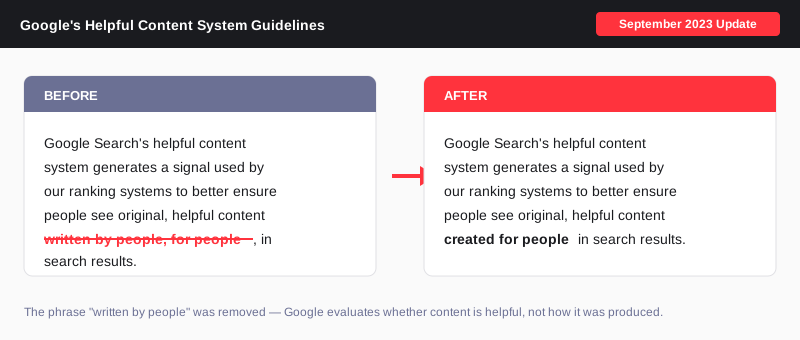
The message is clear: for content to rank well, it must be informative, answer users' queries satisfactorily, and showcase genuine expertise - regardless of how it's created.
AI Content Detectors like GPTZero, ZeroGPT, and many others are not reliable. Even OpenAI has said as much. They consistently produce false positives about human-written content. Conversely, they can be easily fooled with creative prompting or a bit of human editing.
An interesting note from OpenAI: "we found that it labeled human-written text like Shakespeare and the Declaration of Independence as AI-generated."
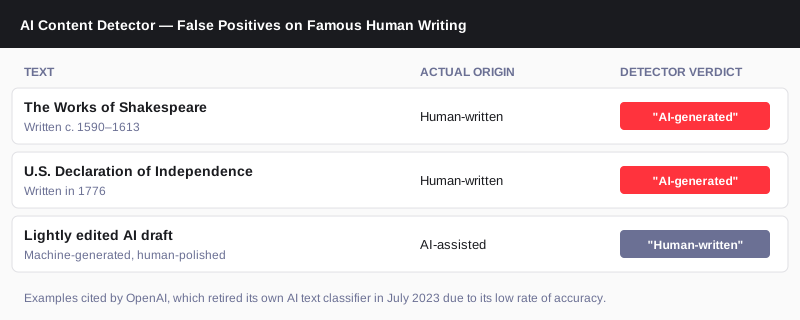
Anecdotal evidence and real-life ranking data suggest that while AI-generated content isn't penalized by search engines, it might only achieve high rankings if it meets the above criteria. The role of AI in content creation is still a developing narrative, and its significance is indispensable for maintaining a competitive edge in the future.
At EmberTribe, the understanding is clear - AI serves as a foundation, not the final product. With ClusterMagic, while AI aids in the initial draft based on expert-driven keyword research, human experts step in for the crucial phases of editing, fact-checking, and final review. This hybrid approach ensures the content is accurate and helpful, has the potential to rank, and truly represents their business.

Choosing a b2b ppc agency is a fundamentally different decision than hiring a general paid media shop. B2B buying cycles are longer, decision-making involves multiple stakeholders, and the metrics that matter -- pipeline quality, cost per qualified lead, CRM-attributed revenue -- require a specialist skill set that most generalist agencies don't carry.
This guide covers what B2B PPC agencies actually do, how they differ from the alternatives, what you should pay, and the questions that separate genuine B2B operators from agencies that happen to run B2B accounts.
B2C paid search is largely a direct-response channel. Someone searches, clicks, buys. The attribution is clean, the sales cycle is short, and success correlates tightly with ROAS.
B2B paid search works differently at every layer.
Longer sales cycles. The average B2B sales cycle runs four to six months, and in enterprise SaaS it can exceed a year. That means a click you pay for today might not show up as closed revenue for two or three quarters. Agencies that optimize purely on immediate conversion metrics -- form fills, demo requests -- often drive the wrong leads at scale.
Multiple decision-makers. A typical B2B software purchase involves five to seven stakeholders. The person clicking your ad may not be the budget holder, the technical evaluator, or the economic buyer. Campaigns need to speak to different personas at different funnel stages rather than hammering a single offer.
Higher CPCs, higher deal values. B2B keywords are expensive. Average CPCs in competitive B2B categories -- software, professional services, financial services -- routinely run $8-$15 or more per click. In some niches they exceed $50. The unit economics only work if your average deal size and retention justify that acquisition cost. A B2B PPC agency that understands your LTV-to-CAC ratio will structure campaigns around profit, not volume.
Lead quality over lead volume. A B2C team optimizing for conversions at the lowest CPL will flood your CRM with unqualified contacts. B2B success means generating SQLs and pipeline, not raw form submissions. The agency needs to understand -- and ideally integrate with -- your lead scoring model and sales process.
Account-based targeting. The best B2B campaigns go beyond keyword intent and layer in firmographic signals: company size, industry, job title, revenue band. LinkedIn's professional targeting tools let you target by seniority, function, and employer directly. Google campaigns can be reinforced with Customer Match lists and job title and intent targeting to narrow reach toward actual buyers.
A qualified B2B paid search partner covers more than buying keywords. The scope typically includes:
Google Search campaigns. Capturing high-intent demand from buyers actively researching solutions. This includes keyword strategy, match type management, negative keyword pruning, query mining, and ad copy testing -- all calibrated to B2B intent signals rather than consumer purchase behavior. For a broader look at what this engagement covers, see our guide on paid search agency partnerships.
LinkedIn Ads. For B2B, LinkedIn often complements or outperforms Google for upper-funnel awareness and retargeting. Sponsored Content, Message Ads, and Dynamic Ads let you reach decision-makers by company, seniority, and function -- targeting that doesn't exist on the Google network.
Retargeting and nurture sequences. B2B buyers rarely convert on the first visit. A strong agency builds retargeting audiences segmented by page visited, content consumed, and funnel stage, then serves different creative to prospects who looked at your pricing page versus your blog. This keeps your brand visible across a months-long research cycle.
Conversion tracking and attribution. B2B attribution is hard. A buyer who clicks a Google ad in January, downloads a whitepaper through LinkedIn in March, and requests a demo in April represents three touchpoints. The agency needs to configure Google's conversion tracking with appropriate attribution windows and connect ad platform data to your CRM so you know which campaigns actually produce revenue -- not just leads.
Bid strategy and smart automation. Platforms like Google Ads offer automated bid strategies -- Target CPA, Target ROAS, Maximize Conversions -- that use machine learning to optimize bids at auction time. But these systems require sufficient conversion volume and correctly configured goals to work. See Google's Smart Bidding documentation for how the signals work. A B2B agency knows when to trust automation and when to override it.
Lead quality feedback loops. The best setups pipe CRM disposition data (qualified vs. disqualified, deal size, close rate by source) back into the ad platforms as offline conversions. This trains bidding algorithms on revenue signals rather than raw lead counts -- a major performance difference over time.
A generalist PPC management company can run B2B accounts competently at the tactical level -- keywords, bids, ad copy. The gap shows up in strategy and measurement.
Hire a B2B specialist when:
A generalist may be fine when you're early-stage, testing basic demand capture, or running a relatively transactional B2B offer with short sales cycles and a clear, direct conversion.
Demonstrated B2B portfolio. Ask for case studies from clients with similar deal sizes, sales cycles, and buyer personas. An agency with strong ecommerce case studies and one B2B client isn't a B2B agency.
CRM integration experience. The agency should have direct experience connecting Google Ads and LinkedIn to Salesforce, HubSpot, or your CRM of choice. If they talk about leads but can't explain offline conversion imports, move on.
Lead quality reporting. Go beyond CTR and CPL. Ask what their standard reporting includes: SQL conversion rates, pipeline by campaign, cost per opportunity, CAC by channel. If they can't show you pipeline data from past clients, they haven't built it.
Conversion window understanding. An agency that sets a 30-day conversion window for a product with a six-month sales cycle is flying blind. Confirm they configure attribution windows to match your actual sales process.
B2B-specific keyword strategy. B2B keywords span informational ("what is account-based marketing"), comparative ("HubSpot vs. Salesforce"), and transactional ("marketing automation software pricing") intent. A strong agency builds campaigns around this intent progression, not just the highest-volume terms.
Alignment with your demand gen team. B2B paid search doesn't operate in isolation. The best agencies integrate with your content, SDR, and ops teams to ensure landing pages, lead routing, and follow-up sequences are built to convert the traffic they're generating. This connects directly to how you measure customer acquisition cost across channels.
Pricing structures vary, but the most common models for B2B accounts:
Percentage of ad spend. Typically 10-20% of monthly ad spend with a minimum retainer floor. Common for agencies managing larger accounts where spend scales. At $20,000/month in ad spend, expect $2,000-$4,000 in management fees.
Flat monthly retainer. Most small-to-midsize B2B engagements run $1,500-$5,000/month for management fees, independent of ad spend. Accounts with more complexity -- multiple platforms, ABM targeting, CRM integration -- sit at the higher end or above it.
Performance tiers. Some B2B agencies structure fees around pipeline or revenue milestones. These can align incentives well but require clean attribution infrastructure on both sides.
Expect to budget $2,500-$6,000/month in management fees for a competent B2B specialist handling Google Ads and LinkedIn with proper attribution setup. Boutique or enterprise-focused agencies with deep industry experience will price above that range.
Reporting that leads with impressions and clicks. These are operational metrics. A B2B agency should lead with pipeline and CPL, not vanity numbers.
No access to your own accounts. You should own your Google Ads and LinkedIn Campaign Manager accounts directly. Agencies that hold account ownership are a structural risk -- if you part ways, you lose your data and history.
Guaranteed results. No legitimate agency guarantees specific lead volumes or CPLs before understanding your market, budget, and conversion infrastructure. Guarantees are a sales tactic, not a service commitment.
Optimizing for form fills, full stop. If the agency's KPI is cost per form submission without any connection to lead quality or pipeline, they will generate cheap leads that your sales team won't close.
Lack of B2B case studies. Ecommerce results don't transfer to B2B. Ask specifically for clients with longer sales cycles, higher AOVs, or multi-stakeholder buying processes.
One-size-fits-all reporting. B2B measurement requires custom attribution windows, CRM integration, and pipeline-stage reporting. Agencies using templated dashboards without CRM data are measuring the wrong things.
The best b2b ppc agency for your business is the one that treats pipeline as the primary metric from day one -- not the agency that promises the lowest CPL or the most leads per month.
Vet them on attribution rigor, B2B portfolio depth, and their ability to speak your sales team's language. Those three filters eliminate most of the field. EmberTribe works with growth-stage B2B companies to build paid search programs built around qualified pipeline, not vanity metrics.
For more on how paid search fits into a broader demand generation strategy, see our guide on B2B lead generation and how paid channels integrate with SEO and content.

PPC management companies run and optimize pay-per-click advertising campaigns on behalf of businesses. But "management" covers a wide range of actual services — and two agencies with identical pricing and similar pitches can deliver dramatically different results.
This guide explains what PPC management companies actually do, how they price their work, and what to look for when you're evaluating your options.
The core scope of a PPC management engagement covers more than just "running ads." A full-service PPC management company typically handles:
Before any campaign goes live, a PPC company should be building the structural foundation: defining campaign types (Search, Shopping, Display, Performance Max), segmenting by intent (branded, non-branded, competitor), organizing ad groups around tightly themed keyword clusters, and setting match type strategies.
Poor campaign architecture is one of the most common reasons accounts underperform. An account with a handful of broad-match ad groups will waste a significant portion of its budget on irrelevant traffic — and many businesses never diagnose the root cause because the reporting looks acceptable on the surface. Understanding Google's ad auction system is essential context for evaluating whether an agency's structural decisions actually serve your goals.
Initial keyword research identifies the terms your potential customers are actually searching. Ongoing refinement — reviewing the search terms report weekly, adding negative keywords, and identifying emerging opportunities — is what keeps an account efficient as time goes on. How an auction-based system like Google Ads works directly affects which keywords are worth bidding on and at what price.
Whether using manual bidding or Google's Smart Bidding strategies (Target CPA, Target ROAS, Maximize Conversions), bid management requires active oversight. Automated bidding isn't set-and-forget — it needs sufficient conversion data to work, and it needs monitoring to catch cases where the algorithm optimizes for the wrong signals.
Search ads live and die by their copy. PPC management companies write, test, and iterate on headlines and descriptions across Responsive Search Ads. For display and shopping campaigns, they manage asset libraries and test creative variations to identify what drives the strongest click-through and conversion rates.
The best PPC companies review and often guide improvements to landing pages, because ad click → landing page → conversion is a single funnel. An ad that generates strong CTR but sends traffic to a generic page bleeds conversion rate. Some agencies offer landing page design as a service; most at minimum consult on page structure, messaging, and CTA.
Monthly (minimum) reporting that goes beyond automated dashboards. Good reporting tells you what changed, why, and what the agency is doing about it — not just a data dump of the same metrics.
There's no single standard pricing model. Here are the four main structures you'll encounter:
The most common model. The agency charges 10–20% of your monthly ad spend as their management fee. At lower spend levels, there's usually a minimum retainer to make the engagement viable for the agency — typically $500–$1,000/month.
Who it works for: Growing brands where ad spend is likely to increase over time. As you scale, the percentage often decreases.
Watch out for: Incentives to increase spend without a corresponding increase in efficiency. Ask how your agency measures success — if it's primarily spend volume, that's misaligned.
A fixed fee regardless of spend level. Often $500–$2,500/month for small-to-mid accounts.
Who it works for: Businesses with stable, predictable budgets who want cost certainty.
Watch out for: Retainers that are too low to justify genuine management time. A $500/month retainer might mean your account gets a few hours of attention. Ask what the deliverables include and how many hours are built in.
A base retainer covering core management work plus a performance percentage above a spend threshold. This structure attempts to align agency incentives with client growth — they earn more when you scale, but you're not paying inflated percentages on high ad spend from day one.
Who it works for: Mid-market brands with ambition to grow spend significantly over a 12-month period.
The agency is compensated based on results — conversions, leads generated, or revenue attributed. In theory, this aligns incentives perfectly. In practice, it's uncommon with reputable agencies because too many variables outside the agency's control (product quality, price competitiveness, site experience, demand seasonality) affect conversion outcomes.
If a PPC company leads with performance-based pricing, ask exactly how attribution is measured and what happens when external factors suppress results.
Management fees are only part of the total cost of working with a PPC management company. Factor in:
With dozens of agencies in any geographic market and hundreds more operating nationally, the evaluation process is where most businesses get stuck. Here's a practical framework:
Before evaluating agencies, get specific about what success looks like for you. Not "more leads" — but: what's your target cost per lead or CPA? What's your current performance baseline? What's your monthly ad budget? What verticals and geographies matter?
Agencies that receive a clear brief produce better proposals. More importantly, a clear brief exposes which agencies actually tailored their response versus sent a template.
PPC strategy varies significantly by vertical. The keyword intent, funnel dynamics, and competitive landscape for B2B SaaS lead generation are completely different from ecommerce PPC management. An agency that has managed campaigns in your category — with case studies at comparable spend levels — will ramp faster and avoid learning-curve mistakes on your budget.
Confirm upfront that you will own your Google Ads account and all the data in it. Some agencies build campaigns in their own manager accounts and retain control of your campaign history, audiences, and conversion data. Google's manager account structure means ownership can be transferred — but only if it was set up correctly from the start. Losing that data when you leave an agency can cost months of performance.
Ask to see a sample monthly report. You're looking for: was this generated automatically, or did a human analyze it? Does it explain changes in performance, not just report the numbers? Does it include recommendations for the coming month?
A report that a machine generated in 30 seconds costs you in decision-making quality. A report that required an analyst to sit with your data costs more but produces better outcomes.
Specifically: who will manage your account, how many accounts do they run, and what is their background? An account manager handling 40 clients cannot give any one account meaningful strategic attention. The ratio that predicts quality work is roughly 10–15 accounts per manager, depending on complexity.
Once you've shortlisted two or three agencies:
At EmberTribe, our paid search engagements start with a thorough audit of existing campaign structure and conversion tracking before we touch bids or budgets. The most expensive thing you can do is spend money on a broken foundation — and auditing first is the fastest way to know what you're actually working with.
When you find the right partner, PPC management fees become one of your better investments — because expert management compounds over time. Better campaign architecture, more efficient bids, stronger creative, and cleaner conversion data build on each other quarter over quarter.
The goal isn't to find the cheapest PPC management company. It's to find the one where the output value exceeds the input cost by a margin that justifies the engagement.
That math is very achievable with the right partner and very difficult with the wrong one.

How do Google Ads work? It's a question most business owners ask before running their first campaign — and one many experienced advertisers still don't have a complete answer to, because Google's system is more nuanced than it first appears.
The short version: Google Ads is an auction-based advertising platform where businesses bid for placement in search results and across Google's network. But the winner of each auction isn't necessarily the highest bidder — it's the advertiser with the strongest combination of bid, ad quality, and relevance. Understanding that distinction is the foundation of effective Google Ads management.
Every time someone searches on Google, an ad auction takes place in milliseconds to determine which ads appear and in what order. This isn't a simple highest-bidder-wins system — it's a real-time calculation that weighs multiple factors simultaneously.
Google's auction evaluates six variables for each participating ad:
The output of this calculation is your Ad Rank — a score that determines whether your ad shows and where it appears relative to competitors.
Ad Rank = Bid × Quality Score × (expected extension impact)
The practical implication: a higher bid doesn't guarantee a better position. An advertiser with a lower bid but a significantly higher Quality Score can outrank a higher-spending competitor. This is why understanding and improving Quality Score is central to effective PPC management.
Here's a detail that surprises many first-time advertisers: you rarely pay your maximum bid. Actual CPC is determined by the Ad Rank of the advertiser below you, divided by your Quality Score, plus one cent. In most auctions, you pay just enough to maintain your position over the next competitor — not your full maximum bid.
Quality Score is Google's rating (on a 1–10 scale) of the relevance and quality of your keywords, ads, and landing pages. It's calculated per keyword and consists of three components:
Google predicts how likely your ad is to get clicked when shown for a given keyword, compared to historical performance data across all advertisers. Strong ad copy that clearly addresses search intent drives better expected CTR.
How closely your ad copy matches the intent behind the keyword. An ad for "commercial cleaning services" that runs on a keyword for "office cleaning near me" should reflect that specific intent in the headline — generic copy about "professional cleaning solutions" will score lower on relevance.
Google evaluates whether your landing page is relevant, transparent, and easy to navigate. Specifically: does the page deliver on what your ad promised, does it load quickly, and does it provide useful information to visitors?
Landing page experience is the component most advertisers overlook. You can have excellent ad copy and still have a low Quality Score if traffic is landing on a slow, irrelevant page.
Why Quality Score matters financially: A Quality Score of 8 versus a Quality Score of 4 on the same keyword can result in a 50%+ difference in CPC, with the higher-Quality Score advertiser paying less while appearing in a better position.
Google offers several campaign types suited to different business objectives:
Text ads that appear in Google search results when users search for specific keywords. The highest-intent ad type — you're reaching people who are actively looking for what you sell.
Best for: Lead generation, direct response, capturing demand that already exists.
Product listing ads that show product images, prices, and store names in search results and Google Shopping. Essential for ecommerce. Performance Max extends this by showing ads across all Google surfaces — Search, Shopping, YouTube, Display, Gmail, and Maps — using Google's machine learning to allocate budget.
Best for: Ecommerce brands selling physical products.
Image and banner ads shown across Google's Display Network of over 2 million websites. Lower intent than search, but effective for brand awareness and retargeting.
Best for: Building awareness, remarketing to past visitors, promoting to interest-based audiences.
Video ads on YouTube and Google's video partners. Skippable, non-skippable, and bumper formats. Increasingly important for top-of-funnel brand building.
Best for: Brand awareness, product demonstrations, audience building for remarketing.
In Search campaigns, match types control which searches can trigger your ads. Getting this right significantly affects both reach and efficiency.
Broad Match: Your ad can show for searches related to your keyword, including synonyms and variations Google's system deems relevant. Broadest reach, lowest precision. Requires active negative keyword management to stay efficient.
Phrase Match: Your ad shows for searches that include the meaning of your keyword phrase. More controlled than broad match — good for capturing intent variations while limiting irrelevant traffic.
Exact Match: Your ad shows for searches that match your keyword's meaning very closely. Highest precision, lowest volume. Best for high-value, high-intent keywords where conversion rate justifies the limited reach.
Most well-structured campaigns use a combination — exact match for proven high-performers, phrase match for discovery, and controlled broad match with aggressive negative keyword lists.
You set a maximum bid for each keyword individually. Gives you the most control, but requires more active management and doesn't react to real-time auction signals.
Google's machine learning optimizes bids in real time based on your campaign goal. Smart Bidding strategies include:
Smart Bidding works best when your campaigns have sufficient conversion data — generally 30–50 conversions per month, per campaign. Without adequate data, the algorithm makes poor bid decisions. This is one reason why working with an experienced PPC company matters: they know when to use Smart Bidding, when to stay manual, and how to structure campaigns to feed the algorithm what it needs.
How you organize your Google Ads account directly affects performance, manageability, and the quality of your data.
A standard account hierarchy:
Best practice campaign structure:
Ad assets (formerly called extensions) are additional pieces of information that expand your ad without adding to cost per click. They include:
Extensions improve click-through rate by making ads larger and more informative, and Google factors expected extension impact into Ad Rank calculations. Using all relevant extensions is one of the easiest optimizations available.
There's no minimum spend on Google Ads — technically you could start with $5/day. But practical minimum budgets for meaningful data collection and optimization depend on your target CPA and how many conversions per day you need for Smart Bidding to work.
A rough framework:
The question isn't "what's the minimum I can spend" but "what ad spend level lets me collect enough data to optimize effectively while maintaining a viable CPA?"
Understanding how Google Ads work is the first step. Running campaigns that consistently generate profitable results is a different skill set — one that requires ongoing testing, analysis, and adjustment as the auction landscape shifts.
Many businesses run their own Google Ads with mixed results, then bring in professional PPC management once they realize the gap between "ads running" and "ads working." The system is learnable, but it has enough depth that expertise matters — especially when you're competing against other advertisers who have years of account history and optimization data behind them.
The fundamentals covered here — auction mechanics, Quality Score, match types, Smart Bidding, and campaign structure — are what every competent Google Ads practitioner has internalized. They're also the lens through which you should evaluate any agency or in-house team managing your campaigns.

Choosing the wrong Google PPC agency is one of the most expensive mistakes a growth-stage company can make. The damage compounds fast: wasted ad spend, poor conversion data, months of underperformance, and the time cost of switching partners mid-funnel.
The challenge is that agencies are better at pitching than performing. A polished deck, a few case study logos, and a Google Partner badge are easy to assemble. What's harder to spot during a sales process is whether the team behind the pitch has the operational depth to actually run your account well.
This guide is a practical selection framework for 2026 — what to look for, what to ask, what the red flags actually look like in practice, and what you should expect to pay.
At its core, a Google PPC agency manages your presence in Google's paid search ecosystem — Google Search Ads, Shopping Ads, Performance Max, Display, YouTube, and Demand Gen campaigns. The specific scope varies significantly by agency and engagement.
The core services of a capable Google PPC agency include:
The gap between agencies is often less about which services they offer and more about how deeply they execute each one. Budget management on autopilot is not the same as active optimization.
Before any spend scales, an accountable Google PPC agency will ensure conversion tracking is accurate. Ask specifically:
Conversion tracking setup is the foundational infrastructure for everything else. An agency that moves fast on spending but is vague on tracking is managing your budget blind.
You should own the Google Ads account. The agency should have access. This is a structural requirement, not a preference.
If an agency creates and controls your Google Ads account, they own your historical data, your audiences, your conversion history, and your quality scores. When the relationship ends — and it will eventually — you lose everything. This is one of the most commonly cited red flags among businesses that have had poor agency experiences.
Any agency that resists giving you full admin access to your own account should not be hired.
Ask who specifically will be managing your campaigns. The person presenting in the sales process is often not the junior account manager who will be assigned to your account post-signing. Get names and verify experience where possible.
A good rule: if you're spending $20,000+/month on Google Ads, your account should have a dedicated specialist — not be pooled with a dozen others managed by someone with 18 months of experience.
Also ask about tool access: Google Analytics, Search Console, any third-party platforms. If they're managing your paid search in isolation from your broader site data, they're flying partially blind.
A high-quality Google PPC agency invests time in understanding your business before proposing anything. That means a discovery conversation about your ICP, sales cycle, average order value, competitive landscape, and existing marketing stack.
If an agency sends a proposal with specific cost-per-lead guarantees based on a 20-minute intake call, treat that as a red flag. No reputable PPC agency guarantees specific results — too many variables outside their control affect campaign performance.
A good proposal includes a strategy that acknowledges your specific situation, realistic outcome ranges based on comparable accounts, and a testing period assumption before drawing performance conclusions.
Google has significantly reduced manual control in the platform over the past three years. Performance Max campaigns now often consume the majority of budget for most advertisers, and smart bidding strategies rely on Google's machine learning rather than manual bid management.
A capable Google PPC agency in 2026 understands how to work with Google's automation rather than against it — how to feed the algorithm the right signals through proper asset groups, audience lists, and conversion data rather than trying to override automation with outdated manual tactics.
Ask any prospective agency about their Performance Max strategy. If they're dismissive of it or don't have a coherent framework for managing these campaigns, they're behind on how the platform actually operates today.
Google PPC agency pricing typically follows one of three models:
Percentage of ad spend. The most common structure. Typically 10–20% of monthly ad spend. At $10,000/month ad spend, expect $1,000–$2,000/month in management fees. This model aligns incentives well — the agency earns more as your spend grows.
Flat monthly retainer. A fixed fee regardless of spend level. Ranges from $1,500/month for small accounts to $7,500+/month for mid-market. Better for accounts with stable spend levels.
Performance-based. A smaller base fee plus a percentage of revenue or leads generated above a baseline. Less common, harder to structure fairly, but can align incentives well when configured correctly.
Most mid-market accounts pay $2,500–$7,500/month in management fees, with setup fees of $2,500–$10,000 for new account builds or major rebuilds.
Be cautious of pricing significantly below these ranges. Underpriced management usually means underdedicated management — your account is one of many being touched minimally each week.
Beyond the structural criteria above, these questions reveal how an agency actually operates:
"Walk me through how you'd approach the first 90 days on our account." Good agencies have a structured onboarding process: audit, tracking verification, account restructure where needed, then systematic testing. Vague answers suggest vague execution.
"How often will we communicate, and what does reporting look like?" Expect at least monthly strategy calls with access to real-time dashboards. Quarterly reviews for account structure. Weekly or biweekly updates during active testing periods.
"Show me an account where you took over from a previous agency and improved performance." This is a high-signal question. Turnarounds require real diagnostic skill and the discipline not to blow up what's working.
"How do you handle underperforming campaigns?" Look for a structured test-and-learn process — hypothesis, change, measurement window, decision. Avoid agencies that respond to underperformance by immediately increasing budget or changing too many variables at once.
"What metrics do you use to define campaign success, and how do they connect to our business goals?" Clicks and impressions aren't success metrics. Revenue, ROAS, CPL, and CPA against your business model are success metrics. Agencies that speak primarily in platform metrics (CTR, Quality Score) rather than business outcomes may be optimizing for the wrong things.
"We guarantee [specific result] within [specific timeframe]." No legitimate Google PPC agency makes unconditional performance guarantees. Market conditions, bid auctions, Quality Scores, and landing page performance all affect outcomes in ways no agency fully controls.
They're slow to answer pre-sales questions. If communication is polished during the sales process and deteriorates after signing, that's a preview of the relationship. How fast they respond to your questions before you're a client is often how fast they'll respond after.
Set-and-forget management. Google Ads requires continuous active management — regular bid adjustments, negative keyword expansion, creative testing, and audience refinement. An agency that logs in once a week to check dashboards is not actively managing your campaigns.
They talk about ad spend without mentioning landing pages. Clicks land somewhere. If an agency is optimizing for clicks but not for what happens after the click, they're managing half the conversion equation. PPC management without landing page accountability is a common performance leak.
Long contracts with no performance reviews. A 12-month commitment with no performance checkpoints benefits the agency. A fair contract includes defined performance reviews and a reasonable exit provision if targets are substantially missed.
For ecommerce brands, Google Shopping and Performance Max often drive the majority of paid search revenue — make sure any agency you evaluate has specific, measurable experience managing product feed optimization and Shopping campaigns at scale.
For SaaS and B2B companies, the sales cycle complexity means PPC should connect directly to CRM data. Agencies that can configure lead quality tracking and close-rate measurement by ad group are significantly more valuable than those reporting on raw lead volume.
Our guide to PPC management for ecommerce covers how to evaluate these partnerships specifically for DTC and retail brands.
For search programs that include both paid and organic, it's also worth reading our breakdown of how SEO and PPC services work together — running them in coordination rather than in isolation is where the compound returns come from.
A good Google PPC agency won't just manage your ad spend — they'll improve the efficiency of every dollar you spend on Google. That means better conversion data, tighter audience targeting, more relevant ad creative, and a consistent improvement in ROAS over time.
The evaluation process requires real diligence. Get specific on team structure, account ownership, tracking setup, and performance expectations before any contract is signed. Ask for case studies from comparable accounts. Verify their Performance Max and smart bidding experience.
The wrong partner costs you time, money, and months of bad data. The right one becomes one of your highest-leverage growth investments.

You may still call it Google AdWords — the legacy name stuck around long after Google rebranded the platform to Google Ads in 2018. Whatever you call it, the fundamentals of hiring an agency to manage your paid search haven't changed: you're trusting someone with real ad budget, and a bad partnership costs more than just the agency fee.
This guide covers what genuinely matters when evaluating a Google Ads agency — the criteria that separate accountable, skilled partners from agencies that optimize for their own retention rather than your results.
When people search for "google adwords agency," they're usually looking for the same thing: an agency that manages Google's paid search platform professionally. The name is outdated (Google retired the AdWords brand in 2018), but the intent behind the search is clear — find someone who knows Google Ads well enough to manage campaigns against a real budget.
Any agency worth working with will acknowledge the rebrand and speak fluently about the modern Google Ads interface, campaign types (Search, Performance Max, Shopping, Display, YouTube), and the platform's ongoing evolution. If an agency still leads with "AdWords" as a primary identifier, that's a minor signal worth noting — but what matters more is whether they can demonstrate current, hands-on expertise.
A legitimate Google Ads agency provides:
The last two points — reporting and testing — are where agencies most commonly underdeliver. Fancy dashboards with week-over-week click trends don't tell you whether the campaigns are working. Revenue-anchored reporting with clear attribution does.
This is the single most important thing to verify. Your Google Ads account should be created under your Google account — not the agency's. If the agency creates the account under their own manager account (MCA) and you don't have admin access, you have no real data portability, no ability to audit historical performance, and a painful exit path.
Any reputable agency will grant you admin-level access from the first day of the engagement. Full stop.
The percentage-of-spend model misaligns incentives fundamentally: the agency earns more when you spend more, regardless of whether that increased spend is producing proportionally better results. Look for flat monthly retainers with clear scope definitions, or performance-based models tied to revenue outcomes — not spend volume.
Google Ads campaigns need a meaningful data accumulation period before Smart Bidding algorithms can optimize effectively. Expect 60–90 days before you have enough data to evaluate campaign performance fairly. Any agency promising significant ROAS improvements within two to four weeks is either overpromising or inheriting a well-built account and claiming credit for it.
Legitimate agencies set realistic timelines and communicate clearly about what the first 30, 60, and 90 days will look like.
These are inputs, not outcomes. A click that doesn't convert is a cost, not a result. Agency reporting should lead with conversion metrics, CPA or ROAS relative to target, revenue contribution, and quality score trends — not reach and click volume. If the sample report an agency shows you during the sales process is impression-heavy, their actual reporting will be too.
Twelve-month contracts with new agencies are high risk. A three-to-six month initial engagement with a monthly option to continue is a fair ask from any established agency. Long lock-ins benefit the agency's revenue stability, not your campaign performance. If an agency insists on a year-plus commitment before you've seen any results, walk away.
Large agencies routinely win new business with senior talent and hand it off to junior account managers. Ask explicitly: "Who will be managing our account day to day, and can I speak with them before we sign?" The account manager who will handle your campaigns should be able to speak fluently about campaign structure, bidding strategy, and creative testing. If you get a sales rep instead of the practitioner, that's a flag.
Before signing, verify that the contract addresses these elements clearly:
Account ownership: Explicit language stating that the Google Ads account, all campaign data, and all creative assets belong to you — not the agency.
Termination terms: Reasonable notice periods (30 days is standard) with no early termination fees after the initial engagement period. Multi-year contracts on first-time relationships are unusual and should be questioned.
Scope of services: Specific deliverables per month — campaign types managed, ad copy cycles, landing page recommendations, reporting cadence — rather than vague language like "ongoing optimization."
Fee structure: Transparent breakdown of management fee vs. ad spend. No hidden fees for creative production, reporting tools, or account access.
Performance review cadence: At minimum, monthly reporting calls with QBRs at 90 days and 6 months. Clear definition of the KPIs that define success.
Data and tool access: You should retain access to all analytics properties, call tracking platforms, and any third-party tools used in the management of your account.
Use these in your evaluation calls:
Strong practitioners answer these questions with specifics. Generalists answer them with generalities. The difference is obvious within a few minutes.
Management fees vary significantly by scope and agency size:
These are rough ranges. The right question isn't "what's the cheapest management fee" — it's "what's the total investment relative to the revenue I should expect the campaigns to generate." An agency charging $5,000/month that improves your ROAS from 2.5× to 4.0× on $50,000/month of spend generates far more value than a $1,500/month manager who maintains flat performance.
Even after you've selected a strong agency and signed a solid contract, manage your expectations for the first quarter:
At the 90-day mark, you should have enough data to evaluate whether the agency's approach is working. That's the conversation to have before committing to an extended engagement.
Google Ads managed well is one of the most reliable acquisition channels for growth-stage ecommerce and DTC brands. The difference between a mediocre agency and a great one isn't marginal — it's often the difference between a channel that drains budget and one that compounds your customer acquisition over time.
Take the time to verify account ownership terms, understand the reporting you'll receive, and speak directly with the person managing your campaigns before you sign anything.
For more on evaluating paid media partners, see our complete guide to ecommerce PPC management agencies and our breakdown of how to choose the best ecommerce marketing agency.

The phrase "best PPC company" gets searched thousands of times a month, and almost every agency in the space claims that title. The problem isn't finding a list of options — it's knowing which criteria actually predict results versus which ones are just good marketing.
This guide takes a criteria-first approach. Before you look at agency names, you need a clear framework for what makes a PPC company genuinely effective, so you can evaluate each option on substance rather than sales pitch.
There are a few qualities that consistently separate high-performing PPC agencies from the field.
The best PPC companies don't lead with impressions, clicks, or even ROAS in isolation. They orient around your actual business economics — your margin structure, customer lifetime value, target CPA, and what a profitable acquisition actually costs.
An agency that presents a proposal full of reach and impression metrics but can't articulate your target cost per acquisition is an agency optimizing for optics. The question to ask: "What does a successful outcome look like for my business, and how will you measure it?" A strong answer will reference your specific margins and CPA targets, not generic benchmarks.
Creative is consistently the largest performance lever in paid campaigns, and it's the one most mid-tier agencies deprioritize. A great PPC company has a documented process for creative iteration: hypothesis, test, measure, scale winners, kill losers. Agencies without this framework plateau quickly once initial account optimizations are exhausted.
Ask for examples of creative tests they've run, what they learned, and how they applied those learnings. Vague answers about "A/B testing" without specifics are a yellow flag.
Google's Smart Bidding and Performance Max campaigns can deliver strong results when managed correctly. They can also quietly waste budget when left unmonitored. Smart Bidding optimizes bids at auction time using dozens of contextual signals — device, location, time of day, remarketing list membership — but it still requires at least 30 conversions per month to function accurately, and it breaks down when conversion tracking is misconfigured or when campaigns are structured poorly from the start.
The best PPC companies use automation as a tool, not an abdication. They review search term reports manually, identify when broad match expansion is pulling in irrelevant traffic, and know when to override automated bidding.
Ask prospective agencies: "Can you give me an example of when you disagreed with automation and what you did about it?" If they can't, they're flying on autopilot.
Strong PPC management involves actively mining data for opportunities — not just forwarding automated Google Ads reports. Look for agencies that analyze time-of-day performance for bid adjustments, geographic data for budget allocation, device performance for bid modifiers, and audience overlap across campaigns. A useful proxy: ask whether they actively monitor Quality Score components — expected CTR, ad relevance, and landing page experience — as diagnostics for where accounts are losing ground in the auction.
The difference between a dashboard dump and an actionable analysis is the difference between a vendor and a partner.
Ask directly: will you retain ownership of your Google Ads account if you leave? Some agencies lock clients into accounts they control, meaning you lose your campaign history, audience data, and conversion tracking if you switch. Google's own documentation on manager account ownership makes clear that client accounts always retain data ownership and the right to remove manager access — but agencies that create accounts under their own manager hierarchy without granting you admin access are effectively holding your campaign history hostage. Reputable PPC companies always work inside client-owned accounts.
Not all red flags are obvious. Here are the ones worth watching for during the evaluation process:
Guaranteed ROAS promises: No legitimate agency can guarantee specific performance outcomes because auction dynamics, competitive landscapes, and market conditions are outside their control. Agencies that lead with guaranteed returns are either lying or planning to underreport costs to hit the number.
Below-market pricing: Genuine PPC management takes time. Keyword research, bid management, ad copy testing, landing page analysis, and ongoing optimization aren't automatable at scale. Agencies pricing significantly below market are usually either doing less than advertised or relying on account managers handling too many clients simultaneously.
Long lock-in contracts with no performance benchmarks: Confident agencies offer 30 or 90-day cancellation terms because they're confident in their work. A 12-month contract with no performance clauses is a sign they know they need time to hide underperformance.
No demonstrated industry experience: PPC strategy isn't fully transferable across verticals. B2B SaaS and DTC ecommerce have entirely different keyword intents, funnel structures, and bidding dynamics. Ask for case studies specifically from your category.
One point of contact who is also the person running campaigns: Strategic thinking and execution are different skill sets. Agencies where the account manager is also the person building and optimizing campaigns often sacrifice one for the other.
Use these during discovery calls to separate signal from noise:
PPC management pricing typically follows one of three models:
Flat monthly retainer: Usually $500–$2,500/month for smaller accounts. Predictable costs, but can misalign incentives if the agency isn't motivated to scale your spend.
Percentage of ad spend: Typically 10–20%, with the percentage decreasing at higher spend levels. Aligns agency compensation with scale, but watch for incentives to spend more rather than spend smarter.
Hybrid: A base retainer covering core management plus a performance percentage above a threshold. Often the most aligned structure for growth-stage brands.
Performance-based pricing (pay only on results) sounds attractive but is uncommon with reputable agencies for good reason — too many variables outside the agency's control affect conversion outcomes.
Rather than gathering five proposals and comparing line items, structure your evaluation around three phases:
Phase 1 — Screen for alignment: Share your P&L context, your target CPA, and your current performance. Agencies that respond with generic proposals didn't listen. Agencies that ask clarifying questions and propose a diagnostic approach are showing you how they'll actually work.
Phase 2 — Assess technical depth: Ask the specific questions above. Request a sample campaign audit or strategy memo. What they produce tells you more than any sales presentation.
Phase 3 — Check references and results: Talk to current clients, not just the references they hand you. Look at case studies for comparable spend levels and verticals. Triangulate what they say with what their clients confirm.
Even the best PPC company operates in a vacuum if your campaigns aren't connected to your landing pages, CRO work, and retention strategy. Paid clicks that go to slow, generic landing pages will underperform regardless of how well the campaigns are built. The relationship between paid search and on-site conversion is where most of the real optimization opportunity lives.
At EmberTribe, we treat paid search as one channel in a connected growth system — not an isolated budget line. The PPC companies that deliver the best long-term results take the same approach: they're invested in what happens after the click, not just what happens in the auction.
The best PPC company for your business is the one that understands your unit economics, runs campaigns with genuine strategic depth, gives you full account ownership, and communicates clearly about what's working and what isn't.
That list is shorter than most "best PPC company" roundups would have you believe — which is exactly why the evaluation criteria matters more than the ranking.

In the age of rapid digital transformation, AI has seeped into almost every industry, revolutionizing how we conduct business, design products, and even create content. The ClusterMagic service is a great example, which seamlessly integrates AI for content generation in a hybrid model, providing significant benefits in the SEO results of brands seeking a massive increase in organic traffic. But while AI holds immense promise, it has its limitations. Let's explore the pros and cons of using AI for content creation and understand why a hybrid approach might be the way forward.
Major publishers in sensitive niches like CNET.com, Bankrate.com, and Creditcard.com have already integrated AI-generated content. Other large companies, such as CNN and Forbes, might also be doing so. Countless smaller companies and publishers are utilizing AI, not only on their websites but also on social media, in email marketing, and virtually everywhere else.
Google's stance on AI-generated content is neutral, emphasizing that content should primarily be user-centric. In fact, Google's September 2023 Helpful Content Update removed the mention of "written by people" from their helpful content system guidelines.
The message is clear: for content to rank well, it must be informative, answer users' queries satisfactorily, and showcase genuine expertise - regardless of how it's created.
AI Content Detectors like GPTZero, ZeroGPT, and many others are not reliable. Even OpenAI has said as much. They consistently produce false positives about human-written content. Conversely, they can be easily fooled with creative prompting or a bit of human editing.
An interesting note from OpenAI: "we found that it labeled human-written text like Shakespeare and the Declaration of Independence as AI-generated."
Anecdotal evidence and real-life ranking data suggest that while AI-generated content isn't penalized by search engines, it might only achieve high rankings if it meets the above criteria. The role of AI in content creation is still a developing narrative, and its significance is indispensable for maintaining a competitive edge in the future.
At EmberTribe, the understanding is clear - AI serves as a foundation, not the final product. With ClusterMagic, while AI aids in the initial draft based on expert-driven keyword research, human experts step in for the crucial phases of editing, fact-checking, and final review. This hybrid approach ensures the content is accurate and helpful, has the potential to rank, and truly represents their business.
Admit it, marketer or not we have all talked about algorithms being (scarily) artificially intelligent, real-life Skynet, and a sinister machine that monitors all our actions and knows us better than we know ourselves.

But do we even know what algorithms are?
We assume there is this one algorithm in a top-secret file at Google Headquarters that’s prized for listening in on our conversations and reading our minds.
But there isn’t just one algorithm, there are many algorithms—each one personalized to produce a result we care about.
For example, putting a pan of water on the stove at a certain temperature for a certain time is a way to reach the result of boiling hot water. This is one equation, or rule, or sequence. Adding eggs to the boiling water and letting them stay in for a certain period of time leads to hard-boiled eggs. This is another sequence that leads to a result.
Continuing with that metaphor, when you type a query into the Google search bar, it doesn’t just fire one sequence to get your result, it fires up an entire kitchen of line cooks. 🍳
Algorithms are excellent tools for optimizing your marketing campaign because they provide what we love best: data. They can help you pick apart your audiences’ complex decisions. Here are a few examples of how you can use algorithms as a marketer.
Algorithms help monitor the behavior of your demographic and suggest the likely hours during the day when your leads are browsing online.
Having a pool of valuable behavioral data can help you remarket to the right people at the right time. If you share that information with your broader marketing team you can even use it to design a unique campaign that incorporates highly targeted information about your audience.
Algorithms can help you personalize the way you show an ad to your consumer or a lead. Remember that song that played on Spotify shuffle? Wasn’t it exactly the kind of tune you were looking for? Now how did that happen? Or that ad about artisanal potato chips made from handpicked Idaho potatoes...how did they know that’s just what you were craving?
Google uses algorithms to show you information that you are likely going to be interested in, such as targeted news articles and tutorials. That means you’re not just being delivered the answer to your query, but information about your query targeted for you based on your search habits.
Targeting is what allows the internet to predict what you may feel like eating the next day. It has consumed so much of your behavioral pattern that you start panicking Google is reading your mind. It’s not…
Or is it?

No seriously, that's just how proactive algorithms are. They make use of something that we hear a lot: Machine learning, aka another way of saying artificial intelligence.
Machine learning helps figure out what your customer is thinking. Are they browsing? Are they going to spend soon? Are they looking to spend now? Basically, it helps you determine the stage of your buyer’s journey so you can address it.
🛠️ Find out how you can build a better funnel with retargeting. →
Sounds great right? By now you feel ready to drive your entire digital marketing campaign based on algorithms. We’ve said a lot of great things about them so far, but are algorithms really the bee’s knees?
The answer to that is yes and no. Google algorithm and machine learning is great at monitoring behavior and 7 times out of 10 it does strike true, but the times it does not is because algorithms cannot grasp context. AI can predict a customer’s response to likely be a certain way, but what if the routine context is changed (as it is in life), rendering the data ineffective?
That being said, algorithms remain the foremost tools to learn about humans and their actions. They have brought us far in the way marketers engage with audiences and it has proven effective. For that reason, we have to raise our glass to algorithms that make our lives as marketers just a little easier and more data-driven.


.svg)