
Seattle's business landscape is genuinely distinct from most US markets. A city where 290,000 tech workers represent nearly 30% of the regional economy, and where Amazon, Boeing, and Microsoft anchor an information sector generating $134 billion in output, creates a buyer who approaches marketing content with more skepticism and more sophistication than most. Generic social media content performs poorly here. Olive Group's Seattle digital marketing analysis documents that Seattle audiences have a measurably stronger preference for authentic over polished content and are among the most likely in the US to disengage from templates and stock-photo aesthetics.
Choosing a Seattle social media company means evaluating not just capability but cultural fluency. This guide covers the platform benchmarks that matter, when local presence creates a real advantage, what social media management costs, and the questions that separate genuine local expertise from agencies that simply have a Seattle mailing address.
The Seattle market concentrates several industries that each require distinct social media strategies. Tech and SaaS companies need LinkedIn-first content that demonstrates technical authority for B2B buyer audiences. Healthcare and biotech organizations navigate HIPAA-compliant content requirements with educational thought leadership. Hospitality, food and beverage, and retail brands operate in a strong shop-local culture where community roots and sustainability positioning move the needle in ways they do not in most other markets.
Seattle's TikTok adoption among local businesses grew 56% in the past year, per local business data compiled by Visualwebz. The platform split that works in this market runs TikTok for discovery, Instagram for lifestyle and visual brand building, YouTube for research-stage content, and LinkedIn for B2B tech buyer audiences. A social media company without platform-specific expertise for each of these is building a one-size strategy for a market that rewards specialization.
The sustainability orientation of Seattle consumers also affects content directly. Brands that communicate environmental credentials authentically earn engagement and loyalty at rates above national averages. Brands that greenwash face audience backlash more quickly than in less values-driven markets.

Buffer's 2026 social media benchmarks show LinkedIn at 6.5% to 8% median engagement, TikTok at 4.86%, Instagram at 4.3%, Facebook at 3.6% (down 36% year over year), and X at 2.15% (down 48% year over year). Emplifi's 2026 report puts TikTok brand engagement at 27.6% in Q4 2025, with 200% year-over-year brand follower growth. For B2B-oriented Seattle companies, LinkedIn carousel and document posts generate a 21.77% median engagement rate, the highest of any single content format on any platform.
The organic reach context is critical for setting expectations. Sprout Social's organic reach data shows Facebook organic reach at under 2.2% of followers without paid amplification, down from 16% in 2012. Instagram sits at 2% to 4% of followers, down 12% year over year. LinkedIn organic reach declined 34% year over year.
These numbers do not mean social media is less valuable. They mean that algorithm expertise, content format selection, and posting cadence are the primary differentiators between agencies that generate results and those that maintain activity metrics.
Paid social ad costs are rising simultaneously. Affect Group's Meta ad benchmark data shows CPM costs rising 8% to 38% across industries in 2025. For Seattle businesses with physical locations or geo-targeted campaigns, the cost-per-result math increasingly favors organic content quality over raw paid reach, making the agency's content and community expertise more valuable than their media buying efficiency.
The case for a Seattle-based social media company is real for specific business types. Local agencies have established relationships with Seattle micro-influencers, community groups, and neighborhood-specific accounts that national agencies cannot replicate. They can react to local events in real time: a Seahawks playoff run, a Capitol Hill Block Party tie-in, or a story in the Seattle Times that creates a content moment a local team sees and a distributed team misses. For brands with physical locations running event-based content or photo shoots, in-person collaboration with a local agency eliminates a coordination layer.
The case for a national or distributed team is equally real for other scenarios. Brands whose target audience is national or international do not benefit from local cultural fluency in their content. Distributed agencies can assemble specialists across paid media, video production, and platform expertise without being constrained to the talent available in one metro area. For B2B technology companies in Seattle targeting buyers in New York, Chicago, and San Francisco, a local agency's neighborhood knowledge is irrelevant to the actual content strategy.
The honest answer for most Seattle businesses: local presence matters most for consumer-facing brands with physical locations, healthcare practices targeting local patients, hospitality and retail with strong "Seattle-made" brand positioning, and professional services firms pursuing local B2B clients. It matters less for product or software companies with national or global buyers.
Hawk SEM's social media pricing data and Clutch's agency project benchmarks set the range:
Boutique agencies run $1,500 to $3,000 per month for strategy and content across two to three platforms. Mid-sized agencies run $3,000 to $10,000 per month for full strategy, content production, community management, and reporting. Full-service agencies with paid media integration run $10,000 to $20,000 or more per month. Clutch's average across agency engagements lands at $5,107 per month, or approximately $61,000 annually.
The pricing structure distinction matters: management fees and ad spend are separate. An agency charging $4,000 per month in management fees is not including ad budget. Most agencies recommend a minimum of $2,500 per platform per month in ad spend alongside organic management.
US-based agency hourly rates run $100 to $149 per hour. For project-based work (strategy audits, brand voice development, platform setup), hourly billing is common before a monthly retainer begins.
The questions that reveal the most about actual capability and fit:
Do they conduct a formal discovery phase of two to four weeks before touching your content, or do they begin posting immediately? Starting without a brand voice audit, audience research, and competitive analysis is a strong signal that the agency is executing templates rather than strategy.
Do they recommend two or three platforms to begin with, or promise to manage every channel? The right answer is focused. Promising everything means diluting attention across platforms where your audience does not actually spend time.
Can they show documented results for a Seattle-area business or a brand in your specific industry? Case studies should include business outcomes: traffic, leads, or sales generated, not engagement rates and follower growth in isolation.
Is their own social media active, consistent, and high-quality? An agency that cannot maintain its own presence is not credibly managing yours.
How do you attribute social media activity to business outcomes, traffic, or pipeline? If the reporting stops at impressions and engagement, the agency is measuring inputs rather than outputs.
Who owns your ad accounts, content assets, and analytics access if you end the engagement? The answer should be: you do. Agencies that retain ownership of client accounts as leverage are structuring a dependency relationship.
Guaranteed follower counts, guaranteed engagement rates, or guaranteed sales from social media. Platforms change their algorithms without notice and no agency controls reach or conversion independent of content quality. Agencies making these guarantees are either misrepresenting the business or measuring metrics that do not connect to business value.
An agency whose own social media is dormant, inconsistent, or uses stock photo aesthetics cannot credibly make the argument that they understand organic social performance. Ask to see their most recent month of content before signing.
Lock-in contracts of twelve months or more with no exit clause. Strong agencies earn renewal. Agencies that require long lock-ins are protecting against churn rather than earning loyalty through results.
No documented onboarding or discovery process. The absence of a structured onboarding means the agency is not investing the time to understand your brand before representing it publicly.
The declining organic reach environment, rising paid ad costs, and Seattle's particularly discerning audience mean that the agency's content strategy and platform expertise matter more now than they did three years ago. The right Seattle social media company has documented results in your industry, a discovery process before strategy development, reporting tied to business outcomes rather than vanity metrics, and the cultural fluency to make content that resonates with a highly skeptical tech-adjacent audience.
For Seattle-area brands and growth-stage companies evaluating their social media and paid channel strategy, EmberTribe works with DTC and B2B brands on demand programs where organic and paid social are measured against the same revenue outcomes, not tracked in separate agency reporting silos.
Facebook made its recommendation guidelines public, and there is a lot for marketers to unpack. With ongoing pressure on the platform to better manage problematic content, this move represents a significant step toward transparency for businesses and content creators operating on both Facebook and Instagram.
Understanding these guidelines is not optional for brands that rely on organic reach. Content that violates recommendation criteria will not be surfaced to new audiences - effectively limiting your distribution to existing followers only. For growth-focused companies, that distinction can mean the difference between a post reaching 500 people and 50,000.
Before diving into the restrictions, it helps to understand what Facebook recommendations actually are. Recommendation experiences are the platform's algorithmic surfaces that introduce users to content from accounts they do not already follow. These include:
These recommendation surfaces represent some of the most valuable organic real estate on the platform. When your content qualifies for recommendations, it reaches users who are predisposed to engage with your brand - but have not yet discovered you. Losing access to these surfaces significantly limits organic growth potential.
Facebook has organized its recommendation restrictions into five categories. Content in these categories is allowed to remain on the platform but will not be recommended to users who do not already follow the account.
This category targets content that, while not explicitly violating community standards, sits close enough to the line that Facebook does not want to amplify it. Examples include:
The resharing provision is particularly important for brands. Even if your original content is clean, resharing a borderline post from another account can affect your recommendation eligibility.

Facebook applies extra scrutiny to content in categories where misinformation can cause real-world harm:
For brands in the health, wellness, or financial services space, this means your content strategy needs to be built on substantiated claims and educational value rather than hype-driven messaging. Factual, well-sourced content is far more likely to qualify for recommendations than promotional material.
This category is essentially Facebook's war on engagement bait - tactics that generate clicks and interactions but leave users feeling annoyed or deceived:
For marketers accustomed to using contests as a growth lever, this restriction changes the calculus. While contests are still allowed, they will not be amplified through recommendations. That means you need to weigh the value of engagement from existing followers against the loss of potential discovery by new audiences.
Facebook's quality standards target content that does not meet a minimum bar for originality and credibility:
This category reinforces the importance of original content creation. Brands that rely heavily on curating and resharing third-party content may find their recommendation eligibility declining over time. Investing in original thought leadership, proprietary data, and unique perspectives is the more sustainable path to organic reach.
The final category addresses factual accuracy:
For businesses, the practical implication is straightforward: ensure every claim in your social content is accurate and can be substantiated. A single post flagged by fact-checkers can impact your entire page's recommendation eligibility.
The recommendation guidelines create a clear dividing line between content that can grow your audience and content that only reaches people who already follow you. For brands investing in organic social as a growth channel, optimizing for recommendation eligibility is now a core strategic consideration.
Recommendation restrictions do not operate in isolation. Facebook's algorithm evaluates pages holistically, meaning a pattern of posting restricted content can suppress the recommendation eligibility of your entire page - not just individual posts. One borderline post will not destroy your reach, but a consistent pattern will.
This is why regular content audits matter. Review your posting history through the lens of these five categories and remove or archive content that could be flagged. Think of it as maintaining your page's algorithmic credit score.
Brands that have been banned from Instagram Ads or Facebook Ads face additional penalties: their pages will not be recommended at all. This creates a compounding problem where advertising policy violations bleed into organic performance.
For brands running paid campaigns alongside organic content, maintaining clean ad accounts is now doubly important. An ad disapproval issue does not just affect your paid performance - it can throttle your organic growth as well.
Based on these guidelines, here are actionable steps every social media team should implement.
Review your page's content history and align it with Facebook's recommendation criteria. Pay special attention to:
Remove or archive anything that could be pulling down your page's overall recommendation eligibility.
If your brand operates multiple Facebook pages that post identical or near-identical content, deactivate the redundant ones. Facebook's quality signals penalize pages that appear to exist solely to amplify the same content across multiple accounts.
Consolidate your social presence around a single authoritative page with original content.
Pages that have purchased likes, followers, or engagement in the past will not be recommended. If your page has a history of bought followers, consider whether the inflated follower count is actually hurting you more than helping. A page with 10,000 genuine followers will outperform a page with 100,000 purchased followers in the recommendation algorithm.
Follower quality also affects your engagement rate, which is a key input to Facebook's distribution algorithms. Low engagement rates signal to the algorithm that your content is not resonating - further reducing reach.
The common thread across all five restriction categories is that Facebook wants to recommend content that genuinely benefits users. Content that educates, informs, entertains, or inspires will always outperform content designed to manipulate engagement metrics.
Practical ways to create recommendation-eligible content include:
Facebook regularly updates its recommendation guidelines as the platform evolves. What qualifies for recommendations today may not qualify tomorrow, and new surfaces for recommendations are added regularly.
Assign someone on your team to monitor the Facebook Business Help Center and adjust your content strategy as policies change. Proactive adaptation is always less costly than reactive damage control.
These recommendation guidelines reflect a broader shift across all social platforms toward quality-first content distribution. The algorithms that power content recommendations are increasingly sophisticated, and platforms are rewarding authenticity, originality, and user value while penalizing manipulation and low-effort content.
For brands that have always prioritized genuine value creation, these guidelines are not a threat - they are a competitive advantage. As platforms tighten their criteria, brands that cut corners will lose distribution while those that invest in quality will gain it.
The bottom line: align your content strategy with what Facebook's algorithm wants to recommend, and the platform will do the distribution work for you. Fight against it, and you will find yourself paying for every impression.
Advertising on Facebook is not for the weak-willed. There’s a lot to know and a lot to learn about Facebook ads to master Facebook marketing skills. That’s one of the reasons there are so many educational resources about Facebook advertising—there’s so much to know!
Luckily, the overlords folks at Facebook have produced tons of learning materials for us lowly marketers.

The Facebook Blueprint certification exams are targeted to digital marketers looking to demonstrate advanced proficiency using Facebook advertising services across platforms. There are 8 total certification levels:
One of our own EmberTribers, Joe, set out to test what a Facebook Blueprint Certification Exam is like and determine if it’s worth the hassle. He took the 100 level “Digital Marketing Associate” course as his test. After finishing his exam (passed with flying colors!), he reported back to us about his experience.
Here’s what he had to say:
Some other questions that our team had for Joe about the process:
Do you think the 100 certification is necessary for Facebook competency?
No, this level is not too difficult and covers a lot of the basics that any seasoned Facebook advertiser would already have under their belt. Taking the certification exam for the 100 level is more of a resume builder than a knowledge builder for those already familiar with Facebook digital marketing.
Was there a fee attached?
Yes, the fee for each exam is $99.
Is it a lifetime or time-limited certification?
The certification is good for 1 year.
Facebook's Blueprint course is a great foundational tool for advertisers. But what about the spaces "in-between" where many marketers find themselves wondering how to address using ads for growth?
Since our agency's inception, we've profitably spent more than $100 million on Facebook runnings ads for ourselves and our clients. We wanted to put all of this practical knowledge to work by creating a free Facebook ads training course for founders who are serious about growing their business with paid ads.
If you're not familiar with Facebook ads yet, you will want to start with the Facebook Blueprint course. Once you're done, we recommend bookmarking our free Facebook ads course or signing up for lessons sent directly to your email inbox.
In these training modules, we outline strategies and tactics that you won't find in the Facebook help section. Take time reviewing these training videos to learn from our deep knowledge of Facebook ads.
Digital marketers seeking a higher level of proficiency in Facebook ads should consider studying up on the 200 and up level certification to get the most bang for their buck. The certification itself, while nice to have, isn’t necessary to become a competent Facebook advertiser, but the lessons can help you boost your skill level.

And if you’re not comfortable learning the ins and outs of Facebook, it might be a good idea to bring in someone steeped in Facebook ad success. Hey, we know some people 😉.

Are you currently maximizing Pinterest advertising for your eCommerce or online retail business? If not, you might be making a big mistake by snubbing this powerful social media marketing platform.

The user mindset on Pinterest is significantly different than it is on other social media platforms — users are often on Pinterest specifically to decide what to buy next, or plan a big future purchase. That high shopping intent is key for conversions!
This makes Pinterest a go-to eCommerce advertising platform full of marketing potential for your business. Imagine being able to present users who are actively searching for your products (or similar ones) with ads while also being able to promote to users who are passively browsing through their feed.
That's a clear win-win for catching ToFu and MoFu audiences.

Pinterest can also reveal your target audience's aesthetic preferences and preferred products and services, giving you an upper hand for your ad creative strategy.
What visuals appeal to your buyer persona? The answer in is the boards!
The best and most effective Pinterest ads:
Here’s some best practices and tips we've come across for how to make the most of your ads:
📌 Pinterest is growing fast and eCommerce advertisers are taking notice. →
This type of ad works well for health and wellness businesses because everyone loves a great success story. The image and the text overlay used for this ad are easily relatable. Your audience is invited to see themselves getting the same end result from your product.
Who says no to cute outfit ideas? There's a lot to gain from advertising clothing and accessories on Pinterest. Just make sure that your ads represent current stock!
Also, take note of the call to action in this ad. A good call to action will grab the attention of audiences. This one gives browsers an idea of cost without having to click first and entices them with a good deal.
Make sure that your pin is interesting enough to convince your audience to visit your website. This ad featuring Drummond House Plans shows a mock up design and floor plan of a modern house. It's not so vague that the viewer thinks it's just a regular house photo, but it also doesn't overstate the business.
On top of the sleek visual, Drummond House Plans takes into account user intent by including tags popular to Pinterest users planning to purchase or build a home.
We've seen clients get big returns on Pinterest ads. Are you ready to try out this visual social platform for your ad campaigns?
Have you scrolled through your Facebook feed and had a good product review catch your eye? Maybe you even ended up buying a product because you were swayed by a positive review from a friend, a relative, or even other online users you don’t really know.

That, my friend, is a result of social proof!
Social proof is social influence derived from the same principle as “word of mouth.” It generally inspires trust between your potential customer and users who leave testimonials about a certain product or service you offer.
Social proof doesn’t just rely on reviews or feedback — it’s also about what people see in your public social engagement such as the number of reactions, comments, and shares your ad receives.
If your ad gained around 1,000 likes whether organically or not, a customer’s natural reaction is to find out why. All thanks to a social phenomenon called FOMO or “fear of missing out,” people always want to know what the next big thing is.

Social proof is part of almost every successful social media marketing campaign and can negatively or positively impact customer’s purchase behavior.
When a customer is in a brick and mortar store, they have full capacity to weigh out options and directly see which product is the best for them. Things are a lot more complicated when shopping online.
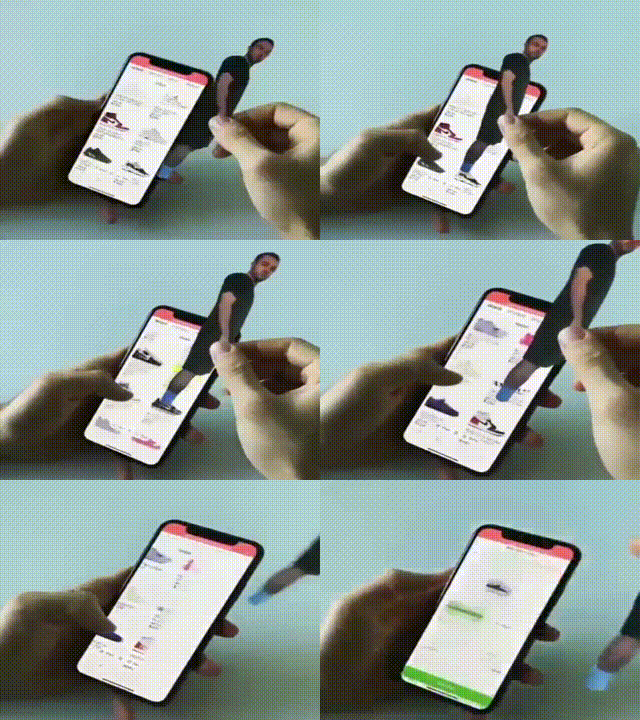
Your potential customer needs an external factor to rely on to make a decision — and this is where social proof steps in.
The key to having effective social proof is using specific and authentic user-generated content (such as reviews) in your ads that are targeted to warm audiences. Your warm audiences are people who are already familiar with your products and just need a bit of a nudge to make that purchase.
Your Facebook campaigns can contain reviews that are not too in-your-face or too dry and unexciting. Although reviews are not exactly reactions or shares on your actual ad, they still showcase how other people love your brand and your products.
You can fit these testimonials into your ad copy or creative image into your actual ad depending on the length. Here are 4 stunning social proof examples used in Facebook ads.
Review in headline:

Review in ad:
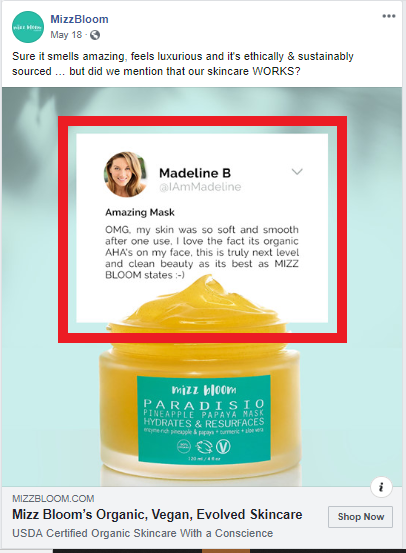
Review in ad text:


Yup, you read that right — Facebook has ad text rules that you need to be wary of before running your campaign.
Facebook’s advertising guidelines include a 20 percent text rule. This specifically means that your image text cannot take up more than 20 percent of the photo. Facebook typically suggests no more than 500 characters and an image that is 400x400 pixels for News Feed ads, simply because they perform and drive results better.
Keep in mind that you can test your ad photos with Facebook’s Text Overlay Tool and see if they fit the standards before officially running your Facebook ads.
How will you use social proof to engage audiences?

Brand awareness is the foundation of every marketing funnel. Before a prospect can evaluate your product, request a demo, or make a purchase, they need to know you exist. Social media remains one of the most effective and cost-efficient channels for building that initial awareness, particularly for DTC brands and growth-stage companies operating with limited budgets.
But posting content and hoping for the best is not a strategy. Building brand awareness through social media requires deliberate choices about platforms, content formats, community management, and measurement. Below is a framework for doing it well.
Many growth teams focus exclusively on bottom-of-funnel metrics: cost per acquisition, ROAS, and conversion rates. These metrics matter, but they measure the output of a system that depends on a healthy top of funnel. Without sustained brand awareness efforts, your bottom-of-funnel campaigns gradually lose efficiency as audiences fatigue and acquisition costs climb.
Brand awareness creates three compounding advantages:
Understanding where awareness sits in the marketing funnel helps you allocate budget and creative resources appropriately across the customer journey.
Not every social platform serves every brand equally. The right platform depends on where your target audience spends time, what content format suits your product, and how much creative capacity your team can sustain.
The biggest mistake brands make is spreading themselves across every platform simultaneously. Start with one or two platforms where your audience is most concentrated, build a sustainable publishing cadence, then expand once you have validated your content approach.
Awareness content is not sales content. The goal at the top of the funnel is to deliver value, entertain, or educate, not to push a product. Brands that lead with value earn attention. Brands that lead with sales pitches get ignored.
Allocate roughly 80 percent of your social content to value-driven posts (education, entertainment, community engagement) and 20 percent to direct promotion (product launches, sales, offers). This ratio builds trust and keeps your audience engaged rather than fatigued by constant selling.
Educational Content. Teach your audience something useful that connects to your product category. A skincare brand might explain how to read ingredient labels. A marketing agency might share a framework for ad creative testing. Educational content positions your brand as an authority and creates shareability.
Behind-the-Scenes Content. Show how your product is made, introduce team members, or document the building of a new feature. This type of content humanizes your brand and creates emotional connection. People buy from brands they feel they know.
User-Generated Content (UGC). Customers sharing their experience with your product is the most credible form of social proof. Encourage UGC through branded hashtags, post-purchase emails requesting reviews, and re-sharing customer content with credit. UGC also performs exceptionally well as paid ad creative.
Trend Participation. Engaging with trending audio, challenges, and formats on TikTok and Reels puts your brand in front of audiences who are not yet following you. The key is relevance - participate in trends that connect naturally to your brand rather than forcing a fit.
Community and Engagement Posts. Polls, questions, this-or-that comparisons, and reply-bait posts generate comments and shares, which signal engagement to algorithms and extend organic reach.
There is a critical difference between an audience and a community. An audience watches. A community participates. Brands that build community around their product create a self-sustaining awareness engine where members introduce new people to the brand organically.
Community building is a long game. It does not produce overnight spikes in follower count. But the brands with the strongest communities have the lowest acquisition costs and the highest lifetime customer values.
Influencer marketing, when done correctly, is one of the fastest ways to generate brand awareness with a target audience you have not yet reached. The key phrase is "when done correctly." Poorly aligned partnerships waste budget and can damage brand perception.
Organic reach on most social platforms has declined significantly over the past several years. Brands that rely exclusively on organic posting limit their awareness ceiling. A smart paid amplification strategy extends the reach of your best-performing organic content to new, targeted audiences.
The combination of strong organic content and strategic paid amplification creates a growth marketing channel that scales efficiently. Organic builds the content engine. Paid extends its reach.
Brand awareness is harder to measure than direct response, but it is not unmeasurable. The key is identifying the right leading indicators and tracking them consistently over time.
Avoid vanity metrics in isolation. A million impressions mean nothing if those impressions do not reach your target audience. Align your awareness metrics with business outcomes by tracking the correlation between awareness activity and downstream conversion rates.
Social media brand awareness is not built overnight. It is built through consistent, value-driven content published on the right platforms, supported by community engagement and strategic paid amplification. The brands that invest in awareness today build the audience that sustains growth tomorrow.
Choose one or two platforms, commit to a sustainable content cadence, engage authentically with your community, and measure what matters. Brand awareness is not a vanity exercise. It is the foundation of a marketing engine that compounds over time.


.svg)