








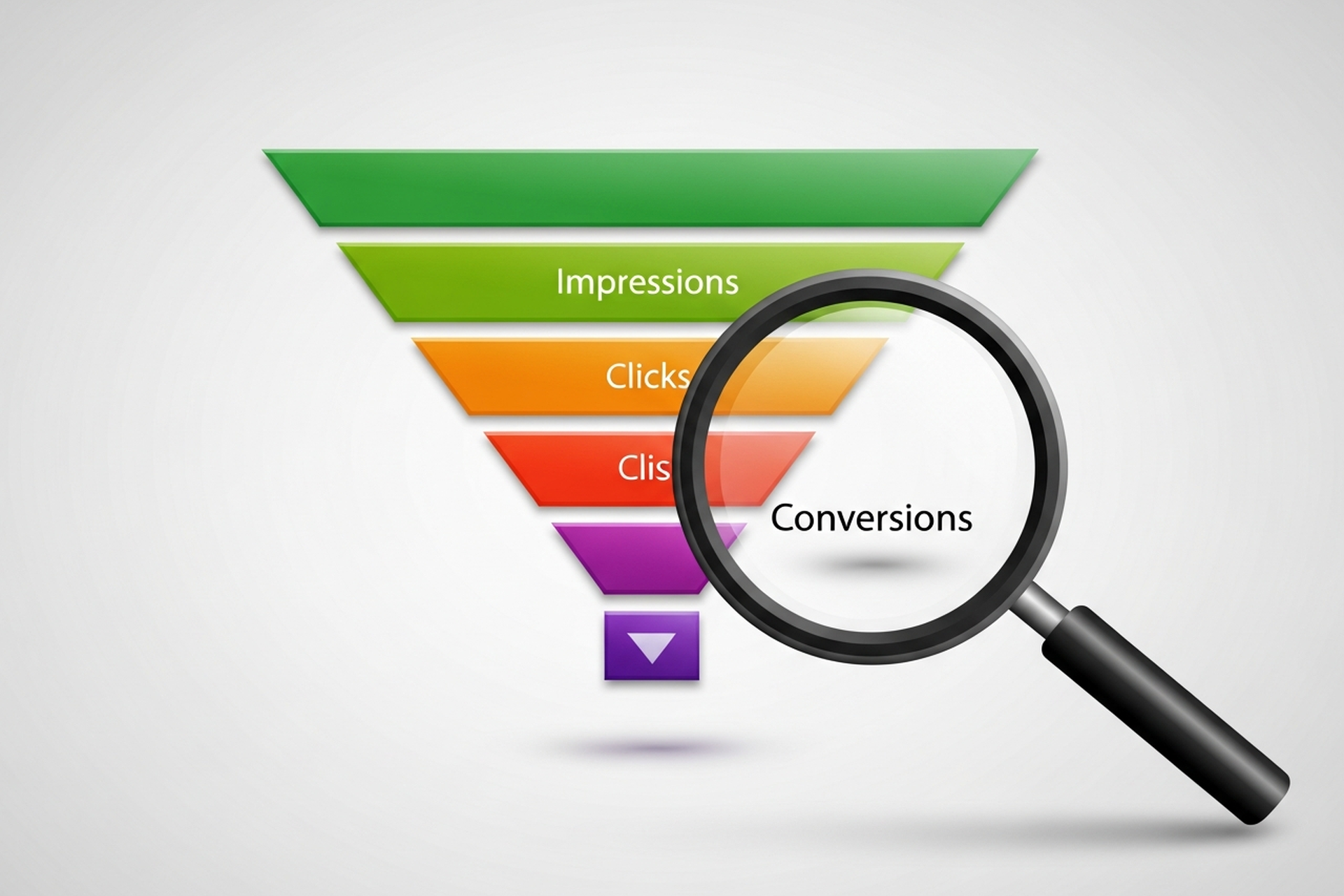
If you're spending money on paid media or investing in content to drive organic traffic, conversion rate optimisation is the discipline that determines whether that traffic actually turns into revenue. Done well, CRO compounds your existing acquisition investment — you get more customers from the same traffic, without needing proportionally more spend.
Conversion rate optimisation (note the British spelling — this is how the keyword is commonly searched, and how teams across the UK, Australia, and much of Europe refer to the practice) is one of the highest-ROI investments a growth-stage brand can make. Yet it's often deprioritised in favour of acquisition channels that are more immediately visible.
This guide explains what conversion rate optimisation actually is, how it works in practice, which tools matter, and how to build a CRO programme that generates compounding returns.
Defining Conversion Rate Optimisation
Conversion rate optimisation is the systematic process of increasing the percentage of website visitors who complete a desired action — a purchase, a sign-up, a demo request, a form submission.
The conversion rate itself is simple to calculate:
Conversion Rate = (Conversions ÷ Total Visitors) × 100
If your store receives 10,000 visitors per month and 200 of them purchase, your conversion rate is 2%. CRO is the discipline of understanding why the other 9,800 didn't convert — and systematically fixing it.
What CRO is not is a collection of random button-colour tweaks. Real conversion rate optimisation is a research-driven, hypothesis-led methodology that produces learning as well as results. Even a test that doesn't improve conversion rate is valuable if it teaches you something about why visitors behave the way they do.
Why Conversion Rate Optimisation Matters
The economics of CRO are compelling compared to acquisition-focused alternatives.
Doubling your traffic through paid media doubles your ad spend. Doubling your conversion rate doubles your revenue from the same traffic. In practice, getting from a 1.5% to a 3.0% conversion rate is faster and cheaper than doubling your qualified traffic — and the improvement is permanent rather than dependent on ongoing spend.
Consider a store with 20,000 monthly visitors, a 1.5% conversion rate, and a £60 AOV:
- Current revenue: 300 orders × £60 = £18,000/month
- At 2.5% CVR (same traffic): 500 orders × £60 = £30,000/month
A one percentage point improvement in conversion rate produces £12,000 in additional monthly revenue without a single additional pound of ad spend. That's the return profile that makes CRO so powerful for growth-stage ecommerce and DTC brands.
The CRO Process: Research → Hypothesis → Test → Analyse → Iterate
The best conversion rate optimisation teams operate as a structured research function, not a testing team. The process looks like this:
Step 1: Research and Diagnosis
Before you test anything, you need to understand where and why visitors are dropping off. This means:
- Quantitative analysis: Funnel analysis in Google Analytics, session recordings, heatmaps, and scroll maps that show exactly where users leave
- Qualitative research: On-site surveys, exit-intent surveys, and customer interviews that reveal why users are hesitating or leaving
- Technical audit: Page speed (a 1-second delay in load time reduces conversions by up to 7%), mobile experience gaps, checkout friction points
This research phase is where most CRO programmes stumble. Teams jump to testing without first understanding the actual problem — and end up testing solutions to problems that don't exist.
Step 2: Hypothesis Formation
A good CRO hypothesis follows a specific structure:
"We believe that [specific change] will [expected outcome] because [evidence or reasoning]. We'll know it worked if [measurable metric] improves."
For example: "We believe that adding a 30-day returns guarantee to the product page hero will increase add-to-cart rate because customer interviews show purchase hesitation is primarily driven by returns uncertainty. We'll know it worked if add-to-cart rate improves by 10%+."
This structure keeps experiments focused and ensures that every test — whether it wins or loses — produces actionable learning.
Step 3: Experiment Design
The most common CRO test format is A/B testing — showing one version of a page to 50% of visitors and a variant to the other 50%, then measuring which version produces a higher conversion rate.
For more complex changes involving multiple elements, multivariate testing allows you to test combinations simultaneously — but requires significantly more traffic to reach statistical significance.
A common mistake is running tests for too short a period. Traffic and conversion patterns vary by day of week, time of month, and seasonal factors. Most tests need a minimum of two full business cycles (typically two to four weeks) before results are reliable.
Step 4: Analysis and Learning
When a test concludes, the analysis should go beyond "did it win or lose?" Ask:
- What segment of users showed the strongest response?
- Did the change affect different devices differently?
- What does the result imply about what drives purchase decisions for our audience?
A test that loses overall may reveal that a specific user segment (mobile users, returning visitors, users from organic search) responded positively — leading to a more targeted follow-up test.
Step 5: Implement and Iterate
Winning tests should be implemented permanently and documented clearly. Every CRO programme should maintain a library of test results that new experiments can reference — so the programme builds on its own learning over time rather than starting from scratch with each test cycle.
The Highest-Impact Areas for CRO
Not all pages and elements are equal. The areas that typically yield the greatest conversion rate improvement:
Product pages: Hero imagery, trust signals (reviews, guarantees, security badges), product descriptions focused on outcomes rather than features, variant selection clarity
Checkout flow: Form length, payment method options, shipping cost transparency, order summary clarity, guest checkout availability
Landing pages: Headline and value proposition alignment with traffic source, above-the-fold CTA clarity, page load speed on mobile
Cart and bag pages: Abandoned cart drivers (shipping cost shock is the most common), cross-sell placement, urgency signals
Site navigation and search: Can users find what they're looking for? Poor navigation is a conversion killer that's easy to overlook.
Essential CRO Tools for 2026
A complete CRO tech stack typically requires four categories of tools:
Analytics (Quantitative)
Google Analytics 4 — free, covers traffic, funnel events, and conversion tracking. Essential baseline for any CRO programme.
Behaviour Analytics (Qualitative)
Hotjar or Microsoft Clarity (free) — heatmaps, session recordings, and on-site surveys. These tools show you how users interact with pages, which quantitative analytics alone can't reveal.
A/B Testing
VWO (Visual Website Optimizer) — a full-stack testing platform that covers A/B testing, multivariate tests, split URL tests, and personalisation. One of the most widely used CRO platforms across ecommerce and SaaS. Other options include Optimizely (enterprise) and AB Tasty.
Customer Feedback
On-site survey tools (Hotjar, Typeform, or Medallia) that capture exit intent and post-purchase feedback. The qualitative data from surveys often generates the most actionable hypotheses.
Common CRO Mistakes to Avoid
Testing too many changes at once: If you change the headline, the hero image, the CTA colour, and the product description simultaneously, you won't know which change drove the result.
Stopping tests too early: A test that appears to be winning in week one often converges toward parity by week three. Statistical significance requires patience.
Ignoring mobile: In most ecommerce categories, mobile accounts for 60–70%+ of traffic. A page that converts well on desktop but fails on mobile is still failing.
Treating all traffic equally: A visitor arriving from a branded search query has very different intent than one arriving from a generic informational post. Conversion rate benchmarks should be segmented by traffic source, not just measured as a site-wide average.
Skipping the research phase: Running tests without first understanding why users aren't converting is like writing solutions before diagnosing the problem. The research phase isn't optional — it's what makes your tests likely to succeed.
Building a CRO Programme That Compounds
Individual test wins are valuable. A systematic CRO programme is transformative. The difference is whether your testing generates accumulated learning — a growing body of insight about your specific customers, their objections, their decision triggers, and what makes them trust your brand.
At EmberTribe, conversion rate optimisation sits at the centre of how we approach growth for ecommerce and DTC clients — because improving conversion makes every other channel more efficient. A higher CVR means paid media generates more revenue from the same spend, organic traffic converts into customers at a higher rate, and email flows close more of the customers who were already considering.
The goal isn't a single winning test. It's a programme that makes your business structurally more profitable over time.
For more on applying CRO principles in practice, see our guide to ecommerce conversion rate optimisation tactics and our breakdown of the ecommerce analytics metrics that drive decisions.

.webp)

.svg)


