
Building an ecommerce business that survives launch is one challenge. Building one that compounds past $1 million, scales past $5 million, and still grows at $10 million is a completely different problem. The data confirms this: roughly 80 to 90% of ecommerce businesses fail within their first few years, and of those that survive, only a fraction break through meaningful revenue thresholds.
The gap between stores that plateau and brands that scale is not product quality. It is structural, rooted in business model selection, unit economics discipline, and the specific levers operators pull at each growth stage.
This post is not about how to get started. It focuses on how to build for longevity once you are past the initial setup and ready to grow deliberately.
The business model you choose determines your ceiling before you acquire a single customer. Each model carries distinct margin structures, scalability characteristics, and unit economics requirements. Choosing the wrong one for your product category and capital position is one of the most common and costly early mistakes.
Direct-to-consumer (DTC) is the highest-potential model for brands with differentiated products and strong creative capabilities. Gross margins typically run 50 to 70%, and the brand owns the customer relationship entirely. Customer acquisition costs average $68 to $84 across ecommerce categories in 2025, according to Swell's DTC ecommerce benchmark report, and those costs have risen 40 to 60% since 2023. DTC rewards brands that generate organic demand, not just those buying paid traffic.
Marketplace selling (Amazon, Walmart, Target Plus) trades margin for distribution. Gross margins compress to 20 to 40% after fees, but the built-in traffic removes much of the acquisition cost burden. The fundamental limitation: the customer belongs to the marketplace, not the brand. Marketplace brands that do not build a parallel DTC presence are renting their customer base indefinitely.
Subscription is the highest-LTV model when executed in the right category. Replenishment products, curated boxes, and software-adjacent physical goods all work well in this structure. Gross margins of 60 to 80% are achievable, and the predictable recurring revenue dramatically improves cash flow planning. The challenge is churn: brands that grow subscriber counts without managing churn simply acquire and replace customers in an expensive loop.
Dropshipping has the lowest barrier to entry and the lowest ceiling. Gross margins of 10 to 30% leave almost no room for paid acquisition at current CAC levels. According to TrueProfit's 2026 dropshipping analysis, only 1 to 5% of dropshippers build a profitable, sustainable business. The model can work as a low-capital test vehicle but rarely supports a brand at meaningful scale.
B2B ecommerce offers the strongest LTV by absolute dollar amount. Longer sales cycles extend CAC payback to 120 to 365 days, but deal sizes and contract values compress LTV:CAC ratios to 4:1 to 8:1 once accounts are established. B2B ecommerce rewards brands that can build product catalogs and customer portals that reduce reorder friction.
The table below summarizes the key unit economics benchmarks by model.
Most ecommerce businesses that plateau are not failing at marketing. They are failing at math. The brands that scale have a clear, repeatable understanding of three numbers: gross margin per order, LTV:CAC ratio, and CAC payback period.
Gross margin is the foundation. Before any marketing spend, the product needs to carry enough margin to support acquisition, fulfillment, and platform costs while leaving a contribution to growth. For DTC brands targeting paid social as a primary channel, gross margins below 50% create a structural problem: there is not enough margin per unit to absorb rising ad costs and still generate profit. Brands with margins below 40% typically need either very high purchase frequency (subscription mechanics) or very low CAC (strong organic channels) to make the math work.
LTV:CAC ratio is the measure of business model health. A 3:1 ratio means the brand generates three dollars of lifetime revenue for every dollar spent acquiring a customer. According to Eightx's 2026 LTV:CAC guide, 3:1 is the minimum threshold for sustainable growth, and 4:1 or higher signals a strong model. Ratios below 3:1 require either lower CAC (better creative, organic channels) or higher LTV (improved retention, higher AOV, cross-sell penetration).
CAC payback period is the timing metric that determines cash requirements. A brand paying $80 to acquire a customer who generates $30 in gross margin on the first order needs 2.7 orders before recovering acquisition cost. If those orders take 18 months, the brand needs enough capital to fund that gap across its entire customer base. Compressing payback by improving conversion rates, increasing AOV through bundles, and activating repeat purchase flows within 30 to 60 days is one of the highest-leverage moves available to growth-stage operators.
Repeat purchase rate is the underlying driver of all three metrics. Health and beauty brands achieve repeat purchase rates around 21.5% in the first year, according to AdZeta's LTV:CAC benchmark analysis. Brands with structured post-purchase flows, SMS programs, and loyalty mechanics see rates 30 to 50% higher than category averages.
For context on what those flows look like in practice, the ecommerce digital marketing framework covers the channel mix that drives repeat purchase at each stage.
Ecommerce brands that scale past $5 million are almost always doing at least two of the following four things systematically.
Owned channel depth. Brands that scale have large, engaged email and SMS lists. These are not vanity metrics. Every subscriber on a retention channel is a future customer who costs near zero to re-engage. Brands allocating 25 to 30% of marketing resources to owned channel growth consistently outperform acquisition-only operators on efficiency metrics.
The customer loyalty program framework is one structured approach to building owned channel depth alongside transactional retention.
Creative velocity. Paid acquisition at scale is a creative problem, not a targeting problem. Brands that maintain a library of 15 to 25 tested creative concepts, rotate regularly, and have a production system for net-new assets sustain paid channel efficiency far longer than brands running two or three ads. Creative fatigue is the primary driver of paid CAC increases at the $500,000 to $2 million annual spend level.
Product expansion with retention in mind. The brands that move from $2 million to $10 million almost always have expanded their product line to increase purchase frequency or introduced a subscription or replenishment mechanic. A one-product brand cannot increase purchase frequency, which means it depends entirely on new customer acquisition to grow. Every dollar of revenue requires a new customer. A product line that gives customers a reason to return every 60 to 90 days changes the economic model entirely.
Margin protection at scale. This one is counterintuitive. Many ecommerce brands that hit $3 to $5 million in revenue see margins compress because they discount aggressively to hit revenue targets, or because unit costs fail to improve with volume. Brands that scale sustainably protect gross margins by negotiating supplier terms at volume and reducing returns through better sizing and photography. Discounting as the primary retention lever trains customers to wait for sales and permanently erodes the margin structure the business was built on.
The ecommerce growth data consistently points to the same pattern: brands that scale through $1 million, $5 million, and $10 million thresholds have built systems, not just stores. They have a documented acquisition channel with known CAC and conversion benchmarks. They have a retention stack that activates automatically after every purchase.
They also have a gross margin floor below which no promotional activity is approved, and a product expansion strategy that increases LTV without increasing acquisition cost.
The brands that plateau have usually succeeded at product selection and initial launch, but have not built the operational and financial infrastructure to grow without proportionally increasing headcount and spend. Every incremental dollar of revenue costs roughly the same as the last because nothing compounds. The difference between those two states is almost always one of deliberate systems investment, not better marketing or better products.
For ecommerce brands working on the content and performance marketing infrastructure that drives compounding growth, EmberTribe builds the acquisition and retention programs that move the metrics above the thresholds that predict scale.

Building an ecommerce business that survives launch is one challenge. Building one that compounds past $1 million, scales past $5 million, and still grows at $10 million is a completely different problem. The data confirms this: roughly 80 to 90% of ecommerce businesses fail within their first few years, and of those that survive, only a fraction break through meaningful revenue thresholds.
The gap between stores that plateau and brands that scale is not product quality. It is structural, rooted in business model selection, unit economics discipline, and the specific levers operators pull at each growth stage.
This post is not about how to get started. It focuses on how to build for longevity once you are past the initial setup and ready to grow deliberately.
The business model you choose determines your ceiling before you acquire a single customer. Each model carries distinct margin structures, scalability characteristics, and unit economics requirements. Choosing the wrong one for your product category and capital position is one of the most common and costly early mistakes.
Direct-to-consumer (DTC) is the highest-potential model for brands with differentiated products and strong creative capabilities. Gross margins typically run 50 to 70%, and the brand owns the customer relationship entirely. Customer acquisition costs average $68 to $84 across ecommerce categories in 2025, according to Swell's DTC ecommerce benchmark report, and those costs have risen 40 to 60% since 2023. DTC rewards brands that generate organic demand, not just those buying paid traffic.
Marketplace selling (Amazon, Walmart, Target Plus) trades margin for distribution. Gross margins compress to 20 to 40% after fees, but the built-in traffic removes much of the acquisition cost burden. The fundamental limitation: the customer belongs to the marketplace, not the brand. Marketplace brands that do not build a parallel DTC presence are renting their customer base indefinitely.
Subscription is the highest-LTV model when executed in the right category. Replenishment products, curated boxes, and software-adjacent physical goods all work well in this structure. Gross margins of 60 to 80% are achievable, and the predictable recurring revenue dramatically improves cash flow planning. The challenge is churn: brands that grow subscriber counts without managing churn simply acquire and replace customers in an expensive loop.
Dropshipping has the lowest barrier to entry and the lowest ceiling. Gross margins of 10 to 30% leave almost no room for paid acquisition at current CAC levels. According to TrueProfit's 2026 dropshipping analysis, only 1 to 5% of dropshippers build a profitable, sustainable business. The model can work as a low-capital test vehicle but rarely supports a brand at meaningful scale.
B2B ecommerce offers the strongest LTV by absolute dollar amount. Longer sales cycles extend CAC payback to 120 to 365 days, but deal sizes and contract values compress LTV:CAC ratios to 4:1 to 8:1 once accounts are established. B2B ecommerce rewards brands that can build product catalogs and customer portals that reduce reorder friction.
The table below summarizes the key unit economics benchmarks by model.
Most ecommerce businesses that plateau are not failing at marketing. They are failing at math. The brands that scale have a clear, repeatable understanding of three numbers: gross margin per order, LTV:CAC ratio, and CAC payback period.
Gross margin is the foundation. Before any marketing spend, the product needs to carry enough margin to support acquisition, fulfillment, and platform costs while leaving a contribution to growth. For DTC brands targeting paid social as a primary channel, gross margins below 50% create a structural problem: there is not enough margin per unit to absorb rising ad costs and still generate profit. Brands with margins below 40% typically need either very high purchase frequency (subscription mechanics) or very low CAC (strong organic channels) to make the math work.
LTV:CAC ratio is the measure of business model health. A 3:1 ratio means the brand generates three dollars of lifetime revenue for every dollar spent acquiring a customer. According to Eightx's 2026 LTV:CAC guide, 3:1 is the minimum threshold for sustainable growth, and 4:1 or higher signals a strong model. Ratios below 3:1 require either lower CAC (better creative, organic channels) or higher LTV (improved retention, higher AOV, cross-sell penetration).
CAC payback period is the timing metric that determines cash requirements. A brand paying $80 to acquire a customer who generates $30 in gross margin on the first order needs 2.7 orders before recovering acquisition cost. If those orders take 18 months, the brand needs enough capital to fund that gap across its entire customer base. Compressing payback by improving conversion rates, increasing AOV through bundles, and activating repeat purchase flows within 30 to 60 days is one of the highest-leverage moves available to growth-stage operators.
Repeat purchase rate is the underlying driver of all three metrics. Health and beauty brands achieve repeat purchase rates around 21.5% in the first year, according to AdZeta's LTV:CAC benchmark analysis. Brands with structured post-purchase flows, SMS programs, and loyalty mechanics see rates 30 to 50% higher than category averages.
For context on what those flows look like in practice, the ecommerce digital marketing framework covers the channel mix that drives repeat purchase at each stage.
Ecommerce brands that scale past $5 million are almost always doing at least two of the following four things systematically.
Owned channel depth. Brands that scale have large, engaged email and SMS lists. These are not vanity metrics. Every subscriber on a retention channel is a future customer who costs near zero to re-engage. Brands allocating 25 to 30% of marketing resources to owned channel growth consistently outperform acquisition-only operators on efficiency metrics.
The customer loyalty program framework is one structured approach to building owned channel depth alongside transactional retention.
Creative velocity. Paid acquisition at scale is a creative problem, not a targeting problem. Brands that maintain a library of 15 to 25 tested creative concepts, rotate regularly, and have a production system for net-new assets sustain paid channel efficiency far longer than brands running two or three ads. Creative fatigue is the primary driver of paid CAC increases at the $500,000 to $2 million annual spend level.
Product expansion with retention in mind. The brands that move from $2 million to $10 million almost always have expanded their product line to increase purchase frequency or introduced a subscription or replenishment mechanic. A one-product brand cannot increase purchase frequency, which means it depends entirely on new customer acquisition to grow. Every dollar of revenue requires a new customer. A product line that gives customers a reason to return every 60 to 90 days changes the economic model entirely.
Margin protection at scale. This one is counterintuitive. Many ecommerce brands that hit $3 to $5 million in revenue see margins compress because they discount aggressively to hit revenue targets, or because unit costs fail to improve with volume. Brands that scale sustainably protect gross margins by negotiating supplier terms at volume and reducing returns through better sizing and photography. Discounting as the primary retention lever trains customers to wait for sales and permanently erodes the margin structure the business was built on.
The ecommerce growth data consistently points to the same pattern: brands that scale through $1 million, $5 million, and $10 million thresholds have built systems, not just stores. They have a documented acquisition channel with known CAC and conversion benchmarks. They have a retention stack that activates automatically after every purchase.
They also have a gross margin floor below which no promotional activity is approved, and a product expansion strategy that increases LTV without increasing acquisition cost.
The brands that plateau have usually succeeded at product selection and initial launch, but have not built the operational and financial infrastructure to grow without proportionally increasing headcount and spend. Every incremental dollar of revenue costs roughly the same as the last because nothing compounds. The difference between those two states is almost always one of deliberate systems investment, not better marketing or better products.
For ecommerce brands working on the content and performance marketing infrastructure that drives compounding growth, EmberTribe builds the acquisition and retention programs that move the metrics above the thresholds that predict scale.

Hiring a marketing agency is one of the highest-stakes vendor decisions a growth-stage company makes. Get it right and you compress months of channel development into weeks. Get it wrong and you spend a quarter paying for deliverables that don't move the needle, then burn more time unwinding the relationship.
The challenge is that "marketing agency" describes an enormous range of organizations — from a two-person boutique specializing in email sequences to a 400-person integrated firm managing nine-figure ad budgets. Picking between them without a clear framework leads to mismatched expectations on both sides.
This guide gives you that framework: what types of marketing agencies exist, when it makes more sense to hire in-house, and what separates agencies worth working with from the rest.
Understanding agency types is the first step to knowing which one fits your situation.
Full-service agencies cover strategy, creative, paid media, SEO, content, and analytics under one roof. The appeal is coordination — you get one account team managing an integrated program rather than juggling multiple vendors.
The tradeoff is depth. Full-service agencies spread their expertise across many disciplines, which means they're rarely the sharpest practitioners in any single channel. They work best for companies with diverse channel needs and large enough budgets to warrant the overhead.
Performance agencies specialize in paid acquisition — Google Ads, Meta, programmatic display, and increasingly connected TV. They're built around ROAS, CAC, and MER optimization and tend to operate with tighter feedback loops and more rigorous testing than generalist shops.
For ecommerce brands and DTC companies where paid media drives the majority of revenue, a performance specialist often outperforms a full-service agency on the channels that matter most. Google's own Smart Bidding documentation underscores how much campaign-level strategic oversight matters — automation amplifies good structure, but it doesn't replace it.
These agencies focus on organic growth — keyword strategy, content production, technical SEO, and link building. The economics are compelling over a 12-to-24-month horizon (traffic compounds without ongoing ad spend), but the timeline to meaningful results is longer than most early-stage companies can tolerate.
SEO agencies work best for companies with at least 6–12 months of runway and a content-driven customer acquisition model.
Social agencies specialize in organic social content, community management, paid social (sometimes), and influencer partnerships. The best ones understand both the creative and the distribution sides of social — the worst ones produce content without any performance accountability.
Be cautious of agencies that separate "organic social" and "paid social" into entirely different offerings — the two should inform each other.
Growth agencies operate across the full funnel — acquisition, conversion, retention — and are defined less by channel and more by a testing-and-iteration methodology. They're typically a better fit for companies that need strategic direction alongside execution, rather than pure channel specialists.
The distinction from a full-service agency: growth agencies are generally smaller, more senior, and more accountable to business outcomes rather than deliverable volume.
This is the question companies get wrong most often, and the answer depends almost entirely on your growth stage.
Before you've validated your core message and conversion funnel, an agency is almost always the wrong move. Agencies require clear direction to be effective — if you don't yet know who your customer is, what drives their decision, and what messaging resonates, you'll spend months paying for campaigns that teach you very little.
At this stage, hire a versatile in-house marketer (or a fractional CMO) who can run experiments quickly and is close enough to the product to iterate the message in real time.
This is the sweet spot for agency engagement. You know your customer, your conversion funnel is working at a basic level, and the question is how to scale acquisition efficiently across channels. An agency can compress the learning curve significantly — they've seen what works across dozens of similar businesses and can apply that pattern recognition to your situation.
At this stage, look for agencies with demonstrable experience in your category and a clear testing-and-optimization methodology. The best ones will tell you within the first 60 days what's working, what isn't, and why. The DTC landscape in particular is demanding: customer acquisition costs have risen 222% over the past eight years, which means a poorly structured agency relationship compounds the damage quickly.
At scale, the value of an agency shifts from execution to decision-quality. You likely have in-house capability on your core channels. What you need is a partner who can improve measurement infrastructure, accountability frameworks, and coordination across a more complex channel mix.
At this stage, a specialist agency that improves one channel meaningfully often generates more ROI than a full-service relationship that spreads across everything.
Regardless of type, strong agencies share a common set of operational characteristics.
Clear accountability to revenue metrics: The agency's reporting should speak the language of your P&L — CAC, LTV, ROAS, pipeline contribution — not just traffic and impressions. If their default reporting is engagement-focused, their incentives are misaligned with your growth. For ecommerce brands, that means tying reporting to actual purchase conversion rates, which vary widely by category and traffic source — not blended traffic metrics that hide where problems actually live.
Documented process, not just talent: Great agencies have repeatable systems — for onboarding, creative testing, campaign management, and performance review. Agencies that depend entirely on individual talent are fragile; the process matters more than any single person.
Relevant experience in your category: Case studies from companies with similar business models, price points, and customer demographics are worth more than impressive names in a deck. Ask for references from clients with a profile similar to yours and follow up.
Transparency over access and data: You should own your ad accounts, analytics properties, and content. Agencies that maintain ownership of campaign infrastructure are creating leverage over you — that's a red flag regardless of their performance.
Honest timelines: Legitimate agencies set realistic expectations. SEO takes 6–12 months. Paid media requires 60–90 days of optimization before you can evaluate performance fairly — Google's Smart Bidding, for instance, needs at least 30 conversions to evaluate performance accurately. Any agency promising significant results in two to four weeks is either misleading you or inheriting a well-built account and claiming credit for existing momentum.
The answers reveal how the agency actually operates. Specificity is a good sign; vagueness is not.
A common mistake is treating in-house and agency as binary choices. Most growth-stage companies run a hybrid: one or two senior in-house marketers who own strategy, channel mix, and reporting — paired with a specialist agency that executes on one or two high-leverage channels. Sagefrog's 2026 B2B Marketing Mix Report confirms this shift — 46% of B2B companies now use a hybrid model, up from 36% the year before, with "faster execution" overtaking "specialized expertise" as the top reason companies bring agencies in.
This structure keeps strategy under your control while getting the benefit of agency expertise and capacity on the execution side. It also gives you a cleaner offboarding path if the agency relationship doesn't work out — because your strategy stays in-house regardless.
At EmberTribe, we've found this hybrid model produces the best outcomes for DTC and ecommerce brands: an internal owner who understands the business deeply, paired with an external team that brings channel-specific depth and creative velocity.
The agencies that consistently deliver are the ones that:
That last point is the most important. A marketing agency should make your marketing program more capable over time, not more dependent on the agency's continued involvement.
The "right" marketing agency isn't necessarily the largest or most well-known. It's the one that has solved the specific problem you're facing, speaks the language of your business stage, and operates with the transparency and accountability you need to make confident decisions.
Take the time to verify claims with real references, review actual reporting (not a sample dashboard), and understand exactly who will be doing the work before you sign.
For more on evaluating specific agency types, see our guides to the best SaaS marketing agencies and the best ecommerce marketing agencies, along with our breakdown of when a fractional CMO makes sense for B2B SaaS companies.
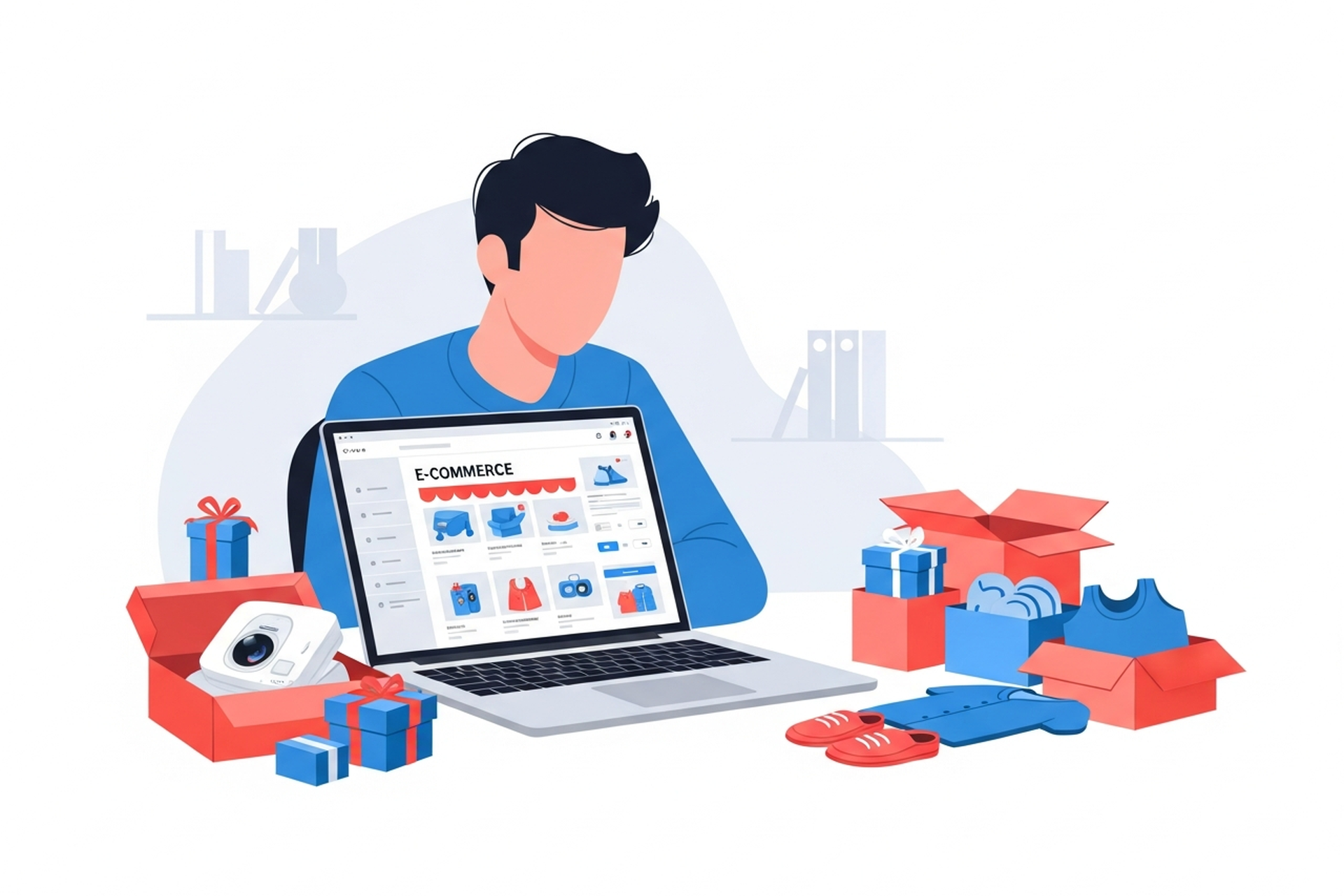
Getting into ecommerce in 2026 has never been more accessible — and never more competitive. Platforms like Shopify have removed most of the technical barriers, payment processing is plug-and-play, and global supplier networks make product sourcing relatively straightforward. The challenge isn't launching a store. The challenge is building one that actually sells.
This guide walks through how to get into ecommerce step by step: picking a model that fits your goals and resources, choosing the right platform, sourcing products, and driving your first traffic.
Before you pick a product or build a store, you need a clear picture of what kind of ecommerce business you're actually building. The model determines your economics, your operational requirements, and your growth ceiling.
You manufacture or source a product, brand it, and sell it directly to consumers through your own online store. No retail middlemen, no marketplace fees — you control the customer relationship, the pricing, and the data.
DTC has the highest margin potential and the highest brand-building ceiling, but it also requires upfront investment in inventory, branding, and customer acquisition. The global DTC market is projected to reach $319.57 billion in 2026, which signals both the opportunity and the competition.
Best for: Entrepreneurs with a specific product idea, domain expertise in a category, or a genuine brand angle.
You list products from a supplier in your store. When a customer orders, the supplier ships directly to them. You never touch inventory.
The appeal is obvious: low startup costs, no inventory risk. The reality is equally obvious: lower margins (typically 15–30%), less control over quality and shipping times, and products that are available from dozens of other stores. Dropshipping can work as a starting point or for validating product demand, but it's difficult to build a defensible brand on a dropshipping-only model.
Best for: Testing product demand before committing to inventory, or supplementing an existing brand with extended product range.
Rather than building your own store, you list products on existing marketplaces with built-in traffic. Lower barrier to entry — you skip the challenge of driving traffic from scratch — but you're competing on a crowded platform with thin differentiation and marketplace fees of 8–15%.
Best for: Validating products quickly, or businesses where marketplace SEO (particularly Amazon) is a core acquisition strategy.
You source generic products from manufacturers (often overseas), brand them with your own labels and packaging, and sell under your brand name. Lower development cost than custom products, higher margin and brand control than dropshipping.
Best for: Entrepreneurs who want brand equity without product development complexity.
If you don't have a specific product idea, the evaluation framework is:
Demand: Is there demonstrable search volume or marketplace demand for this product? Use Google Trends, Amazon bestseller lists, and keyword research tools to validate interest before committing.
Margin viability: Can you source the product at a cost that leaves enough margin to cover shipping, returns, ad spend, and operational costs while remaining price-competitive? As a rough guide, DTC businesses typically target 60–70% gross margin to make paid acquisition economics work.
Repeat purchase potential: Products that get reordered — consumables, supplements, pet food, beauty — have dramatically better lifetime value economics than one-time purchases. If your product is high-ticket and single-purchase, you'll need to prioritize AOV from day one.
Differentiation: What's your angle? "We sell yoga mats" isn't a business. "We sell yoga mats designed specifically for travel athletes, made from recycled materials" is closer to a brand.
For most new ecommerce businesses, the platform decision comes down to Shopify vs. everything else — because Shopify has become the default infrastructure for DTC brands at every stage from $0 to $100M+.
The dominant ecommerce platform for a reason. Shopify handles payments, inventory, shipping integrations, and has thousands of apps for every conceivable use case. The learning curve is gentle — you can have a functional store live in a weekend.
Shopify plans start at $39/month (Basic) through $399/month (Advanced), with Shopify Plus at $2,300+/month for enterprise brands. Transaction fees apply if you don't use Shopify Payments.
Best for: Almost everyone getting started in DTC ecommerce.
WordPress's ecommerce plugin. Highly customizable and no platform fees, but requires more technical comfort than Shopify. Hosting, security, and performance are your responsibility.
Best for: Businesses that already operate a WordPress site or need deep technical customization.
Solid alternatives to Shopify with different feature sets and pricing. Worth evaluating if you have specific requirements Shopify doesn't meet natively.
If marketplace selling is your model, Amazon FBA (Fulfillment by Amazon) is the most powerful distribution option available. FBA handles storage, picking, packing, and shipping. Your products become Prime-eligible. The tradeoff: referral fees of 8–15%, plus FBA fulfillment fees, plus you're building on rented land.
Once model and platform are locked, the foundational setup covers:
Legal structure: Register your business entity (LLC is the most common for US-based ecommerce). Open a separate business bank account. Consult a tax professional on sales tax obligations — nexus rules are complex and vary by state.
Domain and branding: Your domain, logo, brand colors, and brand voice should be established before launch. First impressions are expensive to redo.
Payment processing: Shopify Payments is the simplest option for Shopify stores (includes Visa, Mastercard, Amex, Apple Pay, Google Pay). PayPal is a useful secondary option since some customers trust it more than unfamiliar processors.
Shipping setup: Define your shipping zones, rates, and carriers. Free shipping is often table stakes for conversion — build your pricing to absorb it rather than adding it at checkout.
Return policy: A clear, customer-friendly return policy removes one of the biggest conversion barriers. It also affects how you're rated on marketplaces.
The pages every ecommerce store needs:
Before launch, run through your own checkout as a customer on both desktop and mobile. Mobile drives the majority of ecommerce traffic, and a clunky mobile checkout will kill your conversion rate from day one.
Traffic is the universal challenge for new stores. The options in roughly ascending order of effort and time:
Short-form video on TikTok, Instagram Reels, and YouTube Shorts is the highest-leverage free traffic channel for ecommerce in 2026. The platforms reward authentic, product-focused content — showing how the product works, behind-the-scenes sourcing, before-and-after demonstrations. User-generated content performs particularly well.
The caveat: organic social builds slowly. It's worth starting on day one, but don't bank on it for revenue in months 1–3.
The fastest way to get qualified traffic to a new store. Meta (Facebook/Instagram) and TikTok allow you to target audiences by interest, behavior, and demographics, then test your product-market fit in real time with real dollars.
Start with a small budget ($20–$50/day), test multiple creative angles, and treat early ad spend as product and market research. If you can't get your CPA below your gross margin at small scale, fix the funnel before you scale.
Once you have some product and category page SEO in place, Google Shopping campaigns capture high-intent buyers actively searching for products like yours. Slightly more complex to set up than social ads but often more efficient for established products with clear search demand.
Search engine optimization takes time — typically 6–12 months before meaningful organic traffic — but becomes one of your highest-ROI acquisition channels once established. A solid ecommerce SEO strategy built into your store architecture from the start means you're compounding free traffic while you spend on paid channels.
Build your email list from the first day. A welcome discount popup (10–15% off first order) is the standard entry point. Your email list is the only audience you actually own — social platforms can disappear, ad costs can spike, but your email subscribers remain yours.
Most new ecommerce businesses try to do everything at once. Here's what actually matters first:
Once you have early traction and a converting store, growth becomes about the four core levers of ecommerce growth: traffic, conversion rate, average order value, and retention. The brands that scale to $1M and beyond are the ones that build systems around all four — not just pour money into acquisition.
If you're building something with real product-market fit and are ready to scale paid channels, that's typically where an ecommerce marketing agency partnership starts to make economic sense — because the cost of a strategic partner is small relative to the cost of mismanaged ad spend at meaningful scale.
The technical and logistical barriers to starting an ecommerce business have never been lower. The competitive barrier — building something customers actually prefer, marketing it effectively, and keeping them coming back — is as high as it's ever been.
The businesses that succeed in 2026 aren't the ones with the most sophisticated technology stack. They're the ones with a clear brand angle, a product customers genuinely love, and a disciplined approach to growth.
Start with those fundamentals. Everything else is figure-outable.
Most brands searching for an ecommerce marketing agency find the same thing: listicles written by agencies ranking themselves first. The advice is self-serving, the criteria are vague, and the "frameworks" rarely reflect how agency relationships actually work.
This guide is different. It's written by a DTC-focused agency that has worked across hundreds of ecommerce accounts — and it's designed to help you evaluate any agency, including us, with clear eyes. The goal is a good fit, not a signed contract.
The US direct-to-consumer ecommerce market hit approximately $240 billion in 2025, and competition for customer attention has never been more expensive. Roughly 79% of DTC brands now partner with external agencies for at least one marketing function — and the majority report higher customer acquisition costs than three years ago.
That CAC pressure is reshaping what brands actually need from agency partners. The ROAS-obsessed era is fading. Sophisticated operators have shifted their primary metrics to Marketing Efficiency Ratio (MER) and LTV:CAC ratio — measures that capture whole-funnel performance rather than last-click attribution. Agencies still selling on ROAS alone are behind where the market has moved.
At the same time, most ecommerce brands now prioritize first-party data collection as third-party cookie deprecation reshapes targeting options. An agency that doesn't have a concrete answer to your first-party data strategy in 2026 is not operating at the level your business needs.
Understanding this backdrop matters before you evaluate a single agency. The best partner isn't the one with the biggest client list — it's the one that understands the specific conditions your business is competing in right now.
The category is broad enough to be confusing. "Ecommerce marketing agency" can mean a performance media buyer, a full-service growth partner, a creative studio, or an SEO shop — sometimes all four under one roof.
Core services typically include:
Some agencies specialize deeply in one channel. Others take a unified approach across the full funnel. Neither model is inherently better — what matters is whether the agency's scope of work matches where your actual revenue gaps are. A brand with strong organic traffic but poor retention doesn't need another paid media agency. A brand burning budget on underperforming creative doesn't need more media spend.
Before evaluating agencies, get specific about which levers actually move your business.
Not all ecommerce agencies are built the same, and the differences matter when you're making a hiring decision.
These agencies manage multiple channels together and build strategy at the business level, not the channel level. They're built for brands that want a single accountable partner coordinating paid media, SEO, CRO, and creative. The tradeoff is cost — retainers typically run $5,000-$15,000+/month — and the risk that no single channel gets the depth of attention a specialist would bring.
For growth-stage brands above $2M in annual revenue, this model often produces the best results because the channels reinforce each other. A business growth agency operating at this level is making decisions about your whole funnel, not just optimizing a single ad account.
Paid social, paid search, SEO, or email — these agencies go deep on one discipline. They're the right choice when you have specific, isolated problems and existing in-house capacity to manage the broader strategy. They tend to run $2,500-$6,000/month per channel.
The risk: channel specialists can optimize their channel at the expense of your overall economics. An agency that only owns paid social may push spend aggressively without accounting for what's happening downstream in retention or average order value.
Smaller teams — sometimes 5-15 people — that work exclusively with ecommerce or direct-to-consumer brands. They often punch above their weight on strategic thinking because the senior team is directly involved. The constraint is bandwidth; if your account grows significantly, a boutique agency may not scale with you.
These are not agencies in the traditional sense, but they're worth understanding as a comparison point. If you're early-stage or have very narrow needs, an agency vs. freelancer vs. in-house comparison can clarify whether you even need a retained agency relationship at this stage.
The criteria that appear in most agency comparison articles — "proven track record," "transparent reporting," "dedicated account manager" — are table stakes, not differentiators. Every agency claims them. Here's what to actually evaluate.
Ask any agency you're considering: "What's your primary success metric?" If they lead with ROAS, dig deeper. The best agencies in 2026 are measuring MER and blended CAC payback period, because those metrics account for the full cost of acquisition across channels and time.
Case studies from brands in a different category, at a different price point, or at a different growth stage don't tell you much. A $50M fashion brand's media strategy doesn't translate to a $3M supplement brand. Ask for references from businesses similar in size and vertical to yours — and call those references.
Performance without creative strategy is increasingly unsustainable. Platforms like Meta reward novelty and relevance at the creative level. The best ecommerce agencies either have in-house creative capabilities or a structured process for briefing and evaluating creative. An agency that treats creative as someone else's problem will hit a ceiling on your account. See how this applies to finding the right Facebook ads agency for ecommerce.
With third-party signals degrading, the brands that win in paid media are the ones with the best data infrastructure — post-purchase surveys, clean email lists, server-side tracking, and strong CRM practices. Ask how the agency has helped clients build first-party data assets. If the answer is vague, that's a signal.
A weekly dashboard full of impressions, reach, and engagement metrics isn't useful if it doesn't connect to revenue. The best agencies present reporting that answers the question: "What do we do next and why?" Ask to see a sample report before you sign.
The goal of a discovery call isn't to be sold — it's to qualify the agency as rigorously as they're qualifying you.
The quality of the answers matters less than whether they're honest. A good agency will acknowledge uncertainty, point to real constraints, and give you a grounded picture of what to expect. An agency that only has confident, polished answers to hard questions is a red flag.
Some warning signs are obvious — no references, no case studies, vague deliverables. Others are easier to miss:
Long-term contracts with limited exit clauses. Reputable agencies are confident enough in their work to offer 30-90 day out clauses. A 12-month lock-in with steep exit penalties is not a partnership structure.
Overclaiming on attribution. If an agency presents ROAS numbers without acknowledging incrementality questions or platform-reported vs. revenue-reported discrepancies, they're not being rigorous.
Reactive communication as the default. You shouldn't have to chase your agency for updates. Proactive communication — especially when something isn't working — is a baseline expectation.
No honest onboarding timeline. Real results from a new agency relationship typically take 60-90 days to materialize as campaigns are built, tested, and iterated. An agency promising strong returns in week two is setting you up for disappointment.
Pricing structures vary, but here's a realistic picture of the current market: Agency TypeTypical Monthly RetainerChannel specialist (single channel)$2,500 - $5,000Mid-size full-service agency$5,000 - $10,000Senior full-service or boutique DTC$8,000 - $15,000+Performance-based (% of ad spend)10-20% of managed spend
Most agencies combine a base retainer with a performance component at higher spend levels. The cheapest option is rarely the best value — an agency charging $1,500/month to manage your paid media is either running very junior talent on your account or managing too many clients to give your business real attention.
Budget for the tier that matches the revenue at stake. If paid media represents $1M or more in annual revenue influence, the difference between a $3,000/month and $7,000/month agency is not the primary variable in your economics.
Choosing an ecommerce marketing agency is a business decision, not a marketing decision. The right agency is the one whose expertise matches your actual gaps, whose communication style matches how your team operates, and whose incentive structure is aligned with your long-term economics — not short-term spend volume.
The services that matter most depend entirely on where your funnel is breaking down. If paid acquisition is efficient but retention is poor, more media spend won't fix it. If conversion rate is low, investing in CRO or SEO may outperform any new channel investment. If you need to scale paid media profitably, that requires a partner who understands the full picture.
The best agencies will tell you this. The ones to avoid will tell you they can fix everything.
Take your time, ask hard questions, and evaluate the answer quality over the polish. The right partner will hold up to scrutiny — and will appreciate the rigor.


.svg)