






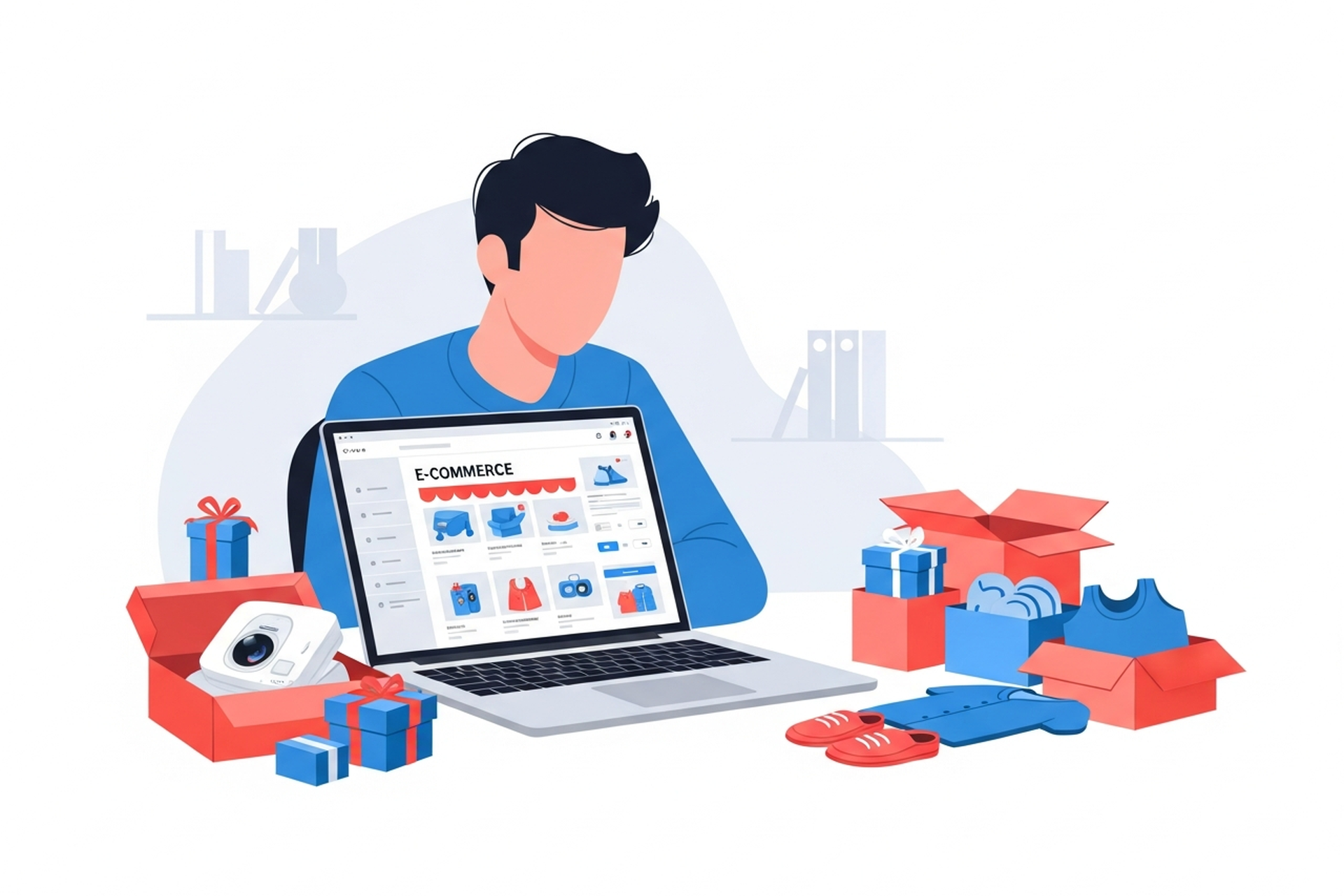
Getting into ecommerce in 2026 has never been more accessible — and never more competitive. Platforms like Shopify have removed most of the technical barriers, payment processing is plug-and-play, and global supplier networks make product sourcing relatively straightforward. The challenge isn't launching a store. The challenge is building one that actually sells.
This guide walks through how to get into ecommerce step by step: picking a model that fits your goals and resources, choosing the right platform, sourcing products, and driving your first traffic.
Step 1: Choose Your Business Model
Before you pick a product or build a store, you need a clear picture of what kind of ecommerce business you're actually building. The model determines your economics, your operational requirements, and your growth ceiling.
Direct-to-Consumer (DTC)
You manufacture or source a product, brand it, and sell it directly to consumers through your own online store. No retail middlemen, no marketplace fees — you control the customer relationship, the pricing, and the data.
DTC has the highest margin potential and the highest brand-building ceiling, but it also requires upfront investment in inventory, branding, and customer acquisition. The global DTC market is projected to reach $319.57 billion in 2026, which signals both the opportunity and the competition.
Best for: Entrepreneurs with a specific product idea, domain expertise in a category, or a genuine brand angle.
Dropshipping
You list products from a supplier in your store. When a customer orders, the supplier ships directly to them. You never touch inventory.
The appeal is obvious: low startup costs, no inventory risk. The reality is equally obvious: lower margins (typically 15–30%), less control over quality and shipping times, and products that are available from dozens of other stores. Dropshipping can work as a starting point or for validating product demand, but it's difficult to build a defensible brand on a dropshipping-only model.
Best for: Testing product demand before committing to inventory, or supplementing an existing brand with extended product range.
Marketplace Selling (Amazon, Etsy, eBay)
Rather than building your own store, you list products on existing marketplaces with built-in traffic. Lower barrier to entry — you skip the challenge of driving traffic from scratch — but you're competing on a crowded platform with thin differentiation and marketplace fees of 8–15%.
Best for: Validating products quickly, or businesses where marketplace SEO (particularly Amazon) is a core acquisition strategy.
Private Label
You source generic products from manufacturers (often overseas), brand them with your own labels and packaging, and sell under your brand name. Lower development cost than custom products, higher margin and brand control than dropshipping.
Best for: Entrepreneurs who want brand equity without product development complexity.
Step 2: Pick Your Product (If You Haven't Already)
If you don't have a specific product idea, the evaluation framework is:
Demand: Is there demonstrable search volume or marketplace demand for this product? Use Google Trends, Amazon bestseller lists, and keyword research tools to validate interest before committing.
Margin viability: Can you source the product at a cost that leaves enough margin to cover shipping, returns, ad spend, and operational costs while remaining price-competitive? As a rough guide, DTC businesses typically target 60–70% gross margin to make paid acquisition economics work.
Repeat purchase potential: Products that get reordered — consumables, supplements, pet food, beauty — have dramatically better lifetime value economics than one-time purchases. If your product is high-ticket and single-purchase, you'll need to prioritize AOV from day one.
Differentiation: What's your angle? "We sell yoga mats" isn't a business. "We sell yoga mats designed specifically for travel athletes, made from recycled materials" is closer to a brand.
Step 3: Choose Your Platform
For most new ecommerce businesses, the platform decision comes down to Shopify vs. everything else — because Shopify has become the default infrastructure for DTC brands at every stage from $0 to $100M+.
Shopify
The dominant ecommerce platform for a reason. Shopify handles payments, inventory, shipping integrations, and has thousands of apps for every conceivable use case. The learning curve is gentle — you can have a functional store live in a weekend.
Shopify plans start at $39/month (Basic) through $399/month (Advanced), with Shopify Plus at $2,300+/month for enterprise brands. Transaction fees apply if you don't use Shopify Payments.
Best for: Almost everyone getting started in DTC ecommerce.
WooCommerce
WordPress's ecommerce plugin. Highly customizable and no platform fees, but requires more technical comfort than Shopify. Hosting, security, and performance are your responsibility.
Best for: Businesses that already operate a WordPress site or need deep technical customization.
BigCommerce and Wix
Solid alternatives to Shopify with different feature sets and pricing. Worth evaluating if you have specific requirements Shopify doesn't meet natively.
Amazon (FBA / Seller Central)
If marketplace selling is your model, Amazon FBA (Fulfillment by Amazon) is the most powerful distribution option available. FBA handles storage, picking, packing, and shipping. Your products become Prime-eligible. The tradeoff: referral fees of 8–15%, plus FBA fulfillment fees, plus you're building on rented land.
Step 4: Set Up the Foundation
Once model and platform are locked, the foundational setup covers:
Legal structure: Register your business entity (LLC is the most common for US-based ecommerce). Open a separate business bank account. Consult a tax professional on sales tax obligations — nexus rules are complex and vary by state.
Domain and branding: Your domain, logo, brand colors, and brand voice should be established before launch. First impressions are expensive to redo.
Payment processing: Shopify Payments is the simplest option for Shopify stores (includes Visa, Mastercard, Amex, Apple Pay, Google Pay). PayPal is a useful secondary option since some customers trust it more than unfamiliar processors.
Shipping setup: Define your shipping zones, rates, and carriers. Free shipping is often table stakes for conversion — build your pricing to absorb it rather than adding it at checkout.
Return policy: A clear, customer-friendly return policy removes one of the biggest conversion barriers. It also affects how you're rated on marketplaces.
Step 5: Build Your Store
The pages every ecommerce store needs:
- Homepage: Communicates your brand proposition, features bestsellers, and gets visitors to product pages quickly
- Product pages: The conversion engine of your store. Great product pages have multiple high-quality images, clear product descriptions with specific features and benefits, social proof (reviews, ratings), and a prominent add-to-cart with urgency elements where appropriate
- Collection pages: Organized browsing by category with filters
- About page: Brand story and values — critical for DTC brands differentiating on mission or founder story
- Contact page: Builds trust and reduces support friction
Before launch, run through your own checkout as a customer on both desktop and mobile. Mobile drives the majority of ecommerce traffic, and a clunky mobile checkout will kill your conversion rate from day one.
Step 6: Drive Your First Traffic
Traffic is the universal challenge for new stores. The options in roughly ascending order of effort and time:
Organic Social
Short-form video on TikTok, Instagram Reels, and YouTube Shorts is the highest-leverage free traffic channel for ecommerce in 2026. The platforms reward authentic, product-focused content — showing how the product works, behind-the-scenes sourcing, before-and-after demonstrations. User-generated content performs particularly well.
The caveat: organic social builds slowly. It's worth starting on day one, but don't bank on it for revenue in months 1–3.
Paid Social (Meta and TikTok Ads)
The fastest way to get qualified traffic to a new store. Meta (Facebook/Instagram) and TikTok allow you to target audiences by interest, behavior, and demographics, then test your product-market fit in real time with real dollars.
Start with a small budget ($20–$50/day), test multiple creative angles, and treat early ad spend as product and market research. If you can't get your CPA below your gross margin at small scale, fix the funnel before you scale.
Google Shopping
Once you have some product and category page SEO in place, Google Shopping campaigns capture high-intent buyers actively searching for products like yours. Slightly more complex to set up than social ads but often more efficient for established products with clear search demand.
SEO
Search engine optimization takes time — typically 6–12 months before meaningful organic traffic — but becomes one of your highest-ROI acquisition channels once established. A solid ecommerce SEO strategy built into your store architecture from the start means you're compounding free traffic while you spend on paid channels.
Email from Day One
Build your email list from the first day. A welcome discount popup (10–15% off first order) is the standard entry point. Your email list is the only audience you actually own — social platforms can disappear, ad costs can spike, but your email subscribers remain yours.
The First 90 Days: What to Focus On
Most new ecommerce businesses try to do everything at once. Here's what actually matters first:
- Get your first 10 sales from people who aren't your friends or family. This validates that strangers are willing to pay for what you're selling.
- Measure your conversion rate from the start. If you're getting traffic but not converting, fix the funnel before you spend more on acquisition.
- Talk to your first customers. Email them, ask why they bought, what almost stopped them, and what they want next. This research is more valuable than any analytics tool.
- Build one acquisition channel to $1,000/month in revenue before diversifying. Trying to run paid search, paid social, SEO, and influencer marketing simultaneously with no data is a fast way to spread thin and learn nothing.
Growing Beyond Your First Sales
Once you have early traction and a converting store, growth becomes about the four core levers of ecommerce growth: traffic, conversion rate, average order value, and retention. The brands that scale to $1M and beyond are the ones that build systems around all four — not just pour money into acquisition.
If you're building something with real product-market fit and are ready to scale paid channels, that's typically where an ecommerce marketing agency partnership starts to make economic sense — because the cost of a strategic partner is small relative to the cost of mismanaged ad spend at meaningful scale.
Getting Into Ecommerce Is the Easy Part
The technical and logistical barriers to starting an ecommerce business have never been lower. The competitive barrier — building something customers actually prefer, marketing it effectively, and keeping them coming back — is as high as it's ever been.
The businesses that succeed in 2026 aren't the ones with the most sophisticated technology stack. They're the ones with a clear brand angle, a product customers genuinely love, and a disciplined approach to growth.
Start with those fundamentals. Everything else is figure-outable.

.webp)

.svg)


