
In the age of rapid digital transformation, AI has seeped into almost every industry, revolutionizing how we conduct business, design products, and even create content. The ClusterMagic service is a great example, which seamlessly integrates AI for content generation in a hybrid model, providing significant benefits in the SEO results of brands seeking a massive increase in organic traffic. But while AI holds immense promise, it has its limitations. Let's explore the pros and cons of using AI for content creation and understand why a hybrid approach might be the way forward.
Major publishers in sensitive niches like CNET.com, Bankrate.com, and Creditcard.com have already integrated AI-generated content. Other large companies, such as CNN and Forbes, might also be doing so. Countless smaller companies and publishers are utilizing AI, not only on their websites but also on social media, in email marketing, and virtually everywhere else.
Google's stance on AI-generated content is neutral, emphasizing that content should primarily be user-centric. In fact, Google's September 2023 Helpful Content Update removed the mention of "written by people" from their helpful content system guidelines.
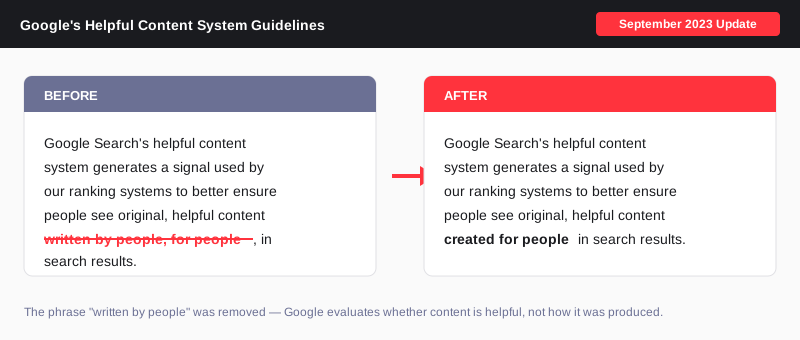
The message is clear: for content to rank well, it must be informative, answer users' queries satisfactorily, and showcase genuine expertise - regardless of how it's created.
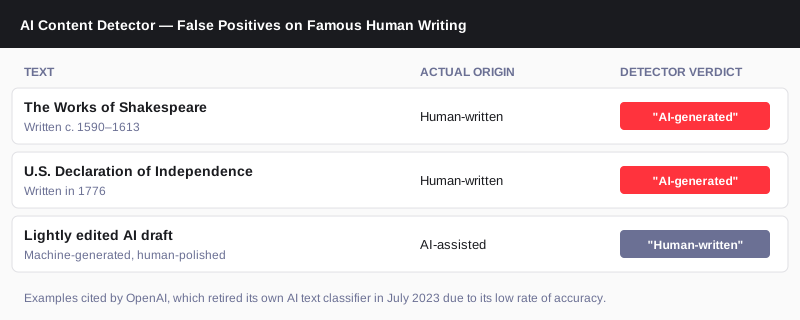
AI Content Detectors like GPTZero, ZeroGPT, and many others are not reliable. Even OpenAI has said as much. They consistently produce false positives about human-written content. Conversely, they can be easily fooled with creative prompting or a bit of human editing.
An interesting note from OpenAI: "we found that it labeled human-written text like Shakespeare and the Declaration of Independence as AI-generated."
Anecdotal evidence and real-life ranking data suggest that while AI-generated content isn't penalized by search engines, it might only achieve high rankings if it meets the above criteria. The role of AI in content creation is still a developing narrative, and its significance is indispensable for maintaining a competitive edge in the future.
At EmberTribe, the understanding is clear - AI serves as a foundation, not the final product. With ClusterMagic, while AI aids in the initial draft based on expert-driven keyword research, human experts step in for the crucial phases of editing, fact-checking, and final review. This hybrid approach ensures the content is accurate and helpful, has the potential to rank, and truly represents their business.
Most founders we talk to can quote their ROAS to two decimals and have no idea what their real customer acquisition cost is. They have a number their ad platform shows them, a different number their finance team uses, and a gut feeling that neither is right. Customer acquisition cost is the number that actually decides whether a business grows or quietly runs out of money, which is why getting it wrong is so expensive.
After managing more than $200M in paid media across hundreds of DTC and SaaS brands, we see the same pattern repeatedly. CAC looks fine when it's calculated wrong, panics set in when it's calculated right, and the fix usually lives in three or four specific places inside the funnel. This guide walks through what CAC actually includes, how it breaks down by channel, what the benchmarks look like in 2026, and the levers that reliably bring it down.
At its simplest, customer acquisition cost is the total amount you spend on sales and marketing divided by the number of new customers you bring in during that period. The basic formula looks like this:
CAC = (Sales + Marketing Costs) / New Customers Acquired
That's the part everyone agrees on. The argument starts when you ask what counts as a sales and marketing cost. Most early-stage teams plug ad spend into the numerator, maybe add agency fees, and call it done. That's the number that flatters the deck and breaks the business.
A fully loaded CAC calculation includes everything you spend to turn a stranger into a paying customer:
According to this Amplitude guide to customer acquisition cost, leaving out indirect costs like salaries, software, and overhead typically understates true CAC by 30 to 50 percent. That's not a rounding error. That's the difference between a healthy unit economics story and a business that looks profitable on paper and bleeds cash in the bank account.
The simple rule: if you wouldn't have spent the money without a new-customer goal attached, it belongs in CAC.
Blended CAC is useful for boardroom conversations. Channel-level CAC is what you actually manage. The cost to acquire a new customer looks completely different across paid search, paid social, organic, and retention work, and understanding the mix is the difference between optimizing and guessing.
Here's how the major channels typically break down for growth-stage DTC and SaaS brands: ChannelTypical CAC RangeWhat Drives ItGoogle SearchMid to highCommercial-intent keywords, quality score, competitionGoogle ShoppingLow to midFeed quality, product-level bids, marginMeta prospectingMid to highCreative strength, iOS 14 attribution loss, audience saturationMeta retargetingLowWarm audience size, frequency capsTikTokMidCreative velocity, organic spilloverOrganic searchVery lowRequires time and compounding content investmentEmail and SMSVery lowAlready captured, mostly retention not acquisitionAffiliateVariableCommission structure, partner quality
Two things matter more than the numbers themselves. First, the cheapest channel is not the best channel, because the cheapest channels usually have the lowest volume ceilings. Second, channel CAC shifts constantly, especially on Meta, where the combination of iOS 14 attribution loss and creative fatigue can move a steady number 20 to 40 percent in a quarter.
One analysis of post-iOS 14 Facebook attribution found average CAC jumped roughly 12 percent after Apple's AppTrackingTransparency update forced Meta into a shortened window. The ads didn't get worse. The measurement did. Any CAC strategy built after 2021 has to account for this gap between platform-reported performance and what the bank account shows.
Benchmarks are a starting point, not a verdict. What looks expensive in one vertical is cheap in another, and margin structure matters more than the headline number. Here are the ranges we see across the brands and SaaS companies we work with, cross-referenced with public data from 2026: IndustryTypical CAC RangeNotesConsumer ecommerce (blended)$60 to $90Up roughly 40 percent over two yearsPremium and luxury DTC$130 to $380+Longer consideration, higher AOV requiredSMB SaaS$200 to $500Self-serve motion, lower ACVMid-market SaaS$1,000 to $5,000Longer sales cycle, AE-led motionEnterprise SaaS$10,000 to $15,000+Field sales, long evaluation cyclesFintech SaaS$1,400 to $14,700Highest in the category, driven by regulation
Ecommerce numbers are pulled from this 2026 ecommerce CAC vertical report, with SaaS ranges cross-checked against public benchmark data.
A $75 CAC on a $40 average order value is broken. A $300 CAC on a subscription product with a $1,200 lifetime value is healthy. Your industry benchmark only tells you whether you're in the neighborhood. Your LTV tells you whether the neighborhood is affordable.
Customer acquisition cost means nothing in isolation. The number that decides whether your acquisition math is sustainable is the LTV to CAC ratio, which compares the lifetime value of a customer to what it costs to get them in the door.
The accepted baseline is a 3:1 ratio, meaning every dollar spent on acquisition should return three dollars in lifetime value. This benchmark comes up in nearly every serious finance and operator resource, including this Harvard Business School breakdown of the LTV to CAC ratio.
What the benchmark really means in practice:
One nuance most benchmark posts skip: LTV is not a single number. Cohort LTV at 6, 12, and 24 months tells very different stories, and your CAC ratio should be anchored to the LTV number you can actually realize inside your planning horizon. Using a theoretical 5-year LTV to justify today's spend is how companies end up explaining away losses that never resolve.
We covered the broader measurement mistake in this breakdown of why ROAS alone is the wrong north-star metric, and the same principle applies here. The number on the platform dashboard is not the number your business runs on.
Reducing CAC is almost always a fix in one of four places: creative, targeting, landing experience, or retention. Everything else is a variation on these four. Here's where the actual gains live:
Creative is the single biggest lever in paid social CAC and one of the largest in paid search display. Brands running three to five new ad concepts per week reliably outperform brands cycling one or two per month. The win isn't just better CTR, it's the compounding effect of defeating audience fatigue before it settles in.
A CAC problem is often a conversion rate problem wearing a paid media costume. If your landing page converts at 1.5 percent and the category average is 3 percent, you are paying twice as much per customer as competitors with the exact same traffic. Product page speed, above-the-fold clarity, trust signals, and checkout friction move this number reliably.
Most brands spend too heavily on the channel that used to work and too lightly on the one that's working now. Quarterly channel reallocation, based on blended CAC and not platform-reported ROAS, usually uncovers a 15 to 25 percent efficiency gain within a single quarter.
This one surprises people. Raising your average order value, attach rate, or repeat purchase frequency mathematically lowers the CAC you can afford to pay. That often unlocks channels you thought were too expensive and shifts what "good" CAC looks like for your business.
Before optimizing anything, make sure the CAC number you're optimizing toward is real. Blended CAC from your finance team, not platform CAC from Ads Manager, should be the north star. The upper funnel vs lower funnel tradeoffs explain why the two numbers drift apart and how to reconcile them.
Most brands reach a point where fixing CAC internally stops being realistic. That point usually looks like one of these: paid media spend crosses roughly $50,000 a month, the team running it is part-time or junior, the channel mix has grown to three or more platforms, or creative has become the bottleneck. At that stage, the question stops being "can we bring CAC down" and becomes "what's the fastest way to get to a sustainable number."
A good outside partner brings three things: fresh eyes on a measurement stack that's probably been duct-taped together, creative throughput that internal teams rarely match, and the ability to make channel-level calls without internal politics. A bad partner brings spreadsheets and excuses. Our guide to PPC management for ecommerce brands breaks down what to look for if you're weighing that decision.
The decision isn't really agency versus in-house. It's whether your current setup can get to healthy unit economics in the next 90 days, and if not, what changes.
Customer acquisition cost is the number that decides whether the rest of your marketing program is worth running. Get the calculation right first, compare it to a realistic LTV second, and optimize the four levers that move it third. If the math isn't working after an honest look at those three steps, the problem usually isn't effort. It's expertise or capacity.
EmberTribe has been managing paid media and running unit economics work for growth-stage DTC brands and SaaS companies since 2012. If you want a second set of eyes on your CAC, your channel mix, or the measurement stack you're using to make decisions, our paid media team can walk through where the gains actually live for your business.
Most ecommerce brands shopping for a ppc management company are evaluating the wrong things. They compare dashboards, ask about reporting cadence, and request case study decks — when the question that actually matters is simpler: does this agency connect paid traffic to revenue, or just traffic to clicks?
The difference is everything. With average ecommerce Google Ads ROAS sitting at 2.87x in 2025 — and Search campaigns outperforming at 5.17x for brands with optimized funnels — there's a clear gap between median performance and what's achievable. The gap rarely lives in bid strategy. It lives in whether your agency treats PPC as an isolated channel or as one lever in a growth system.
This guide covers what ecommerce PPC management actually entails, how to assess agencies on criteria that predict results, and what a full-funnel approach looks like in practice.
PPC management is not a set-it-and-check-it function. For ecommerce brands running Google Ads, Meta, or both, active management encompasses campaign architecture, audience segmentation, creative strategy, bid optimization, landing page alignment, and feed management — often simultaneously.
The scope expands significantly at scale. A brand spending $20K/month has different complexity than one spending $200K, but the categories of work remain constant. What changes is the number of SKUs, the number of audiences, the frequency of creative refreshes, and the sophistication of attribution required.
Ecommerce PPC is specifically demanding because:
Agencies that only optimize within the ad platform are leaving significant performance on the table. The ones worth hiring understand that paid traffic quality is validated downstream, in conversion rate and repeat purchase rate — not in the campaign dashboard alone.
The agency-vs-in-house debate is often framed around cost, but the real variable is access to compounding expertise. A strong in-house hire builds institutional knowledge and alignment with your brand. A strong agency brings pattern recognition across dozens of accounts, access to beta features, and a team structure that doesn't leave you exposed when someone quits.
For most DTC brands under $50M in annual revenue, an ecommerce PPC agency offers better ROI on the dollar than a single in-house hire — provided you choose the right one. A senior paid media manager in-house costs $90,000-$130,000 annually in salary alone, before benefits, tools, and management overhead. Agency retainers for comparable expertise typically run $2,500-$8,000/month, with performance-oriented models available at larger spend levels.
Where in-house wins: brands with highly complex product lines requiring deep domain knowledge, or those running integrated creative and media operations where speed of execution matters more than breadth.
Where agencies win: brands that need platform expertise across Google, Meta, and emerging channels, want accountability tied to results, and benefit from cross-account learning that no single brand can replicate internally.
The choice is not permanent. Many brands start with an agency, build internal competency, and eventually hire in-house for execution while retaining an agency for strategy.
Most agency evaluation checklists focus on surface signals: years in business, client logos, platform certifications. These are not irrelevant, but they are lagging indicators. The criteria that predict results are forward-looking.
An agency worth hiring wants to understand your margins, your average order value, your customer acquisition economics, and your retention profile before they talk about campaign structure. If the first conversation is about which campaign types they prefer, that's a signal they optimize for activity rather than outcomes.
The right question at the start of an engagement is: what does a customer need to be worth for this channel to make sense at your margins?
Case studies are easy to construct favorably. What you want to see is specific attribution to revenue outcomes: ROAS at the account level, impact on CAC over time, and ideally context on what changed and why. Be skeptical of case studies that show CTR improvements without connecting them to revenue.
Ask for examples of accounts they've managed through a difficult period — rising CPCs, algorithm changes, a creative slump. How an agency manages adversity tells you far more than how they perform when everything is working.
Finding the right ecommerce Google Ads agency often comes down to this: does the agency treat your landing pages and conversion rate as their problem or yours? Agencies that drive traffic to underperforming pages and call it a client-side issue are managing to their contract, not your results. The best ecommerce PPC agencies have a CRO perspective built into how they think about campaign performance.
For Meta and increasingly for Google (through Performance Max), creative is the primary lever of performance. An agency that can't speak fluently about creative strategy, testing methodology, and refresh cadence is limited in how much they can move the needle. Ask specifically: how do you determine when a creative is fatigued? What does a testing matrix look like for a new offer?
Not every red flag is dramatic. Some of the most common problems with PPC agencies are subtle and only visible after you've signed.
Vanity metric reporting. If monthly reports lead with impressions, clicks, and CTR without tying directly to revenue and ROAS, the agency is optimizing for what looks good rather than what matters. Your report should answer one question first: did we make money on this spend?
Long-term contracts without performance provisions. A 12-month contract with no performance clause is a risk transfer from the agency to you. Reputable agencies are willing to tie continuation to results — not because they guarantee specific numbers, but because they're confident enough in their process to accept accountability.
Over-reliance on automation without strategic oversight. Smart Bidding and Performance Max have legitimate use cases, but they are not a strategy. Agencies that point to Google's machine learning as the explanation for both successes and failures have outsourced their judgment to an algorithm.
No mention of your full funnel. As we've written about from managing over $200M in Facebook ad spend, paid media performance compounds when it's integrated with what happens after the click. An agency that never asks about your email flows, your post-purchase experience, or your LTV is leaving growth on the table.
Ecommerce brands typically run paid search and paid social in parallel, but the strategic role of each differs. Google Search captures existing demand — people actively searching for your product or category. Meta creates demand — showing your product to people who fit your customer profile before they've searched.
Google Shopping and Performance Max have become the default for product-focused campaigns, though the rise of Performance Max has compressed visibility into where spend actually goes. Smart advertisers are balancing Search and broader campaigns strategically, using Search for high-intent terms where control matters and Performance Max for prospecting at scale.
CPCs in competitive ecommerce categories have risen approximately 33% year-over-year in some verticals, according to recent WordStream benchmarks. This makes creative differentiation and landing page conversion more important than ever — because you're paying more per click, the cost of a poor conversion rate compounds faster.
For brands new to structuring a campaign hierarchy, our foundational PPC tips for lead generation cover the tactical fundamentals that apply across ecommerce and lead-gen contexts alike.
Agency pricing for PPC management follows three primary models:
Flat retainer: $1,500-$10,000/month depending on account complexity, number of platforms, and service scope. Most common for brands spending $10K-$100K/month on ads.
Percentage of spend: Typically 10-20% of monthly ad spend. Common at higher spend levels; creates aligned incentives but can also incentivize spend inflation.
Performance-based: A base retainer plus a performance bonus tied to ROAS or revenue targets. Less common but increasingly available from agencies confident in their results.
What you're buying at each tier: At $2,000-$3,000/month, expect solid execution with a dedicated account manager and monthly strategy reviews. At $5,000-$10,000/month, expect deeper creative involvement, more frequent optimization, and multi-platform coordination. Above $10,000/month, you're typically working with a senior team with direct involvement in strategic decisions.
Be clear on what's included. Creative production, landing page work, and feed optimization are often billed separately.
Before committing to any ecommerce PPC agency, get clear answers to these questions:
The right paid media partner won't just run your campaigns — they'll challenge your assumptions about where your growth constraints actually are. That's the difference between an agency that manages spend and one that drives growth.
The brands that extract the most value from ecommerce PPC aren't necessarily running the most sophisticated campaigns. They're the ones who've connected paid traffic to every downstream touchpoint — product pages built to convert, post-purchase flows that extend LTV, and attribution frameworks that show the real economics of acquisition.
A ppc management company earns its fee when it helps you answer the question that matters: is paid traffic making us more profitable over time? That requires more than platform expertise. It requires a partner who understands your business well enough to know what profitable growth actually looks like — and who holds themselves accountable to it.

Hiring the wrong paid social agency can quietly drain six figures from an ecommerce budget before anyone notices the numbers aren't working. The right partner, on the other hand, can turn paid social into the most predictable growth lever in your business. The difference comes down to knowing what to look for — and what to avoid.
This guide breaks down how to evaluate a paid social agency for ecommerce, what separates good agencies from great ones, and the specific criteria that matter most for DTC and growth-stage brands.
Running Facebook ads or TikTok campaigns in-house sounds manageable until you factor in creative production, audience testing, attribution complexity, and the constant platform changes that can break a campaign overnight.
A dedicated paid social media agency brings three things most internal teams lack:
According to Statista's advertising spending data, global social media ad spending is projected to exceed $270 billion by 2026. Ecommerce brands account for a significant share of that spend. The stakes are high enough that getting agency selection right has a measurable impact on growth.
If you're specifically evaluating Facebook and Instagram partners, we've written a deeper guide on how to find the right Facebook ads agency for your ecommerce business.
Not every paid media services provider is built for ecommerce. Some agencies cut their teeth on lead gen or B2B SaaS. That experience doesn't automatically translate to managing product feeds, catalog ads, and contribution margin targets.
Here's what to evaluate:
Ask for case studies from brands with a similar average order value, product catalog size, and growth stage. An agency that scaled a $5M DTC skincare brand operates in a fundamentally different world than one that ran awareness campaigns for a Fortune 500 retailer.
Key questions to ask:
Ad creative is the single biggest lever in paid social performance. A high-performing ad combines scroll-stopping visuals with clear positioning and a direct call to action. The best agencies don't just buy media — they produce the creative that goes into it.
Look for agencies that offer:
We've broken down the anatomy of ads that actually convert in our post on 9 components of a high-performing ad.
Ecommerce paid social in 2026 is not a single-platform game. Meta (Facebook and Instagram) still drives the majority of DTC revenue for most brands, but TikTok, Pinterest, and Snapchat have matured into serious acquisition channels.
A strong fb ads agency should also have a clear perspective on cross-platform allocation. When should you shift budget to TikTok? When does Pinterest make sense for top-of-funnel discovery? For a detailed comparison, see our breakdown of TikTok Ads vs. Facebook Ads.
Post-iOS 14.5, measurement is harder than ever. A credible ecommerce paid social partner should be fluent in: MetricWhy It MattersMER (Marketing Efficiency Ratio)Holistic view of total revenue vs. total marketing spendBlended ROASAccounts for attribution gaps across platformsContribution MarginConnects ad performance to actual profitabilitynCPA (New Customer CPA)Separates acquisition from retention spendingLTV:CAC RatioDetermines long-term sustainability of paid acquisition
If an agency only talks about in-platform ROAS, that's a red flag. The Meta Business Help Center documents how platform-reported metrics can overstate or understate true performance. Sophisticated agencies use server-side tracking, incrementality testing, and media mix modeling to get closer to the truth.
Some warning signs are obvious. Others only surface after you've signed a contract. Here's what to watch for:
1. No creative production capability. If an agency expects you to supply all ad creative, they're a media buying vendor — not a growth partner. The best paid social agency teams own the creative process end to end.
2. Long-term contracts with no performance benchmarks. Six- or twelve-month minimums are common, but they should include clear performance milestones and exit clauses tied to results.
3. Black-box reporting. You should have direct access to ad accounts, full transparency into spend allocation, and regular reporting that connects ad metrics to business outcomes. HubSpot's agency selection guide recommends verifying reporting transparency before signing any agreement.
4. One-size-fits-all strategy. If the pitch deck looks identical regardless of your brand, vertical, or growth stage, the agency is selling a template — not a strategy.
5. No testing framework. Paid social is an iterative discipline. Agencies that don't have a structured approach to hypothesis-driven testing will plateau your account quickly.
Top-tier paid media services providers follow a structured approach to account architecture. While specifics vary, the best agencies share common principles:
High-performing agencies test creative on a weekly or biweekly cycle. They isolate variables — hook, format, offer, visual style — and kill underperformers fast. According to Meta's best practices for creative testing, consistent creative refresh is one of the strongest predictors of sustained campaign performance.
Rather than dumping entire budgets into bottom-of-funnel conversion campaigns, sophisticated agencies allocate spend across awareness, consideration, and conversion based on where the brand sits in its growth curve.
A brand spending $50K/month on paid social with strong brand recognition needs a different allocation than a brand at $10K/month that's still building its audience.
Choosing a paid social agency is one of the highest-leverage decisions an ecommerce brand can make. The right partner accelerates growth. The wrong one wastes budget and time that you can't get back.
Here's what matters most:
At EmberTribe, we work with ecommerce and DTC brands to build paid social programs that drive measurable growth across Meta, TikTok, and emerging platforms. Our approach combines rigorous creative testing with full-funnel media strategy — you can explore how we structure our Paid Media services.
The ecommerce brands winning with paid social in 2026 aren't the ones spending the most. They're the ones who found the right agency partner, built a testing culture, and stayed disciplined about the metrics that actually matter.

In the age of rapid digital transformation, AI has seeped into almost every industry, revolutionizing how we conduct business, design products, and even create content. The ClusterMagic service is a great example, which seamlessly integrates AI for content generation in a hybrid model, providing significant benefits in the SEO results of brands seeking a massive increase in organic traffic. But while AI holds immense promise, it has its limitations. Let's explore the pros and cons of using AI for content creation and understand why a hybrid approach might be the way forward.
Major publishers in sensitive niches like CNET.com, Bankrate.com, and Creditcard.com have already integrated AI-generated content. Other large companies, such as CNN and Forbes, might also be doing so. Countless smaller companies and publishers are utilizing AI, not only on their websites but also on social media, in email marketing, and virtually everywhere else.
Google's stance on AI-generated content is neutral, emphasizing that content should primarily be user-centric. In fact, Google's September 2023 Helpful Content Update removed the mention of "written by people" from their helpful content system guidelines.
The message is clear: for content to rank well, it must be informative, answer users' queries satisfactorily, and showcase genuine expertise - regardless of how it's created.
AI Content Detectors like GPTZero, ZeroGPT, and many others are not reliable. Even OpenAI has said as much. They consistently produce false positives about human-written content. Conversely, they can be easily fooled with creative prompting or a bit of human editing.
An interesting note from OpenAI: "we found that it labeled human-written text like Shakespeare and the Declaration of Independence as AI-generated."
Anecdotal evidence and real-life ranking data suggest that while AI-generated content isn't penalized by search engines, it might only achieve high rankings if it meets the above criteria. The role of AI in content creation is still a developing narrative, and its significance is indispensable for maintaining a competitive edge in the future.
At EmberTribe, the understanding is clear - AI serves as a foundation, not the final product. With ClusterMagic, while AI aids in the initial draft based on expert-driven keyword research, human experts step in for the crucial phases of editing, fact-checking, and final review. This hybrid approach ensures the content is accurate and helpful, has the potential to rank, and truly represents their business.


.svg)